
When the jihad against the Soviet Union took shape in the 1980s, seven major Mujahideen groups that came to be known as the “Peshawar Seven” in Western literature led the resistance. They included Gulbuddin Hekmatyar’s Hezb-e-Islami-Gulbuddin (HIG), Burhanuddin Rabbani’s Jamiat-e-Islami, Mohammad Yunus Khalis’s Hezb-e-Islami-Khalis (HIK), Abdur Rasul Sayyaf’s Ittehad-e-Islami, Mohammad Nabi Muhammadi’s Harkat-e-Inqilab-e-Islami, Pir Sayyid Ahmad Gailani’s Mahaz-e-Milli-ye-Islami, and Sibghatullah Mojaddedi’s Jabha-ye-Nejat-e-Milli.
While the roles of these seven Mujahideen groups during and after the jihad have been debated in Afghanistan and beyond, their significance as symbols of Afghan resistance against occupation remains. Besides the leaders of these groups, Jamiat-e-Islami produced towering Afghan resistance figures like Ahmad Shah Massoud (d.2001) and Ismail Khan, and HIK produced figures like Jalaluddin Haqqani (d.2018), whose progeny sit at the helm of half of today’s Taliban movement and government.
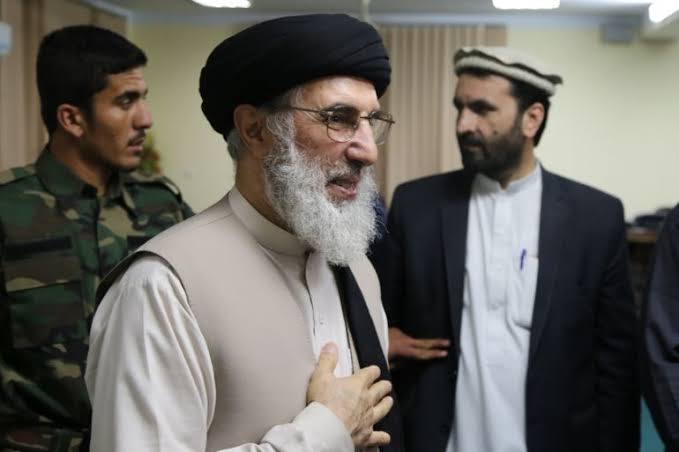
While Mohammad Nabi Mohammadi (d.2002), Muhammad Yunus Khalis (d.2006), Burhanuddin Rabbani (d.2011), Pir Sayyid Ahmad Gailani (d.2017), and Sibghatullah Mojaddedi (d.2019) have passed away, among Abdur Rasul Sayyaf and Gulbuddin Hekmatyar, only the latter had expressed his hopes from the return of the Taliban to power in August 2021. He was also among those rare former Mujahideen leaders who opted to stay back in Afghanistan after the Taliban’s return to power. He left the country for Malaysia as late as December last year and chose not to return.
In recent months, he has also been growing more and more vocal in his criticism of the Taliban regime of Afghanistan. Last month, he urged his party members to sever ties with Taliban supporters. Earlier this month, he not only reiterated a demand he made in April for an elected government in Afghanistan but also asserted that the Taliban rule would not endure. “When you say opponents have no place in Afghanistan, then you have no place either, because you do not tolerate others,” he said. In a similar vein, his son, Habib-ur-Rehman Hekmatyar had earlier remarked that if the Taliban could use force to come into power, so could the others.
Should these statements as well as reports of Hekmatyar’s organization of HIG for resistance against the Taliban be a source of concern for the Taliban?
HIG was one of the largest and best-resourced mujahideen organizations during the jihad years against the Soviets. Even though the Taliban’s capture of Kabul in 1996 weakened the outfit and some of its ranks even joined the Taliban, like the latter, it rejected the Republic government of Afghanistan after the United States intervention in 2001 and carried out attacks against government forces parallel to the Taliban, particularly in eastern Afghanistan. While the two groups provided each other tactical assistance here and there, their command structures remained distinct and, at times, competed with each other. So, in a way, he remained ideologically aligned with the Taliban, even if not operationally, until his group signed a peace agreement with the Republic government in September 2016 and traded its armed struggle for a blanket immunity for the group.
HIG continues to remain a divided house. Notwithstanding reports of Hekmatyar’s efforts at reorganization of the group for armed resistance against the Taliban, it would take some time before the group can effectively challenge the Taliban’s power militarily. The problem for the Taliban, however, is that its pot of resistance is already boiling. Ahmed Shah Massoud’s son, Ahmad Massoud, is already engaged in an armed resistance against the Taliban from exile, through his National Resistance Front (NRF). Two Republican era generals, Yasin Zia and Sami Saadat, are also leading armed resistance movements from exile, named Afghanistan Freedom Front (AFF) and Afghanistan United Front (AUF), respectively. Ongoing persecution of the minority Hazara Shia community is turning that particular community against the Taliban as well. So, the conundrum for the Taliban is that HIG will be dropping into a boiling pot of military challenges for the Taliban. But Hekmatyar poses an even more serious challenge to the Taliban’s legitimacy than the other resistance figures do, that is, ideological.
He is a veteran political figure and a prominent Pashtun Mujahideen commander who has not emerged after the Taliban’s return in August 2021 or even their first ouster in 2001. Moreover, he has resisted the US forces on Afghan soil for years, like the Taliban. This gives him a perspective on the Taliban’s political project from within Afghanistan’s Islamist political tradition and counters the perception that resistance to Taliban rule is confined to the former republican establishment, liberal activists, or Afghanistan’s diaspora.
One can discern that his criticism of the Taliban over lack of representative institutions and political inclusion is not a straightforward endorsement of Western liberal democracy but a presentation of an alternative form of Islamist governance. His Mujahideen-era credentials add to his religious-nationalist legitimacy among the pro-Taliban Pashtun circles that differs from that of former Republican era officials and pose a greater challenge to the Taliban’s claim to legitimacy, even if his party has become largely absent from the battlefield. This challenges the Taliban’s political and ideological narrative even if it does not necessarily possess the means to challenge its coercive control right now.
Even though Hekmatyar remains a deeply divisive figure because of his role in Afghanistan’s civil war and allegations of serious abuses, and his historical standing might not automatically translate into an ability to influence Taliban decision-making or mobilize resistance, his ideological and ethnic overlap with the Taliban makes his criticism and potential mobilization more troublesome for the Taliban’s legitimization agenda on ethnic and religious grounds.
Aarish U. Khan
Aarish U. Khan is a Research Analyst at the Institute of Regional Studies, Islamabad, Pakistan.
![Indian Christian community faces rising violence while Modi congratulates new Jacobite Catholicos in Lebanon. Rights groups sound alarm. [Image via Reuters]](https://southasiatimes.org/wp-content/uploads/2025/03/deccanherald_2025-02-12_8gxoemcr_file7zbn3w0b8kj1egk2eks4.webp)