


Climate change can’t be experienced as a gender-neutral crisis. Droughts, floods, economic decline, displacement, and environmental insecurity affect entire communities; however, their consequences aren’t equally distributed across social groups.
For women, living within deep-rooted patriarchal structures, climate carnage delivers a tidal blow to a second layer of insecurity, encompassing displacement, loss of privacy, sexual violence, domestic violence, economic exploitation and restricted access to justice.
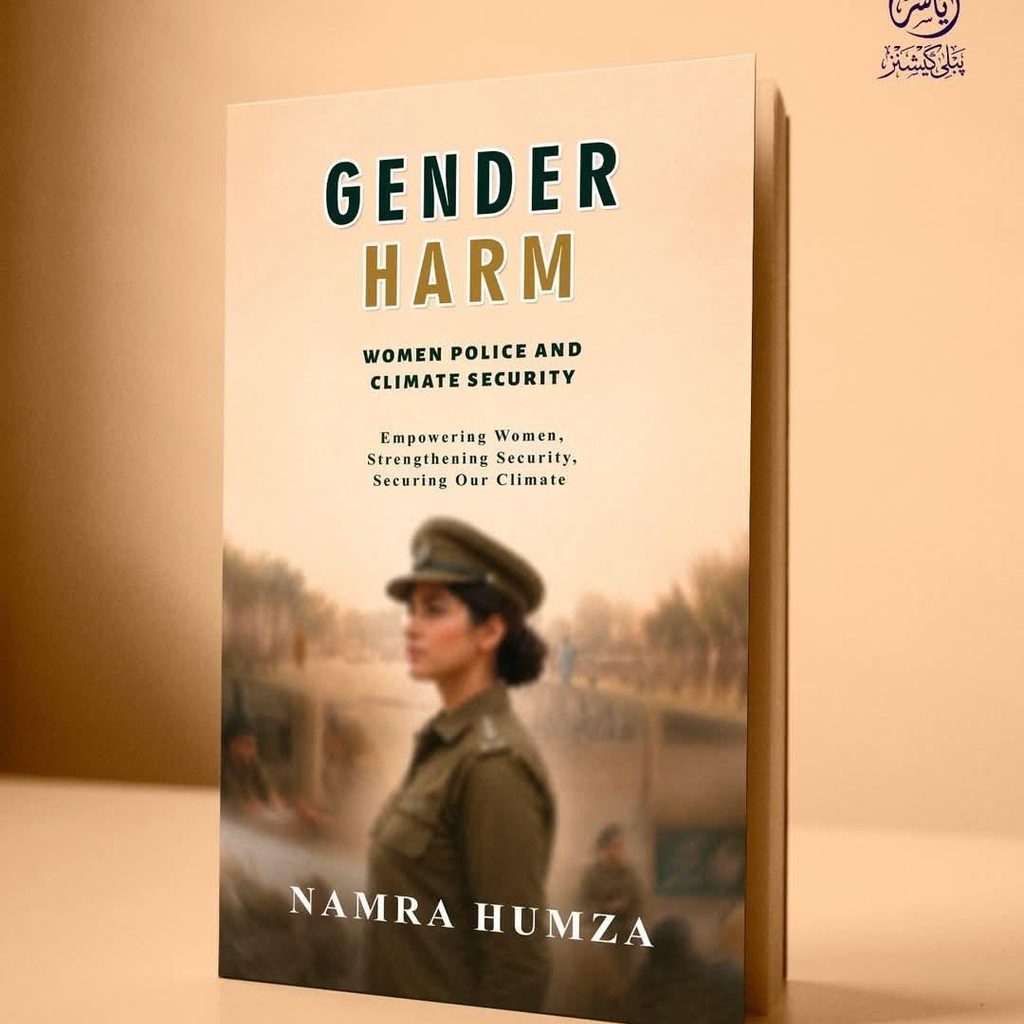
“Gender Harm: Women Police and Climate Security” by Namra Humza makes this nexus the center of its analysis, constructing an intriguing triangular relationship between climate change, gender vulnerability and women policing.
The central proposition of this book is that women’s security and protection in climate-vulnerable settings need not be addressed merely through climate mitigation or adaptation, but also through structural transformation of policing, capacity-building for women police, and streamlining institutional presence across Pakistan.
The book begins by establishing the notion that climate disasters amplify pre-existing social disparities. The author particularly draws a theoretical framework from Theory of Change and Eco-Feminism, tailoring climate crisis to patriarchal structures and institutional responses. It is analyzed through this lens that women are not simply passive victims of climate change, but rather their vulnerability is galvanized by environmental, social, economic and institutional forces.
Therefore, the novelty of this book is that it moves beyond conventional understanding of climate insecurity and puts forward a more difficult question: who will protect women when the institutions responsible for protection themselves remain structurally inaccessible to them?
One of the most prominent aspects of this book is its examination of patriarchal gatekeeping across different strata of society in the country. Climate disasters have exposed these realities. When livelihoods disappear, crops fail, or displacement occurs, women may become the “economic shock absorbers” of households.
The fuel to the fire is when the disruption of traditional masculine provider role occurs; it gives surge to new forms of domination within the household and manifests as increased control over women, transforming Climate insecurity into gender insecurity.
The author critically highlights the “patriarchal bargain”, particularly in the times of displacement. For instance, overcrowded camps, absence of gender-segregated spaces, inadequate privacy and exposure to predatory environment expose displaced women to heightened risks. The phenomenon of “monsoon brides” is a stark example.
A particularly significant dimension of this book is access to justice and treatment of policing. The typical Thana culture, instrumental through a male-dominated institutional environment, becomes an additional barrier for women who have already experienced trauma.
A victim or survivor of domestic violence, sexual violence or other gender-based violence feels reluctant to even enter the police station, where she fears a lack of trauma-informed engagement and insensitive treatment, creating a paradox where the institution theoretically responsible for providing security can itself become a source of institutional and psychological insecurity.
Namra Humza’s response is the idea of gender-responsive policing. The writer argues for a structural shift in crime reporting and criminal investigation mechanisms through visibility, transparency and inclusivity of women police.
The emphasis on survivor-centered support, trauma-informed entry points and digitization of women policing demonstrates practical dimensions to what might otherwise be an abstract gender-security argument. The research also intertwines quantitative and qualitative methods, including case studies, field surveys, documentation of victims’ experiences and interviews with police officers.
The inclusion of graphical representation, tables and primary data makes the arguments more empirically grounded. The book sheds light on the trajectory of gender-based violence across the period from 2020 to 2025, which reinforces the author’s argument that gender insecurity and climate insecurity cannot be examined independently.
Ultimately, the author shifts the discussion from asking how climate creates catastrophe for women to asking how the state should respond to the gender harm. It broadens the horizon of gender-responsive institutions, trauma-informed mechanisms to overall state responsibility.
In doing so, Namra Humza presents gender security not as a peripheral issue of policy on climate rather one of its core dimensions. For practitioners and scholars of climate security, gender studies, public policy and political science, the book provides a valuable framework for conceptualizing and understanding the climate-gender-policing securitization nexus.

Hafsa Mustafa
Hafsa Mustafa has been Lecturer in the Department ofInternational Relations at Government College University, Lahore, and is allocated to the Civil Services of Pakistan. She holds an MPhil in Political Science from GCU, Lahore, with a strong academic and research orientation.