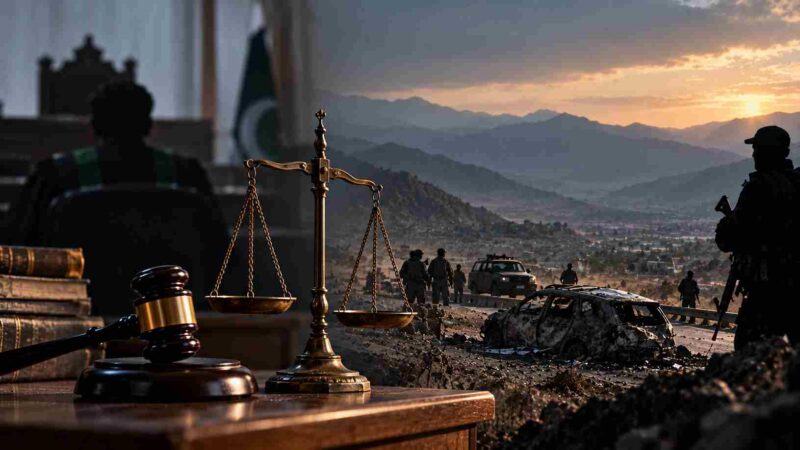
On the morning of 23 July 2026, District and Sessions Judge Abdul Hakeem Kakar set out from Quetta for the sessions court in Mastung. He never reached it. Gunmen on the national highway opened fire on his vehicle, took his life and his guard’s life and seriously wounded a fellow judge, Tariq Lashari.
The bullets were aimed at more than one man. They were aimed at the idea that terrorism can be answered in a courtroom. And they were fired in a province where militant networks and their political fronts have spent years accusing the state of making people vanish.
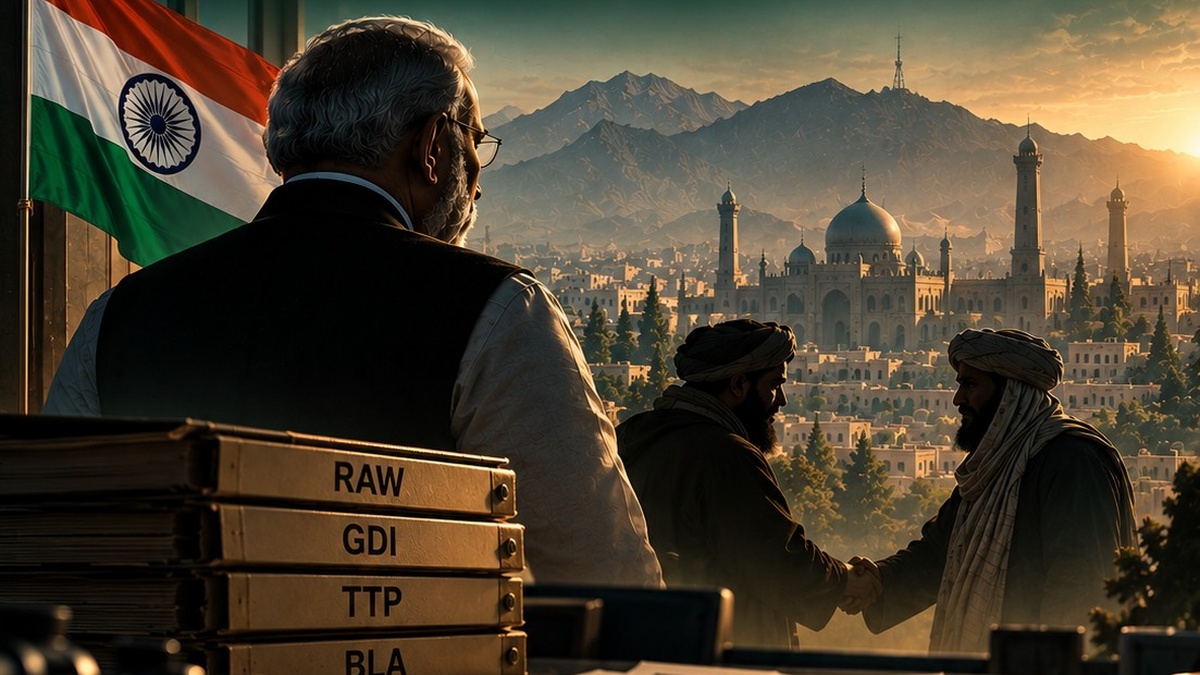
This is the grey zone, where wars are rarely declared and bullets work alongside lawfare and diplomatic pressure. Groups such as the Balochistan Liberation Army (BLA) and Tehreek-e-Taliban Pakistan (TTP) have learned that a battlefield defeat can be offset by a courtroom delay, and a courtroom delay converted into a grievance. The most potent is the charge of “missing persons” and enforced disappearances, which travels quickly from local protest camps to international forums and shifts scrutiny from the terrorist to the state.
The state’s answer draws on one of the oldest principles in law: habeas corpus, “you shall have the body”. Anyone detained must be produced before a court, which tests whether the detention is lawful. An enforced disappearance is its exact opposite, a detention denied or concealed and placed outside the protection of the law. Pakistan’s new counter-terrorism framework is built to keep every terrorism suspect on the right side of that line.
A Gap the Adversary Exploited
The narrative did not emerge in a vacuum. Pakistan’s criminal code was built to try ordinary criminals, not cadres of transnational terror networks. Legal gaps, the inadmissibility of much electronic and surveillance evidence, and relentless threats to witnesses and judges left terrorism prosecutions crippled. Official estimates put the conviction rate in terrorism cases between 2001 and 2020 at around 8 percent, in line with the International Crisis Group’s assessment of overall conviction rates of 5 to 10 percent. A United States Institute of Peace (USIP) study of 235 anti-terrorism court judgments found that courts depended almost entirely on witness testimony, even as witnesses stayed away out of fear.
When courts cannot convict hardened militants, the pressure on law-enforcement agencies grows. Where an arrest is not promptly followed by a visible legal process, a vacuum forms. Into that vacuum step the political fronts of terrorist outfits, recasting suspects as victims and the state as the aggressor. The weakness of the justice system thus became a weapon in someone else’s hands.
Bringing Detention into the Light
Pakistan’s answer has been to close that vacuum with law. The Anti-Terrorism (Balochistan Amendment) Act 2025 inserted Section 11-EEEE into the Anti-Terrorism Act (ATA) 1997, providing for “Preventive Detention for Inquiry” of up to 90 days. Parliament extended a comparable power nationwide in August 2025, subject to a three-year sunset clause, and the Anti-Terrorism (Punjab Amendment) Act 2026 followed in Punjab.
The significance lies in the safeguards. A suspect’s family is notified and granted access. A judge must hear the detainee within 24 hours. Investigators and Joint Investigation Teams (JITs) then have a defined window to gather evidence. If allegations are not established, the suspect walks free; if they are, the case proceeds to trial.
This is what keeps preventive detention within the habeas corpus tradition rather than outside it. A judge sees the detainee on the first day, custody runs against a fixed statutory clock, and it must end in release or trial. Throughout, the detention remains open to scrutiny by the High Courts, which already hold habeas corpus jurisdiction under Article 199 of the Constitution.
Early figures from Balochistan suggest the process is moving. Of 90 detainees, 5 have been released for lack of evidence and 40 have been referred for trial. Every apprehension now leaves a paper trail, and a paper trail is the antithesis of a disappearance.
Protecting Those Who Deliver Justice
Investigation, however, is only half the battle. A case is only as strong as the judge willing to hear it and the witness willing to testify. In Balochistan, that willingness has been tested in blood. Judge Kakar’s killing in Mastung was not the first. Justice Muhammad Noor Meskanzai, former Chief Justice of the Balochistan High Court and the Federal Shariat Court, was shot dead outside a mosque in Kharan in October 2022, a killing the BLA claimed. Around 50 Counter Terrorism Department (CTD) officials have reportedly lost their lives in the province.
The Punjab amendment responds with Faceless Courts, inserting Section 21-AAA into the ATA to create “special security cases”. The High Court Chief Justice nominates five Anti-Terrorism Court (ATC) judges and five prosecutors whose identities, along with those of witnesses, remain confidential. Protection extends to documentation, signatures and voice masking. The message to terrorist groups is loud and clear that killing a judge will no longer kill the case.
Not an Exception, but a Norm
Critics may call this extraordinary. It is not.
Colombia used faceless courts against narco-terrorism in the 1990s, after 48 judges, prosecutors and lawyers were killed in 1989 alone.
Italy’s Law No. 82 of 1991 protected those cooperating against the Mafia.
The United Kingdom’s Coroners and Justice Act 2009 allows witness anonymity orders, including pseudonyms, screening and voice modulation.
France’s Law No. 2016-731 shields threatened witnesses in terrorism cases, and the Netherlands applied similar provisions in the Malaysia Airlines Flight 17 (MH17) proceedings.
More recently, several Brazilian states, including Rio de Janeiro, have adopted faceless judges for organized-crime cases.
Democracies facing organized violence have long accepted that protecting the justice chain is part of protecting justice itself.
The GSP+ Front
This is where the grey zone reaches Pakistan’s economy. Since 2014, Pakistan has enjoyed the European Union’s (EU) Generalized Scheme of Preferences Plus (GSP+) status, which grants duty-free access for a large share of its exports. Pakistan was the scheme’s top beneficiary in 2024, with €7.5 billion in exports under preferential tariffs. That access is conditional on the effective implementation of 27 international conventions, including the International Covenant on Civil and Political Rights (ICCPR) and the UN Convention against Torture (CAT).
The stakes are rising. The EU’s fifth GSP monitoring report, released in July 2026, found that enforced disappearances and extrajudicial killings increased during 2023–2025 without accountability. It named reversing that trend as a key priority as the revised GSP rules take effect from 1 January 2027.
Hostile actors understand this linkage well. A sustained missing-persons campaign is not merely a domestic grievance; it is a lever aimed at Pakistan’s trade lifeline. Every unaccounted detention becomes ammunition in Brussels and Geneva, and every report questioning Pakistan’s rights record raises the cost of its renewal.
The scrutiny is also uneven. When the United Kingdom allowed terrorism suspects to be held for up to 28 days without charge until 2011, or France lived under a state of emergency for 719 days after the 2015 Paris attacks, with hundreds placed under house arrest, these were debated as hard choices of democracies under attack. They did not put either country’s market access at risk. Pakistan, among the countries most affected by terrorism in the world, faces a different test. Its security measures are read first as rights concerns and only later, if at all, as responses to an insurgency that kills judges, police and civilians.
This is precisely the asymmetry that grey zone actors exploit. Militant networks cannot defeat the state on the battlefield, so they work to raise the price of every counter-terrorism step. An operation becomes an atrocity claim, an arrest becomes a disappearance, and each claim becomes leverage over a trade lifeline that sustains millions of Pakistani livelihoods.
The new framework does not mark the beginning of Pakistan’s commitment to due process; it codifies that commitment in a form the world can verify. Judicial production within 24 hours, family notification, fixed timelines and recorded outcomes leave little room for manufactured grievance.
In the grey zone, a verifiable record is the strongest defense.
From Narrative to Process
No law is self-executing. The credibility of this framework will rest on consistent implementation, independent judicial oversight and transparent reporting of outcomes. Pakistan should publish periodic data on detentions, releases and trials, and engage international partners with the same openness.
Yet the direction is clear. Apprehension, notification, judicial production, investigation, then release or trial. A traceable chain replaces an unaccounted void. Faceless Courts ensure that the bullets fired at judges like Abdul Hakeem Kakar cannot break that chain. In a grey zone war fought as much over perceptions as territory, the state has reached for its oldest safeguard. Habeas corpus, the promise that every detainee will be produced before the law, is now the answer to the charge that detainees disappear.

Haleema Khalid is a research and strategic communications professional specializing in policy research, knowledge management, and analytical writing. With an interdisciplinary background spanning linguistics, security studies, and regional affairs, her work focuses on translating complex research into accessible outputs for policy and stakeholder audiences. She is a published researcher in corpus linguistics and political communication and is currently pursuing an MPhil in Intelligence & Security Studies, with a growing focus on Pak-Afghan affairs, regional security, and South Asian dynamics.