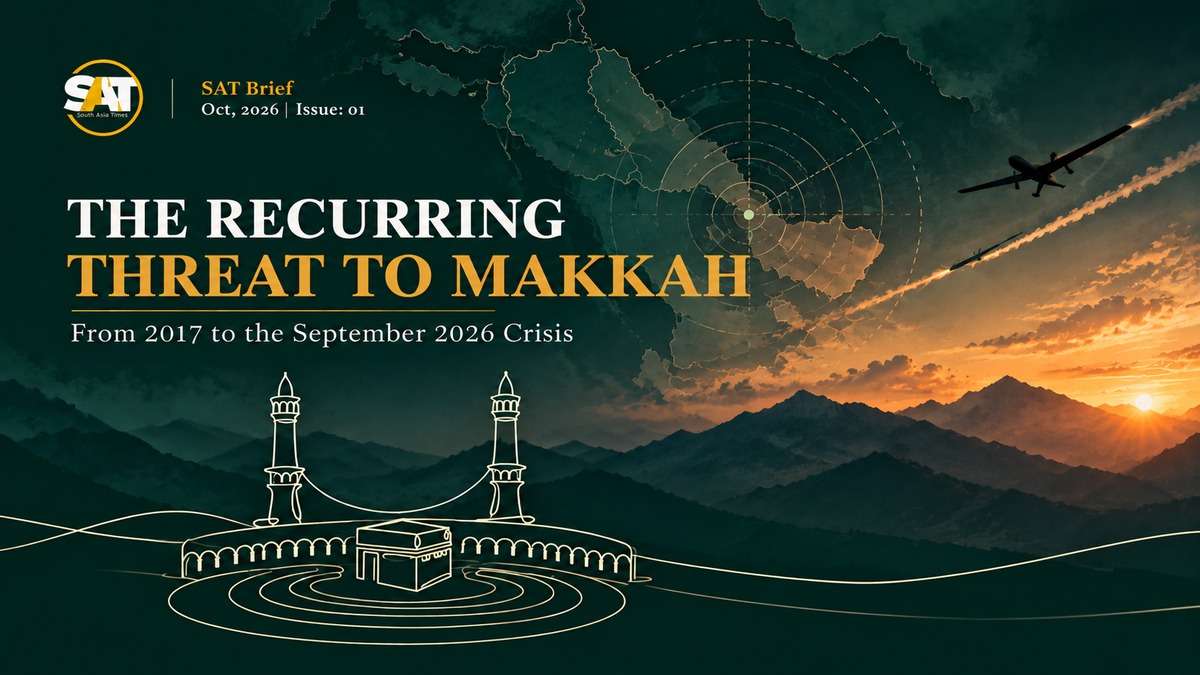
Twice in less than a decade, Houthi weapons have come within reach of Islam’s holiest city. The second time, a new defense pact was tested.
Executive Summary
- In July 2017, a Houthi ballistic missile was intercepted roughly 65 kilometers from Makkah. In September 2026, an armed drone was shot down just south of the city, amid a wider regional war involving Iran, Israel and the United States.
- The brief argues that the recurrence is deliberate. A movement unable to defeat Saudi Arabia militarily has found that threatening the holy sites imposes political and religious costs far beyond the material cost of an attack.
- September 2026 was the first test of the Pakistan–Saudi–Turkey Makkah Joint Defense Agreement. Islamabad framed it as purely defensive and limited its response to solidarity and a continued air-defense presence, with no intervention in Yemen.
Introduction
Makkah is the direction of prayer for nearly two billion Muslims and the site of the Hajj. Since King Fahd adopted the title in 1986, the city has also underpinned the Saudi monarchy’s claim to be Custodian of the Two Holy Mosques. A threat to Makkah is therefore never only a Saudi security matter. It challenges the Kingdom’s legitimacy, the Muslim world’s shared heritage, and the cohesion of the fifty-seven-member Organization of Islamic Cooperation (OIC).
That is why the Houthi movement’s two approaches to Makkah matter, even though neither struck its target. In this brief, Sumaiyya Kainat argues that the pattern is predictable and that no defensive arrangement since 2017 has closed it off.
Who are the Houthis, and how did they acquire this reach?
The Houthi movement, formally Ansar Allah, emerged in the 1990s from a Zaydi revivalist current in Yemen’s northern Saada province. It fought six rounds of conflict with the Yemeni government between 2004 and 2010, seized Sanaa in September 2014, and prompted the Saudi-led intervention in March 2015. Despite a United Nations arms embargo, and with persistent Iranian support, it went on to build an arsenal that includes the Burkan ballistic missile family, with a range of more than 800 kilometers, along with attack drones, anti-ship missiles and naval mines. Makkah lies about 750 kilometers from Saada.

Why target the holy sites?
The brief identifies three reasons:
- Universal sanctity: The sanctity of the sites is universal, so an attack near Makkah cannot be dismissed as a Yemeni affair.
- State legitimacy: The sites underpin the Saudi state’s core claim to legitimacy.
- Asymmetric cost structure: The cost structure favors the weaker party. A strike on an oil facility raises economic costs, but a threat to the Two Holy Mosques raises reputational costs that money and military superiority cannot offset.
What happened in September 2026?
The calm of the 2022 UN-brokered truce collapsed in 2026. The US–Israel confrontation with Iran began in February, and the Houthis struck Israel in March and Saudi Arabia from July. The June 2026 Islamabad Memorandum briefly halted direct hostilities but broke down within three weeks.
Between 8 and 22 September, Houthi forces captured Mokha, Dhubab and Perim Island. Cross-border strikes reached Riyadh-area targets, and drones launched from Iraq shut the East–West oil pipeline. Washington offered intelligence support but declined Saudi requests for strikes.
On 16 September, Saudi air defenses intercepted a drone south of Makkah. The coalition called the security of the holy sites a red line. The Houthis denied involvement, and Iran warned against politicizing the incident.

What is the Makkah Joint Defense Agreement, and where does Pakistan stand?
Pakistan and Saudi Arabia signed the Strategic Mutual Defense Agreement on 17 September 2025. On 7 August 2026, it was expanded into the Makkah Joint Defense Agreement, with Türkiye joining as the third signatory. The agreement rests on collective deterrence, that is, aggression against any one signatory is treated as aggression against all.
Pakistan’s position through the September 2026 crisis was clear and consistent:
- Political support: Prime Minister Shehbaz Sharif reaffirmed Pakistan’s unwavering solidarity with the Kingdom on 9 September. The Ministry of Foreign Affairs and Pakistan’s Mission to the United Nations both condemned the Houthi attacks on Saudi territory.
- The pact’s character: The Director General of ISPR, Lt Gen Ahmed Sharif Chaudhry, said the agreement is purely defensive, with no offensive or interventionist element. He described it as a framework for regional stability, not a bloc directed against any state or sect.
- The commitment: He was equally plain that Pakistan’s commitment is unconditional, and that Pakistan will go “to any extent” to defend the Kingdom.
In practice, Pakistan’s air-defense presence in the Kingdom continued throughout the crisis. At the same time, Islamabad kept diplomatic channels open, including with Tehran, which had made it a facilitator of the June 2026 Islamabad Memorandum. Defending Saudi territory and the Haramain while working for de-escalation is not a contradiction; it is the balance the agreement was designed to strike.
The brief recommends one next step: the three signatories should set out in advance which defensive measures the agreement covers, such as air-defense integration, early warning and information-sharing. That way, it establishes its full deterrent weight before the next test.
What role does the OIC play?
The OIC is the only multilateral body that can frame an attack on Makkah as a collective Islamic concern. Its condemnations since 2017 have been swift but declaratory. It has no standing mechanism for verification, sanctions, early warning or coordinated security assistance.
What should be done?
The brief concludes that no single instrument is enough. It recommends five complementary measures:
- Layered defense: A layered air and missile defense of the Makkah–Medina–Jeddah corridor.
- Interdiction: Enforced UN arms-flow interdiction.
- Standing mechanism: A standing OIC response mechanism.
- Insulated talks: An insulated negotiating track that keeps the holy sites out of the wider conflicts.
- Alliance clarity: Advance clarity on what the Makkah Joint Defense Agreement commits its signatories to do.
Read the Full SAT Brief
Policy Research · 30 Pages · PDF Format

Sumaiyya Kainat
Sumaiyya Kainat is an MPhil Scholar at the National Institute of Intelligence and Security Studies (NISS), Quaid-i-Azam University (QAU), Islamabad. Her research interests include international relations, geopolitics, regional security, strategic affairs, and emerging security challenges.
Write for SAT Briefs
South Asia Times invites researchers, scholars and practitioners to author forthcoming SAT Briefs: rigorous, well-sourced policy research on consequential questions in regional and international affairs. Contributors are paid. Send a working title, a 300-word outline, and a note on your expertise to submission@southasiatimes.org. Terms are discussed after review.

Sumaiyya Kainat
Sumaiyya Kainat is an MPhil Scholar at the National Institute of Intelligence and Security Studies (NISS), Quaid-i-Azam University (QAU), Islamabad. Her research interests include international relations, geopolitics, regional security, strategic affairs, and emerging security challenges.