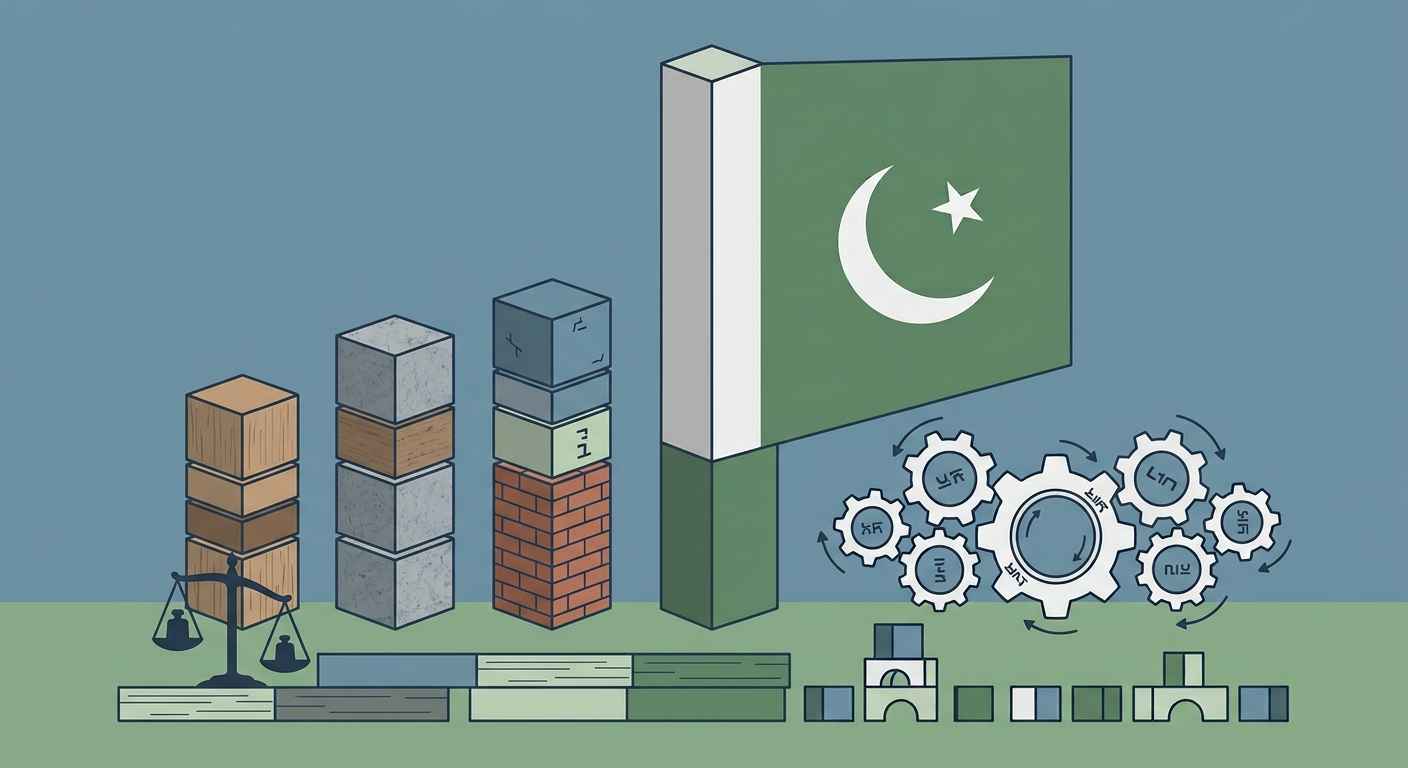
Federalism rests on a simple bargain: a country divides sovereignty between a national government and constituent units, each with powers the other cannot casually revoke.
The bargain works when the units are balanced enough that none can dominate the rest, and when each is small enough to govern responsively. Pakistan’s four-province structure fails both tests, and a comparison with other federal republics shows how unusual the failure is.
The 2023 census counted about 241 million Pakistanis. Punjab holds roughly 127 million of them, more than half the country. Balochistan holds about 15 million, yet covers over 40 percent of the land. Punjab is therefore eight or nine times more populous than one of its fellow provinces, while Balochistan is many times larger than Punjab in area and far harder to administer.
Compare the largest units elsewhere. California holds about 12 percent of Americans. Uttar Pradesh, India’s most populous state, holds about 16 percent of Indians. North Rhine-Westphalia has about a fifth of Germans. Brazil’s São Paulo comes closest, at around 22 percent of the population.
No other major federation has a single unit approaching Punjab’s share. In Pakistan, whoever wins Punjab wins the National Assembly, which is why the smaller provinces have long suspected that the centre and Punjab are one and the same. The Senate’s equal representation of the four provinces was meant to offset this, but it cannot cure a structural imbalance of this size.
Federations that inherited awkward maps have redrawn them. India reorganised its states along linguistic lines in 1956, and has kept adjusting since: Uttarakhand, Jharkhand and Chhattisgarh were carved out in 2000, and Telangana in 2014. India now has 28 states, and none of these divisions broke the union. They made it easier to govern.
Nigeria began with three regions at independence and now has 36 states, created in stages between 1967 and 1996 partly to prevent any single region from dominating. Ethiopia, another ethnically diverse federation, has recently split existing regions, creating Sidama in 2020. Whatever one thinks of their politics, these countries treat internal boundaries as tools to be adjusted, not relics to be defended.
The lesson is not that more units are always better. Germany has 16 Länder and Switzerland 26 cantons, and both are stable. The lesson is that other federations have decided their maps deserve periodic review. Pakistan’s has hardly changed in structure since the One Unit scheme was dissolved in 1970. It has absorbed the tribal areas into Khyber Pakhtunkhwa in 2018, but it has never asked whether four provinces is the right number for the population it now serves.
The deeper problem is not the number of provinces but what happens beneath them. The 18th Amendment of 2010 rightly devolved education, health and other subjects from Islamabad to the provincial capitals. But it stopped there. Article 140A obliges provinces to establish local governments, yet provincial governments have repeatedly suspended them, delayed their elections or starved them of funds. Power moved from one capital to four, and there it pooled.
Other federations treat the local tier as part of the constitutional design. India’s 73rd and 74th Amendments, passed in 1992, gave rural panchayats and urban municipalities constitutional status, mandatory elections and state finance commissions. Brazil’s 1988 constitution goes further, recognising its roughly 5,570 municipalities as members of the federation with their own legal autonomy. Switzerland’s communes, numbering about 2,100, collect their own taxes and run their own schools. In each case, the local government cannot be dissolved at a provincial minister’s convenience.
Pakistan’s average Punjab district has around three and a half million residents, and Karachi, a single city, holds more than 20 million. These populations are governed largely through commissioners and deputy commissioners, officials appointed from above and inherited from the colonial district-officer model. A citizen of Rahim Yar Khan who wants a working school or a clean water supply must petition a capital 600 kilometres away.
Critics will say that redrawing provinces invites ethnic strife, and that new provinces mean new bureaucracies and a costlier state. The concern is fair, and the Nigerian experience shows that proliferation can produce patronage and dependency on federal transfers.
But the answer to badly designed units is careful design, not paralysis. A national boundary commission with a transparent mandate, tied to population, geography and viable revenue bases, could evaluate proposals on their merits, as India’s States Reorganisation Commission did. The current alternative is a map that satisfies nobody and cannot be discussed.
Nor does fiscal distribution need to fear new units. The National Finance Commission formula already allocates resources by population and other criteria, and it can be adapted.
Three steps follow from this comparison. First, Pakistan should establish an independent commission to review its federal units, examining whether a larger number of more balanced provinces would improve both representation and service delivery.
Second, the constitution should protect elected local governments as firmly as it protects provincial ones, with fixed terms, guaranteed election dates and a share of provincial revenue set by a local finance commission.
Third, the administrative machinery must change. The colonial-era commissioner and district-officer system should yield to elected mayors and councils with real budgets and the authority to hire, spend and answer to voters.
None of this is radical by international standards. It is what most large federations already do. A structure that made sense when the country’s population was a fraction of today’s, and when the modern state had fewer duties, cannot bear the load now placed upon it. Pakistan does not need to abandon federalism. It needs to finish building it.

Your go-to editorial hub for policy perspectives and informed analysis on pressing regional and global issues.