Every few months, a familiar scene repeats itself somewhere in Pakistan. A flood destroys a village in interior Sindh, a gas pipeline never reaches a town in southern Punjab, or a hospital in a Balochistan district sits without doctors for years.
The response, almost ritualistically, is a press conference in the provincial capital, a promise of funds, and then silence. The citizen who filed the complaint is left with the same question every time: who, exactly, is responsible for fixing this?
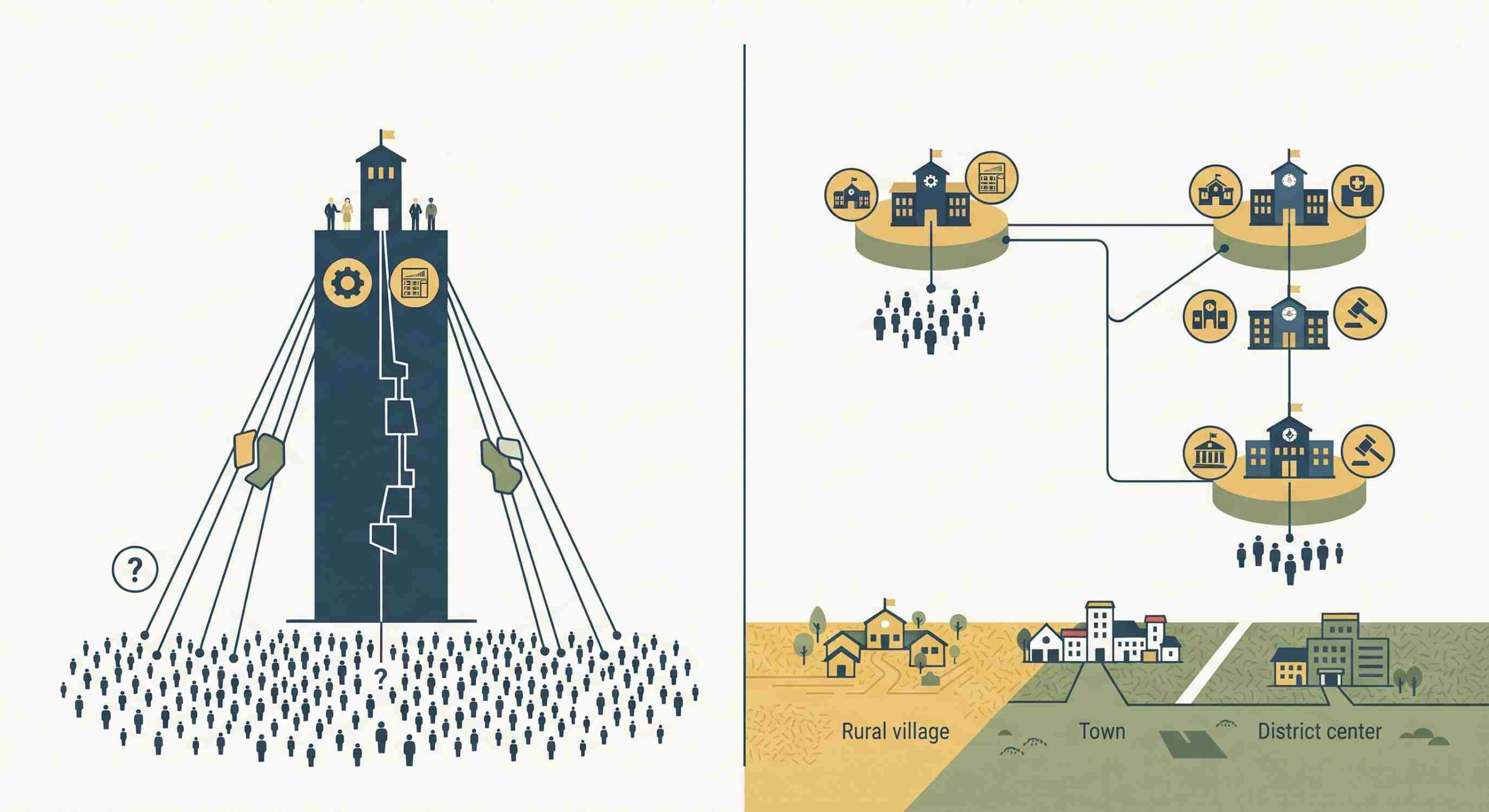
In a country of four provinces governing more than 240 million people, that question has become harder to answer. It points to a structural problem that Pakistan has avoided discussing honestly for decades: its provinces have grown too large, too centralized, and too distant from the people they govern.
The system of commissioners and deputy commissioners that still runs district administration in Pakistan was designed by the British Raj, and it was designed to extract revenue and maintain control over vast, unfamiliar territory, not to deliver responsive public service.
The deputy commissioner was the crown’s man in the district: a generalist who collected land revenue, kept the peace, and reported upward through a rigid hierarchy. That logic made sense for an empire managing subjects at arm’s length.
It makes considerably less sense for a democratic state whose citizens expect to be served, not merely administered. Pakistan inherited this machinery at independence and, aside from some tinkering, largely kept it intact, even as the population it governs has grown roughly eightfold.
The consequence is a form of governance that concentrates decision-making power in provincial capitals while leaving the periphery to wait its turn. Lahore, Karachi, Peshawar, and Quetta function as gravitational centres where bureaucratic authority, budget approvals, and political attention pool together.
Provincial assemblies and secretariats were never designed to micromanage local infrastructure and municipal services for dozens of districts spread across enormous and often ecologically distinct terrain, yet that is effectively what the system demands of them.
This centralization produces a particular kind of unevenness in development. Roads, universities, hospitals, and industrial zones tend to cluster disproportionately around the home districts of whichever political family or faction holds provincial power at a given time, while regions with less political weight are left waiting for their turn that never quite arrives.
This is not necessarily a matter of ill intent so much as structural incentive: when authority and resources are this centralised, proximity to power becomes the most efficient route to development, and everyone in the system, from bureaucrats to elected representatives, responds rationally to that incentive. The fix is not to hope for more virtuous leaders. It is to change a structure that rewards this behaviour in the first place.
Within districts, the deputy commissioner remains the most visible face of the state, yet the office is oriented in the wrong direction. A DC answers upward, to the provincial government that appointed and can transfer him, not downward to the citizens he administers. Postings rotate frequently, often for political rather than administrative reasons, which discourages the kind of long-term, accountable relationship with a community that good governance requires.
Pakistan has, at various points, experimented with empowered local government, most notably in the early 2000s, but these efforts have consistently been rolled back or hollowed out once they threatened to shift real power away from provincial elites.
The 18th Amendment devolved significant authority from the federal government to the provinces, a genuine achievement, but provinces have been far more reluctant to pass that authority further down to districts and local bodies, where citizens actually live their lives.
The result is a structure that struggles on nearly every measure of good governance: responsiveness, accessibility, and accountability. When something goes wrong in a village or town, the citizen has no clear, nearby office genuinely empowered to resolve it, only a long chain of authority that terminates somewhere in a provincial capital few will ever visit.
Elections held every five years for provincial and national assemblies are too infrequent and too distant a mechanism to hold local administration accountable for the pothole outside someone’s home or the school that has no teachers.
Democratic accountability requires a scale at which citizens can plausibly know, reach, and judge the people responsible for their daily concerns. Pakistan’s current provincial units, some governing tens of millions of people across widely varied geography and needs, are simply too large for that kind of accountability to function.
Smaller administrative units, whether new provinces or genuinely empowered local governments with real fiscal and administrative authority, would not be a cure-all, but they would change the incentive structure in ways that matter.
Smaller units mean shorter distances between citizens and decision-makers, both literally and bureaucratically. They mean representatives who cannot hide behind the scale of their jurisdiction to explain away neglect, because their performance becomes locally visible and comparable.
They allow development spending to be matched more precisely to local needs rather than filtered through the priorities of a distant provincial capital.
Countries with far larger populations than Pakistan’s individual provinces govern effectively at the sub-national level by dividing authority into more numerous, more manageable, and more accountable units. There is no structural reason Pakistan could not do the same, only a political one: those who benefit from the current concentration of power have little incentive to dilute it.
This is ultimately a conversation Pakistan has avoided for the wrong reasons, treating any discussion of new provinces or genuine devolution as inherently separatist or destabilising, when in fact the opposite may be true. A state that cannot answer, clearly and quickly, where its citizens should take their problems is a state slowly eroding its own legitimacy.
Redrawing the map of administrative authority, whether through new provinces, empowered local governments, or both, is not a radical proposition. It is an overdue correction to a system built for colonial control that Pakistan has never fully adapted for the democracy it claims to be.

Your go-to editorial hub for policy perspectives and informed analysis on pressing regional and global issues.