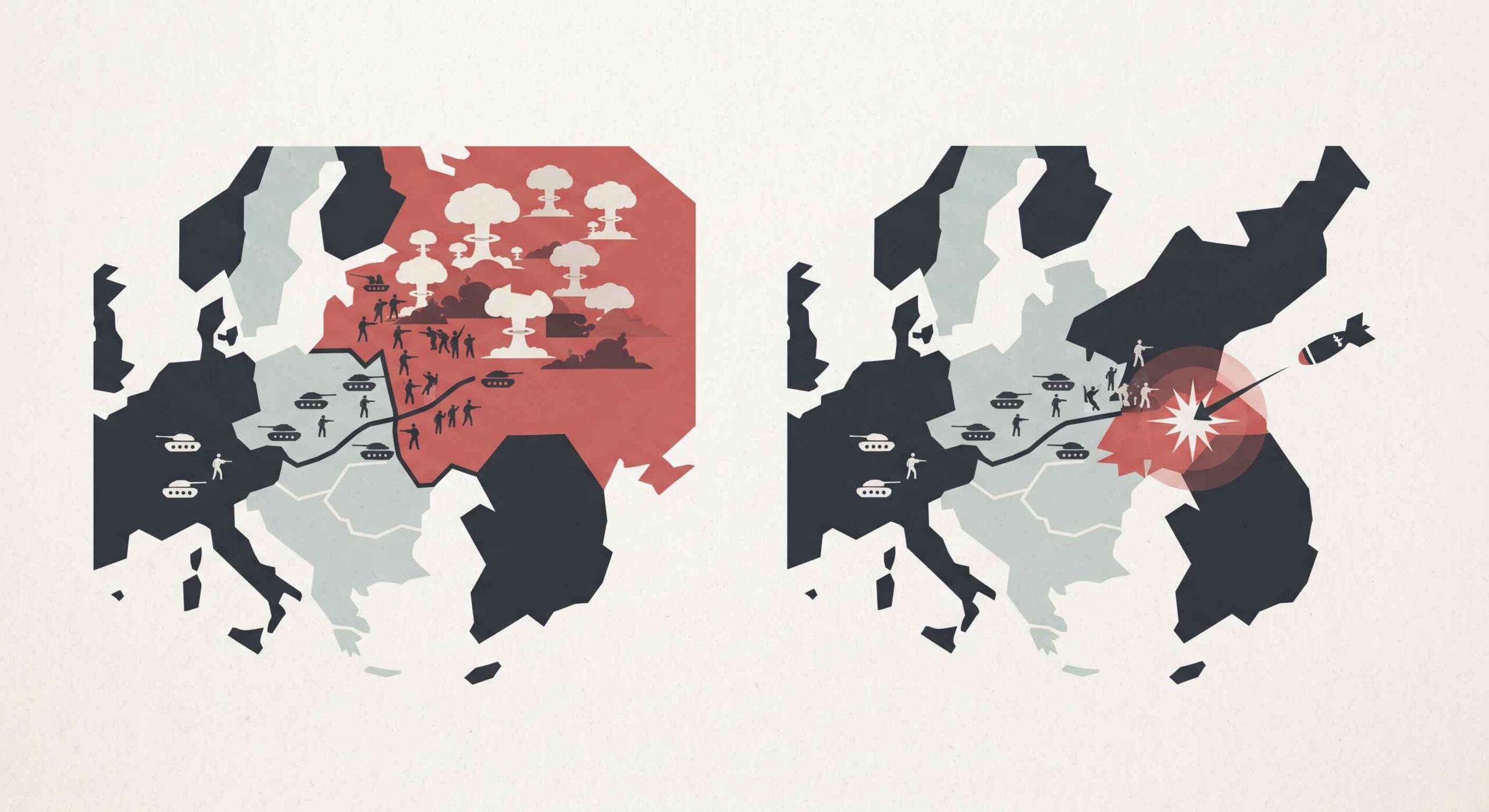
In August 2026, the Pentagon confirmed what attentive observers had been watching crystallize for months: Elbridge Colby, Under Secretary of Defense for Policy and architect of the 2018 National Defense Strategy, is drafting a revised nuclear posture that formally uplifts tactical nuclear weapons as vectors of battlefield use.
The declared rationale is extended deterrence — that Washington must, in Colby’s own words from a 2015 Center for a New American Security paper, develop “the platforms and weapons, doctrine, planning capacity, and other capabilities needed to fight a limited nuclear war more effectively than plausible adversaries.”
Speaking at the 2026 Strategic Command Deterrence Symposium, Colby framed the danger as “a kind of local war, conventional war that might have local employment, God forbid, of nuclear weapons that could escalate from there.” The candor was remarkable. The logic was not new. It was, in fact, exactly seventy-one years old.
Rewind to the summer of 1955. NATO was a nervous alliance, West Germany had been admitted into its ranks only weeks earlier, and the Eisenhower administration’s ‘New Look’ doctrine had staked American strategy on nuclear primacy rather than expensive conventional parity with Soviet ground forces — cutting active-duty Army divisions from 24 in 1953 to 14 by 1957 under the principle of “more bang for the buck.”
The question disturbing planners in Brussels and Washington was simple and brutal: if Soviet armored columns crossed the inner-German border in overwhelming numbers, could tactical nuclear weapons stop them? Exercise Carte Blanche, conducted from June 20 to 28 across West Germany, the Netherlands, Belgium, Luxembourg, and northern France, was designed to find out.
The answer it produced should have ended the question permanently.
Over six days, roughly 2,500 aircraft flew more than 10,000 sorties in a simulated air war. Exercise referees tallied the results with clinical precision: 335 simulated nuclear weapons were used over the course of the invasion scenario. Of these, 268 detonated over German territory. The theoretical toll, when officials finally calculated it, was 1.7 million dead and 3.5 million wounded — killing more people in days than Allied strategic bombing had killed across the entire Second World War.
British Air Commodore Peter Wykeham-Barnes, Chief of Staff of Allied Air Forces in Europe, briefed the assembled press with the exercise’s conclusion: “In an all-out atomic war, there would be no winners and no losers and little left to assess.” Any such conflict, he added, would be “short and horrible.”
The German federal government in Bonn had quietly urged NATO high command to suppress the results entirely. When the figures leaked to Der Spiegel, they produced widespread unrest across the Federal Republic. The population understood immediately what the planners had obscured in bureaucratic language: the tactical nuclear defense of West Germany was structurally indistinguishable from the destruction of West Germany. The territory being saved and the territory being incinerated were the same territory.
Henry Kissinger, then still an academic rather than a statesman, drew the essential conclusion in his 1957 book Nuclear Weapons and Foreign Policy, writing that Carte Blanche had become “a demonstration that the power of nuclear weapons inhibits their use unless there exists a doctrine which poses alternatives less stark than total devastation.” The sentence was honest and precise. The institutions that read it declined to be guided by it.
What followed was not a reckoning but a reclassification. NATO adopted Flexible Response in December 1967 through MC 14/3, which replaced automatic nuclear escalation with a three-tiered framework — direct conventional defense, deliberate nuclear escalation, and general nuclear response — and was sold as a more measured posture.
In reality, it preserved tactical nuclear weapons as the bridge between conventional failure and strategic annihilation, without resolving the fundamental problem Carte Blanche had identified: that bridge, when crossed, destroys the territory it was built to defend. The neutron bomb controversy of the 1970s, the Euromissile crisis of the 1980s, the eventual removal of ground-launched cruise missiles from Europe in the 1990s — each iteration of this debate circled the same unanswered question and arrived at no stable answer. The question was deferred, not resolved.
The deferral worked as long as American conventional primacy remained intact. For the decade and a half following the Cold War’s end, Washington did not need a coherent tactical nuclear doctrine because its conventional forces were without meaningful peer competition.
That supremacy was not dismantled by an adversary. It was spent. Two decades of sustained operations in Afghanistan and Iraq — later compounded by Syria, and now by a Middle East war entered, as one analysis of the USS Abraham Lincoln’s record deployment noted, on “a joint force that was already running hot” — consumed readiness in precisely the way that extended high-tempo deployments always do. In May 2025, an Army sergeant major warned that “the Army’s operational tempo had already surpassed the demands of the war on terror.”
The US Government Accountability Office documented the accumulated damage in testimony before the Senate Armed Services Committee in March 2026: American military readiness “has declined over the past two decades due to ongoing operational demands, aging systems, and challenges in modernizing forces across air, sea, ground, and space domains,” with more than 150 recommendations to address these deficiencies left unimplemented by the Department of Defense.
It is against this backdrop — not against some abstract great-power competition existing in doctrinal isolation — that the Colby posture must be read. The tactical nuclear turn is not primarily a response to adversary capability, though adversary capability is the vocabulary in which it is publicly expressed. It is a response to American conventional inadequacy, and the inadequacy is self-inflicted.
The same institutional culture that generated Carte Blanche’s compensatory logic in 1954 — we cannot match Soviet divisions, so we will substitute nuclear weapons — is generating the Colby doctrine in 2026: we cannot field sufficient conventional force across the Indo-Pacific and the European theatre simultaneously, so we will lower the nuclear threshold and call it ‘extended deterrence.’
In his 2018 Foreign Affairs piece, Colby wrote that “the best way to avoid a nuclear war is to be ready to fight a limited one.” A senior Pentagon official framing the current posture told NBC that “if you actually want extended deterrence to be credible, you have to provide the nation’s political leadership with nuclear capabilities that common sense indicates you could actually use.”
Wykeham-Barnes said something functionally equivalent in a press briefing in June 1955. He said it after watching 268 nuclear weapons detonate over the country being defended.
The problems embedded in this logic are identical to those he articulated over seven decades ago, and they have not become more tractable with time. In the Taiwan scenario, a tactical nuclear strike on advancing forces detonates on the territory whose autonomy is the stated reason for the commitment. On the Korean Peninsula, the geometry is more compressed: a tactical strike on forces moving south detonates within range of Seoul — a metropolitan concentration of more than ten million people located forty kilometers from the border.
Pyongyang has publicly articulated a nuclear doctrine of ‘preemptive and massive response’ to perceived existential threats; a tactical American nuclear strike does not, in that framework, register as a calibrated signal. It registers as the opening of a strategic exchange.
In Europe, as the Bulletin of the Atomic Scientists observed in July 2026, the pursuit of escalation dominance across all rungs of the ladder “is not a sound doctrine against a nuclear peer competitor: it is destabilizing and stokes further arms races.”
The eastern members of the alliance — Poland, the Baltic states — occupy territory with no strategic depth and populations that would absorb the primary damage of any battlefield exchange on their soil.
What the Colby doctrine communicates, stripped of its deterrence vocabulary, is an acknowledgement that the United States cannot match its peer competitors conventionally across its stated defensive perimeters, and therefore proposes to lower the nuclear threshold rather than repair the conventional deficit.
Deterrence derives its credibility from the adversary’s belief that the threatened response would serve the threatening party’s interests under the actual conditions of execution. A strike that destroys the objective of the commitment — Taiwan’s functioning economy, South Korea’s capital, European territorial integrity — does not serve those interests. It demonstrates that the commitment was always contingent on conditions that cannot be sustained.
Air Commodore Wykeham-Barnes told the press in June 1955 that tactical nuclear war would be “short and horrible.” Kissinger wrote two years later that Carte Blanche had demonstrated the limits of weapons whose use produces total devastation.
The institutions that read both statements chose, in each subsequent decade, to reconstitute the same logic under a different name and call it strategy. Colby’s 2026 posture is the latest iteration of that pattern — not its innovation. The reflex has been consistent. The learning has not.

Muhammad Mahad Samija is a scholar at the Department of Political Science, Government College University Lahore.