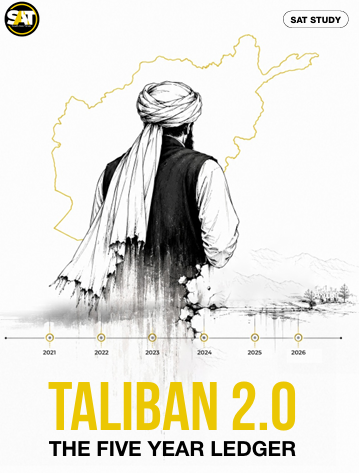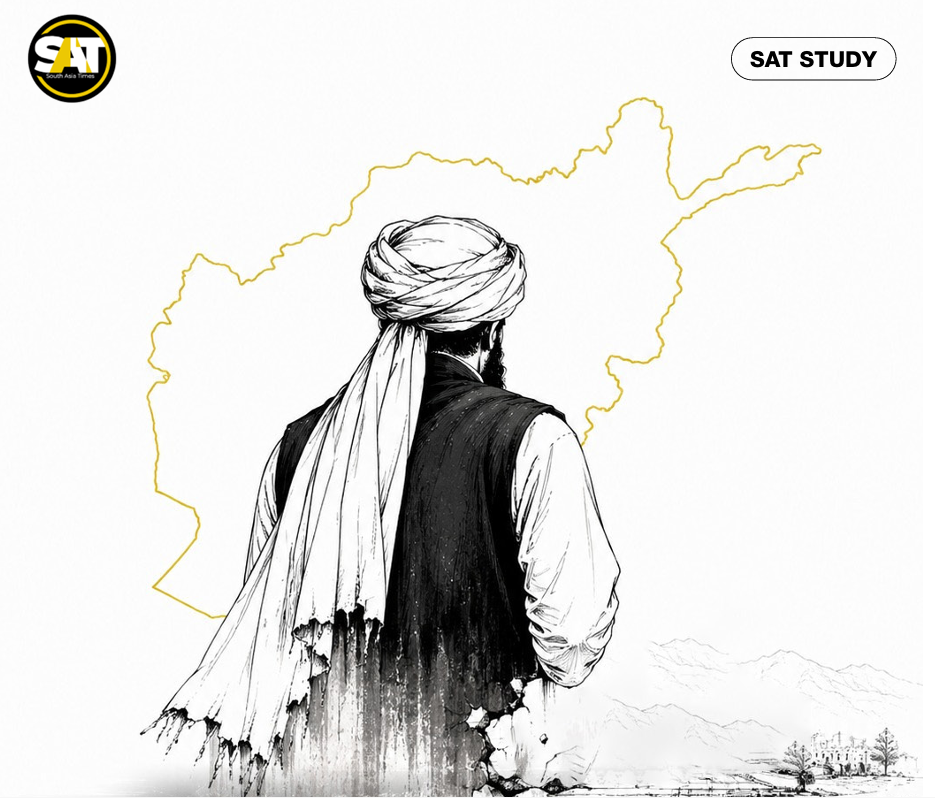
ISLAMABAD — South Asia Times (SAT), an independent research and media lab focused on South Asia, today released “Taliban 2.0: The Five Year Ledger,” a comprehensive study marking five years since the Taliban’s return to Kabul on 15 August 2021.
Authored by Salman Javed, SAT’s Director General, and Haleema Khalid, SAT’s Director of Operations, the report concludes that the Taliban’s five years in power represent institutional evolution without ideological rupture; not the moderation many policymakers anticipated.
Drawing on primary and secondary sourcing across governance, ideology, security, the economy, diplomacy and regional relations, the study finds that the Taliban inherited a functioning state — ministries, courts, provincial administrations, revenue systems and a civil service — from the former Islamic Republic.
But then they removed or excluded large numbers of Republic-era personnel and replaced them with Taliban appointees. The result, the report argues, is the same doctrinal project as the Taliban’s first Emirate, now backed by a working bureaucracy, a national budget and diplomatic relationships it lacked in the 1990s.
Key findings of the study establishes facts relating to education, security, and economy of Afghanistan, amongg other sections.
On education and media, 1.1 million secondary-age girls remain excluded from school, roughly 100,000 female university students were affected by the 2022 higher-education ban, and UNESCO projects the economic cost of that exclusion will reach US$9.6 billion by 2066.
In media, 219 of 547 outlets have closed and the number of working journalists has fallen from 11,857 to 4,759; Afghanistan ranked 175th of 180 countries in press freedom in 2026.
Alongside this contraction in mainstream schooling, a parallel education system has taken root: registered madrassas have grown from roughly 5,000 in 2021 to more than 23,000 by 2025, enrolling upwards of 3.65 million children, as the national curriculum is reoriented toward religious instruction.
On the security front, the United Nations has identified more than 20 militant organisations and up to 13,000 foreign terrorist fighters present in Afghanistan; Russia’s February 2026 assessment put the wider terrorist presence at 20,000–23,000, including 6,000–6,500 TTP fighters. Anti-Taliban resistance has also grown, with NRF-claimed operations rising from 40 in 2022 to 380 in 2024.
Economically, domestic revenue reached AFN 241 billion in FY2024–25, yet Afghanistan has absorbed a cumulative 25% GDP contraction since 2021. The opium ban cut cultivation by 95% but collapsed farmer income from US$1.36 billion to US$110 million, even as methamphetamine seizures linked to Afghanistan rose roughly 50%.
These pressures are being felt across the border as well: Pakistan recorded 600+ TTP attacks in 2025, and bilateral trade fell from approximately US$2.46 billion in 2024 to US$1.77 billion in 2025.
“Five years of Taliban rule have not resolved Afghanistan’s core political, social or security problems — they have reorganised them under a more centralised system,” said Salman Javed, Director General of SAT and co-author of the report. “The question for the next five years is whether exclusion, militant presence, economic weakness and regional security friction remain contained or begin reinforcing one another.”
Haleema Khalid, SAT’s Director of Operations and co-author, added: “Administrative functionality is not legitimacy. A government that excludes girls from education, restricts women from public life and allows a persistent militant ecosystem to operate from its territory cannot have its legitimacy inferred from its ability to collect taxes or run customs.”
The study identifies Badakhshan, the trajectory of the TTP threat, the treatment of Afghan women, ethnic and political exclusion, and Pakistan–Afghanistan security relations as the principal indicators to watch over the next phase of Taliban rule.
“Taliban 2.0: The Five Year Ledger” by South Asia Times is available now.