
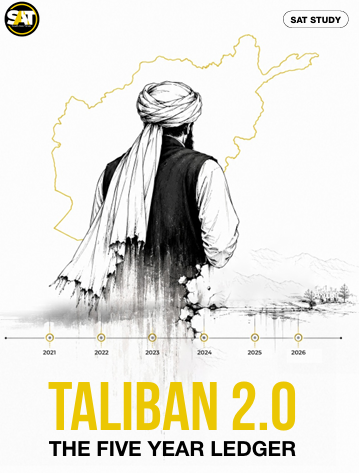
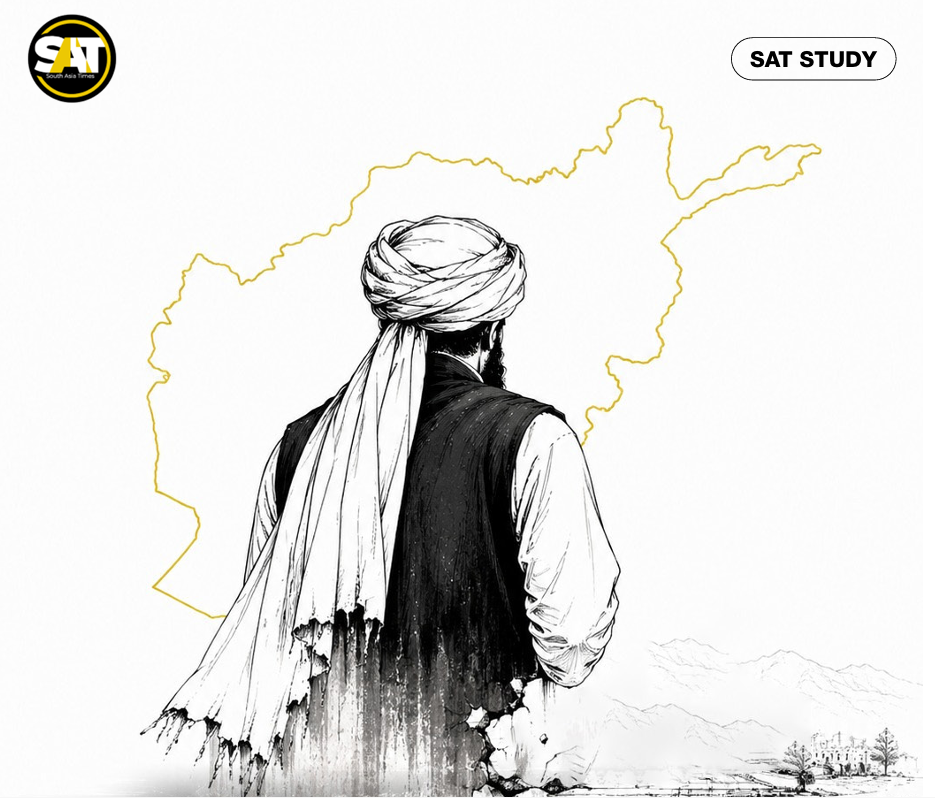
Taliban 2.0: The Five-Year Ledger
- September 2026
- SAT Study
Share
17
Sep 2026
- South Asia Times
- Inqueries: info@southasiatimes.org
Executive Summary
Five years after the Taliban’s return to Kabul on 15 August 2021, “Taliban 2.0” is not a story of moderation. It is the reconfiguration of an inherited state around an unelected, Taliban-controlled militant political order. The movement inherited ministries, courts, provincial administrations, revenue systems, infrastructure and a functioning civil service from the Islamic Republic, then removed or excluded large numbers of Republic-era personnel and replaced them with Taliban appointees and loyalists. The result is a state apparatus operating under a narrower political and ideological framework, not a fundamentally transformed model of governance.
This study’s central finding is blunt: Taliban 2.0 is institutional evolution without ideological rupture. It is not moderation, and it is not simply 1996 repeated; it is the same doctrinal project, now equipped with a functioning bureaucracy, a national budget, and diplomatic relationships it lacked the first time.
The social record is stark. 1.1 million secondary-age girls remain excluded from education, roughly 100,000 female university students were affected by the 2022 higher-education ban, and UNESCO projects the economic cost of that exclusion will reach US$9.6 billion by 2066. Meanwhile, registered madrassas have grown from roughly 5,000 in 2021 to more than 23,000 by 2025, enrolling more than 3.65 million children as the national curriculum is reoriented toward religious instruction.
The security record is equally consequential: the UN has identified 20+ militant organisations and up to 13,000 foreign terrorist fighters in Afghanistan, while the TTP alone is estimated at 6,000–6,500 fighters. For Pakistan, the consequences are immediate; 600+ TTP attacks were recorded in 2025, alongside a sharp fall in bilateral trade and the repatriation of more than 1.7 million Afghan nationals.
The study’s conclusion: five years of Taliban rule have not resolved Afghanistan’s core political, social or security problems; they have reorganised them under a more centralised system. The critical question for the next five years is whether exclusion, militancy, economic weakness and regional security friction remain contained or begin reinforcing one another.
Key Findings
- Taliban rule since 2021 represents institutional reconfiguration without ideological transformation. The republic-era state machinery remains, but subordinated to a narrower political and doctrinal order.
- 1 million girls remain excluded from secondary education; the 2022 university ban affected roughly 100,000 female students, with a projected economic cost of US$9.6 billion by 2066.
- Registered madrassas have quadrupled from ~5,000 (2021) to 23,000+ (2025), enrolling 3.65 million children, as public education is reoriented toward religious instruction.
- Afghanistan hosts 20+ militant organisations and up to 13,000 foreign fighters, with the TTP alone estimated at 6,000–6,500 fighters, echoing the transnational jihadist “magnet” role Afghanistan played in the 2000s.
- Anti-Taliban armed resistance (NRF, AFF and smaller fronts) has grown and diversified, with claimed operations rising from 40 (2022) to 380 (2024); Badakhshan has emerged as the key convergence point of resistance and foreign-militant activity.
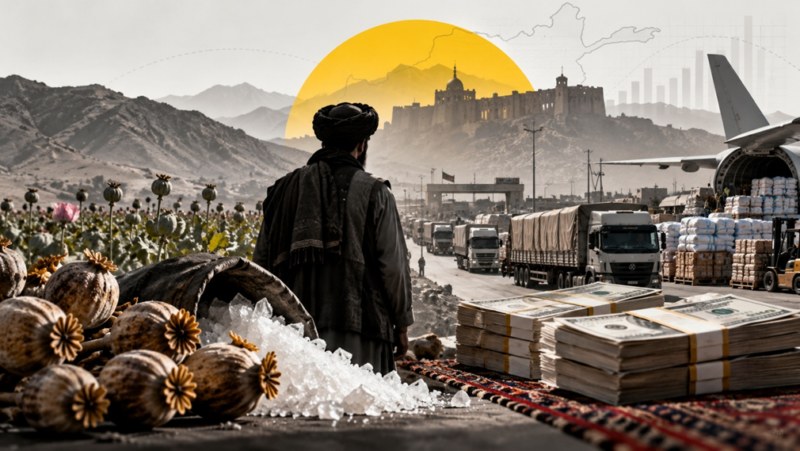
- The opium ban cut cultivation by 95% but collapsed farmer income from US$1.36 billion to US$110 million, while methamphetamine seizures linked to Afghanistan rose roughly 50%, indicating a shift from poppy to synthetic narcotics rather than a genuine decline in the drug economy.
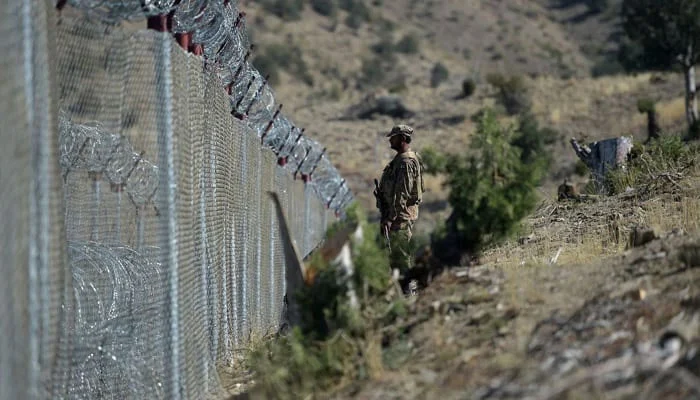
- Pakistan bears the most immediate cost: 600+ TTP attacks in 2025, bilateral trade down from ~US$2.46 billion to ~US$1.77 billion, and over 1.7 million Afghan nationals repatriated.
- Diplomatic recognition remains fragmented: Russia formally recognised the Islamic Emirate in July 2025, but of 65 Afghan overseas missions, only 37 are Taliban-controlled; the Taliban remains subject to the UN’s 1988 sanctions regime.
Scope of the Study
The publication examines:
- The framing and evolution of the “Taliban 2.0” concept, and the record of the 2020 Doha Agreement
- The ideological and historical foundations of Taliban rule
- Five years of governance: state control, institutional adaptation, the civil service, public services and justice
- The political economy of state survival, including poverty, malnutrition, the opium ban and the rise of synthetic narcotics
- Education policy, the madrassa expansion, and the retreat of secular schooling
- The status of women and ethnic/religious minorities under Taliban rule
- The regional militant ecosystem, TTP, ISKP, Al-Qaeda and TIP/ETIM, and comparisons with the Somalia and Syria precedents
- The evolution of armed resistance since 2021, with a focus on Badakhshan as an emerging strategic fault line
- Afghanistan’s place in the regional order: relations with Pakistan, China, Iran, Central Asia, Russia, India, the Gulf states and the West
- Pakistan–Afghanistan relations, from strategic expectations to security reality
- Afghanistan’s strategic trajectory to 2031, and strategic recommendations for regional and international stakeholders
Research Basis
The study draws on primary and secondary sources, including UN and UNODC data, UNESCO projections, official statements, and documented security incidents, compiled and analysed by South Asia Times (SAT).
Authors: Salman Javed, Director General, South Asia Times (SAT); Haleema Khalid, Director of Operations, South Asia Times (SAT)
Intended Audience
This publication is intended for researchers, policymakers, security practitioners, journalists, diplomats, and students of Afghanistan studies, regional security, and South Asian geopolitics seeking a comprehensive five-year assessment of Taliban rule.
About South Asia Times (SAT): South Asia Times is an independent research and media lab dedicated to in-depth analysis, policy insight, and informed storytelling on South Asia and its global intersections.
This publication may be shared for non-commercial and educational purposes with appropriate attribution. Reproduction or commercial use requires prior written consent. © South Asia Times. All rights reserved.
![Afghanistan condemns Pakistan airstrikes in Paktika, claiming death of civilians and escalating tensions between the two countries [Image via AFP/File]](https://southasiatimes.org/wp-content/uploads/2024/12/Pak-Afghan-border1675358892-0.webp)