
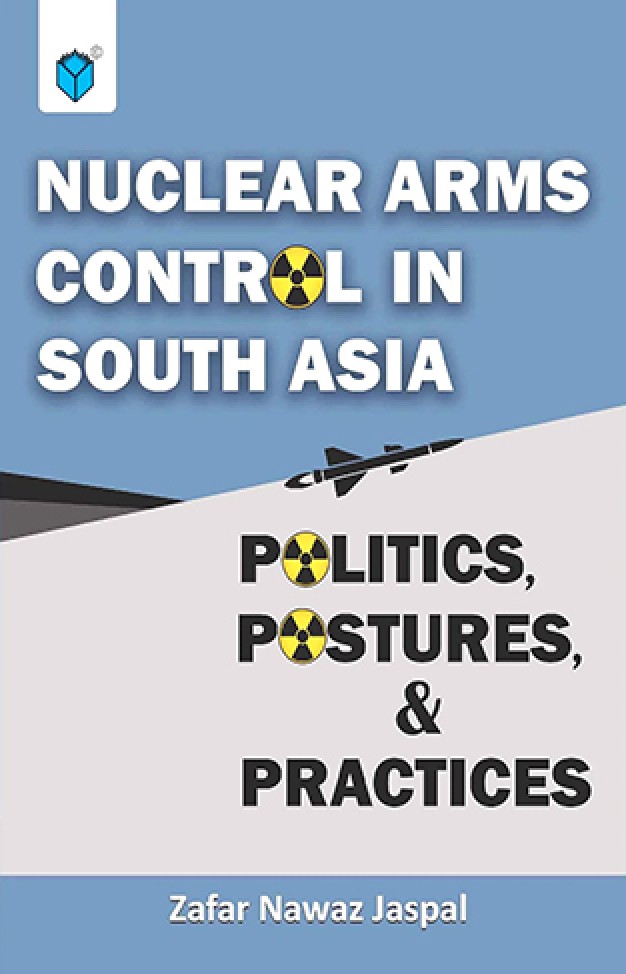

Author: Dr. Zafar Nawaz Jaspal
Publisher: Paramount Books (Pvt.) Ltd.
Nuclear Arms Control in South Asia: Politics, Postures & Practices written by Dr. Zafar Nawaz Jaspal traces the changing pattern of India-Pakistan rivalry in a nuclearized regional political order and how it is paving an intense arms race between the two nuclear armed neighbors.
Dr. Jaspal analyzes the practices, Pakistan and India employed, destabilizing the perilously balanced nuclear deterrence and the strategic stability in South Asia. The book also addresses the discussion surrounding non-proliferation debate and critically analyze the prejudice that is central to the global nuclear debate. The book is a valuable addition to the existing literature on nuclear politics written by a Pakistani author presenting Pakistan’s perspective on nuclear arms control in South Asia.
The book is divided into eleven chapters organized into three main sections explaining the Politics, Postures, and Practices of the South Asian nuclear armed neighbors. First two chapters are dedicated to the philosophical debate on nuclear politics.
These chapters explore the ongoing pattern of international nuclear politics and how it is associated with the changing power dynamics of great power politics. To examine the nuclear doctrines and postures of nuclear weapon states, the second section, Postures, comprised of four chapters. This section explain the deterrence and compellence as a concept, how deterrence is central in nuclear strategic thought, but states also use nuclear weapons for compellence.
Dr. Jaspal also differentiate between the postures and doctrine and explain various typologies of nuclear postures. India’s and Pakistan’s Nuclear Doctrine and Postures are discussed how India’s nuclear doctrine and posture evolved from minimum credible deterrence to credible deterrence into nuclear compellence strategy.
The chapter also explore India’s evolving nuclear posture, from disassembled state to canisterized system. Last chapter of this section analyses Pakistan’s nuclear doctrine and posture transformation and examine its Full Spectrum Deterrence and Quid pro-Quo Plus strategy. Pakistan’s doctrine of FSD is a response to India’s destabilizing changes. Book further argued that Pakistan will continue to restore the imbalance that India’s military modernization and aggressive posture will create.
Third section, Practices, explores Pakistan-India response to global arms control and non-proliferation regimes. The author begins with a detailed discussion on nuclear non-proliferation regime, debates, the factors and trends contributing to its weakness. Nuclear Non-Proliferation Treaty (NPT) also analyzed in detail as a robust institutional and normative arrangement to control nuclear weapon proliferation. The section explains India’s and Pakistan’s response to Nuclear Arms Control and Non-Proliferation.
Dr. Jaspal analyze contradiction between India’s international standing for a world free from nuclear weapons while distancing itself from the same initiative for South Asian region. While, on other hand it is struggling to acquire technical capacity for nuclear weapons.
The book explore how US-India strategic partnership evolved with the transformation in global strategic environment and its implications towards arms control. The US-India nuclear deal signed in 2005, facilitating the sale of civilian nuclear technology to India. Nuclear Supplier Group (NSG) waiver granted to India in 2008 by the US further facilitating its participation in civilian nuclear technology commerce.
The US facilitated India’s membership in informal export control arrangements such as Missile Technology Export Control Regime, Wassenaar Arrangement and Australia Group strengthening New Delhi’s stance on South Asian nuclear restraint regime.
The safety and security of India’s nuclear infrastructure and arsenals critically analyzed that how they are vulnerable to radiological terrorism. Author also explains in detail India’s lobbying to get full membership of NSG since 2010. While its non-compliance attitude led to the objection by few NSG members advocating for rule based criteria for non-NPT candidates to NSG.
While, discussing Pakistan’s response to Nuclear Arms Control and Non-Proliferation Dr. Jaspal explains various initiatives by Pakistan to prevent nuclear arms race in South Asia. Despite not being party to the NPT, Islamabad acts as per treaty norms. It has established robust safety and security apparatuses to prevent unauthorized use of nuclear weapons and radiological terrorism. Pakistan’s approach towards technological cartels and its proposal for nuclear restraint regime are also discussed in detail. Author also eloquently presents Pakistan’s case for NSG membership.
In last chapter, Dr. Jaspal addressed how emerging technologies such as hypersonic weapons, cyber weapons, artificial intelligence and advanced missile defenses are impacting nuclear arms race, referring them, as a disruptive technologies. It would not only intensify an arms race but also distressed the hierarchy of escalation. In concluding part the book emphasizes on the usefulness of proposed regional arms control treaty between Pakistan and India. It also argues that there is a need to change perception regarding nuclear weapons otherwise the nuclear disarmament will remain impossible.
The book is a must read for the students of International Relations, Nuclear Politics, Strategic Studies and Peace Studies. It will enhance their theoretical understanding of issues surrounding nuclear non-proliferation debate, South Asian dimension of international arms control and its impact on South Asian strategic stability. The book comprehensively addressed the changing nature of South Asian nuclear politics.

Syeda Tahreem Bukhari is an Associate Director at the Center for International Strategic Studies-AJK, where she works on strategic stability, South Asian security and emerging regional security dynamics. She has also served as a lecturer at the University of Azad Jammu & Kashmir and is an alumna of the Near East South Asia Center for Strategic Studies (NESA), National Defense University, Washington, DC.