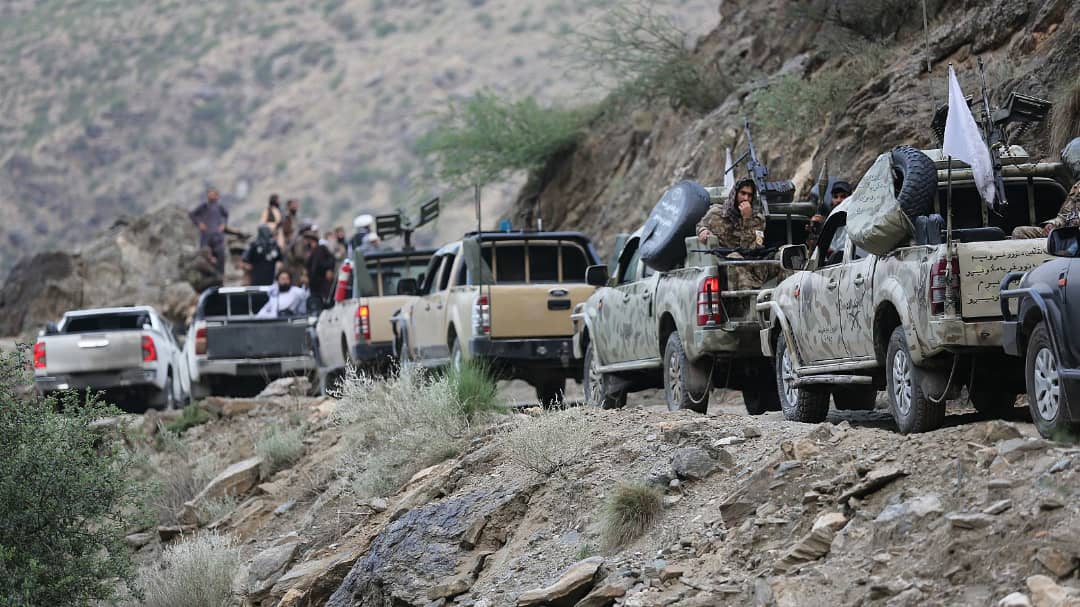
A regime that must lie about its own battlefield reality has already conceded the argument. On 26 July, the Afghanistan Freedom Front released video evidence of its fighters advancing on and capturing Taliban outposts in Zibak district, Badakhshan. The footage is unambiguous. Fighters stand atop a captured hilltop position overlooking Taliban military posts, declaring victory and pledging continued resistance.
The fighting has now stretched into its fourth day. Taliban forces have not recaptured the territory. This is not a contested claim requiring careful adjudication. It is documented fact, and it directly contradicts public statements from the Taliban’s own Chief of Staff, who denied that the Afghanistan Freedom Front maintains any presence in Zibak at all.
This denial is not a communications misstep, but a pattern. Across Afghanistan, the Taliban regime has adopted a strategy of flatly denying the existence and territorial gains of resistance groups operating against it, even as video evidence, eyewitness accounts, and the simple duration of unresolved firefights tell a different story.
Every time this happens, the gap between the regime’s official narrative and the reality on the ground widens. And every time that gap widens, the regime’s credibility, both domestic and international, erodes a little further. A government confident in its control does not need to fabricate the absence of its enemies.
It demonstrates control by neutralizing them. The Taliban’s inability to do so in Zibak, and its subsequent resort to denial, speaks louder than any statement its spokesmen could issue. The footage itself deserves attention on its own terms. Fighters are shown occupying a specific, identifiable position, a hilltop overlooking Taliban military posts in northern Zibak, and naming it as a position they have taken by force.
Their declaration, “Long live the Freedom Front,” is a statement made from a position of demonstrated, physical control over territory the Taliban regime claims to hold. Four days without recapture is an operational failure, and one that Taliban commanders cannot spin away simply by insisting the fight never happened.
None of this emerges from nowhere. The conditions that produce organized, sustained resistance do not appear overnight, and they do not stem from a single grievance. Years of political exclusion have shut entire communities out of governance. Ethnic imbalance in the regime’s structure has deepened resentment among populations who see no path to representation. Economic collapse has stripped ordinary Afghans of livelihood and stability. Repressive governance has closed off every legitimate avenue for dissent.
Together, these forces have pushed a significant portion of the population to a breaking point, and when legitimate channels for grievance are sealed shut, organized resistance becomes the only remaining outlet. What is unfolding in Zibak is the product of conditions the Taliban regime itself has created and sustained, and those conditions are now expanding resistance activity across multiple provinces, not containing it.
This is the point that matters most. The growing momentum behind anti-Taliban resistance is a symptom of deepening internal fracture within the Taliban’s own structure of authority. A government secure in its legitimacy and its control does not face expanding, multi-province resistance four years into its rule. It faces such resistance when its governance has failed broadly enough, and alienated enough of the population, that armed opposition becomes viable and sustainable rather than symbolic.
Zibak is not the whole story, but it is a visible and verifiable chapter in a larger one. It should be read not as an isolated incident but as the first domino in a longer sequence of instability, one that will continue to challenge Taliban authority across Afghanistan as resistance groups gain confidence, territory, and the credibility that comes from documented battlefield success.
The Taliban regime faces a choice it cannot escape through denial. It can acknowledge the scale of the challenge it faces and attempt genuine reform of the exclusionary, repressive governance that created this resistance in the first place. Or it can continue issuing statements that video evidence repeatedly contradicts, forfeiting whatever credibility it has left with each denial that reality disproves.
The fighters standing on that hilltop in Zibak have already made their answer clear. The regime’s Chief of Staff can call it fiction. The footage says otherwise, and four days of failed recapture says otherwise still. Denial is not a strategy. It is an admission, dressed up as confidence, that the ground is shifting beneath a regime that no longer controls the narrative or the territory it claims to hold.

Your go-to editorial hub for policy perspectives and informed analysis on pressing regional and global issues.