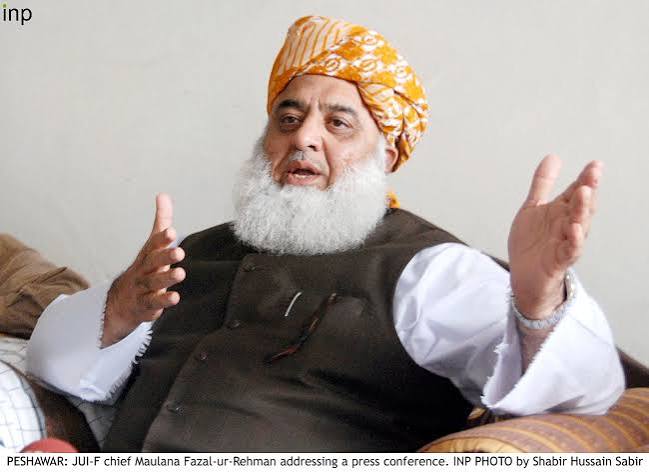
Numbers can be a convenient shield. Say “ninety percent” often enough, and with enough conviction, and it starts to sound like a fact rather than a boast. That is roughly what Maulana Fazlur Rehman has been doing since he claimed that the overwhelming majority of the public, ninety percent by his own count, had rallied behind his remarks that ‘martyrs fight for salary’.
It is simply not true. Not only did the ordinary citizens condemn his remarks, his own party’s scholars criticized him. Criticism is routine in Pakistani religious and political life, and Maulana Fazlur Rehman is no stranger to it. What is unusual is where the silence, and the outright criticism, is coming from. It is scholars within his own party’s orbit, people who would normally be expected to close ranks around their leader.
Strip away the noise and what remains standing with him is a small circle of loyalists, along with his own brothers, Ata-ur-Rehman and Zia-ur-Rehman. That is Fazl-ur-Rehman’s “90 percent”!
The claim that religious scholars broadly, and the madrasa establishment in particular, endorsed his position collapses even faster under scrutiny. Of the fifteen major madrasa organizations in the country, thirteen are on record criticizing his statement rather than supporting it. The Muttahida Madaris Council, which brings together eleven of those fifteen boards, did not stay quiet or noncommittal.
It issued a clear statement distancing itself from what he said. When the body representing the majority of the country’s seminary boards feels the need to formally disassociate itself from a leader’s remarks, “overwhelming endorsement” is not the phrase that fits.
There is a broader point worth making here about the distance between what a public figure claims and what can actually be verified. Maulana Fazlur Rehman speaks both as a religious scholar and as the head of a religious party, and both roles carry an expectation of honesty with facts, not just confidence in one’s own cause.
Repeating a figure like ninety percent does not make it true. It certainly does not hold up against a public that can see for itself which organizations spoke and what they actually said.
So the fair question to put to him is simple. Outside a handful of individuals, can he name one religious or political party in the country that has genuinely endorsed his statement? The evidence so far suggests he would struggle to answer.
Nearly every party of consequence has spoken against it, and the madrasa organizations have done much the same. This pattern is not incidental. It is the clearest evidence available that his position rests on far less support than he claims, and that his standing, both within the religious and political class and among the wider public, has taken a hit rather than a boost.
None of this is to say that dissent within a party or criticism from religious institutions settles every question of substance. People can disagree about how a leader should have handled sensitive matters, and reasonable voices exist on more than one side of that debate.
But there is a difference between disagreement over judgment and a fabricated claim of near unanimous support. The first is normal political life. The second is a leader trying to manufacture a consensus that does not exist, hoping that repetition will do the work that evidence cannot.
What should trouble supporters and critics alike is the pattern itself. A leader who inflates his own support so dramatically, and does so despite visible, documented pushback from the very institutions he claims stand behind him, is asking his audience to trust rhetoric over record.
That is a habit worth naming plainly, regardless of where one stands on the underlying dispute about the martyrs’ statement. Facts about who said what, and which organizations issued which statements, are not really open to interpretation. They can be checked. And once checked, they tell a story quite different from the one Maulana Fazlur Rehman is telling.

SAT Commentaries, a collection of insightful social media threads on current events and social issues, featuring diverse perspectives from various authors.