Every newsroom I still talk to has spent the past few weeks with its cameras pointed at Tehran and Washington, watching a different kind of fire spread. It is an understandable place to look. But wars have a way of using the world’s distraction as cover, and Afghanistan has quietly used the Iran-US spotlight to do exactly that. While the wires ran wall-to-wall on missile strikes and diplomatic brinkmanship elsewhere, a much older war, the one the Taliban insists it already won, started slipping out from under the story nobody was watching.
There is a particular kind of silence that falls over a mountain district in the hour before dawn. I have sat through enough of them across the Hindu Kush to know the sound, or rather, the absence of it. Dogs stop barking. Even the wind seems to hold its breath. It was into exactly that silence, sometime before first light on July 17, that a small column of men walked into Yaftali Sufla and did something nobody in Kabul thought possible anymore.
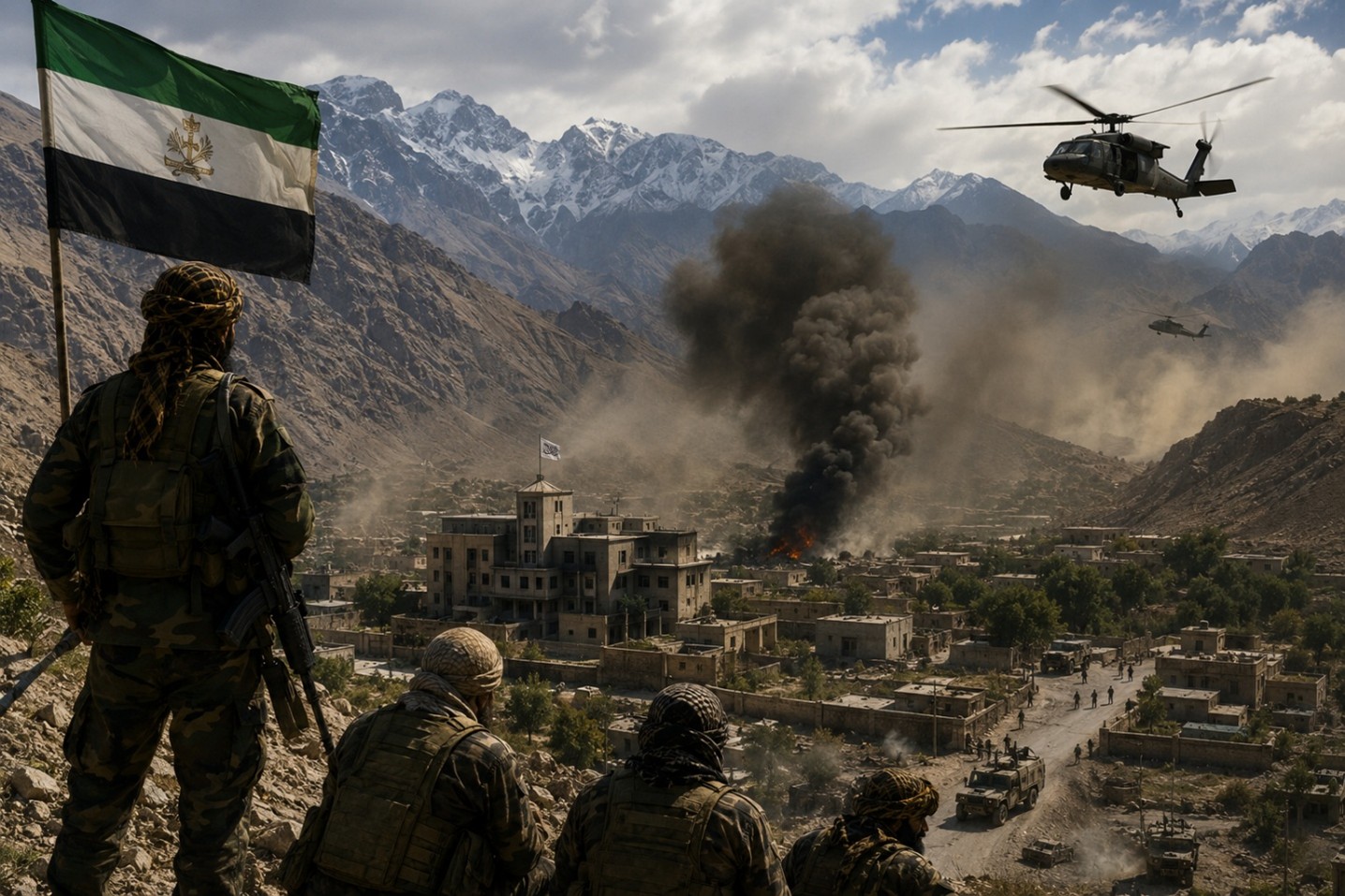
They did not announce themselves with a manifesto. They did not wait for permission from any of the exiled political councils that like to speak on Afghanistan’s behalf from Ankara or Vienna. Somewhere around twenty men, calling themselves Sepahiyan-e Mihan, — Soldiers of the Homeland — walked into a district headquarters, disarmed the garrison without much of a fight, took the police station and the intelligence office along with it, and ran their own flag up the pole. Then, a few hours later, before the Taliban could organize a real response, they vanished back into the mountains they came from.
For five years the Islamic Emirate had built a story around itself: that the war was over, that the opposition was a scattering of exiles with WhatsApp groups and no rifles, that Badakhshan, remote, Tajik, mineral-rich, and never particularly loyal to Kandahar, was pacified. Yaftali Sufla did not destroy that story in one night. But it put the first real crack in it. This was, as far as anyone can determine, the first time since August 2021 that a district headquarters changed hands, even briefly, anywhere in Afghanistan.
I have spent enough years reading Taliban internal politics to know that the story rarely begins where the headlines do. It began, in this case, weeks earlier, with a quieter and considerably less cinematic operation, a purge. Juma Khan Fateh, a Tajik commander who had carved out real influence over the gold-bearing hills of Darwaz, was stripped of his posts by the central leadership in late June. His offense, depending on who you ask, was either corruption or simply the crime of being too independent, too locally rooted, too capable of saying no. He did not go quietly. He set up his own checkpoints. He held court with local elders. For a tense two weeks, Badakhshan sat on the edge of an intra-Taliban shooting war that never quite arrived, resolved only when the army chief himself flew in to negotiate Fateh’s transfer to Kabul.
That is the part of the story that rarely makes it past the wire services: the enemy the Taliban is fighting hardest right now is not always the enemy wearing an opposing flag. It is the slow unraveling of its own coalition of convenience, the local commanders who joined in 2021 for power and patronage, and who are now discovering that Kandahar’s idea of unity looks a great deal like Kandahar’s idea of control.
Into that vacuum walked Sepahiyan-e Mihan, and then, less than a week later, something considerably heavier. On July 23, the Afghanistan Freedom Front, the more disciplined, better-armed successor of the old republic’s officer corps, opened a multi-front assault on Taliban positions in Zebak, a border district sitting astride the old smuggling and infiltration routes toward Chitral. The Front claims it killed twenty-one Taliban fighters, including several commanders, and wounded thirty-seven more, seizing high ground around a border battalion the Taliban could not retake despite repeated attempts. Kabul’s own count puts opposition losses at five and calls the whole affair a contained skirmish. Neither number should be taken as gospel; in country this remote, both sides are essentially reporting from behind their own fog.
What should not be dismissed is the pattern. An internal purge. A district lost, however briefly. A border battalion fought to a standstill over two days of continuous combat. Five weeks, one province, three separate humiliations for a government that built its entire legitimacy on the promise of having ended the war.
I have watched Kabul’s press machine reach, almost on reflex, for the same explanation it always reaches for when the cracks show at home: blame Pakistan, blame Chitral, blame anyone across a border rather than answer for what is happening within its own. It is a familiar move to anyone who has covered this region long enough. It is also, increasingly, beside the point. The ghosts unsettling the Emirate this July did not cross a border. They came down from the same mountains the Taliban once claimed as their own heartland, and they are not finished yet.
The views and opinions expressed in this article are solely those of the author and do not necessarily reflect the editorial position of South Asia Times.

Salman Javed is the CEO of South Asia Times (SAT) and a strategic communications professional with over 15 years of experience in research, media, public diplomacy, and geopolitical analysis. His areas of expertise include Pak-Afghan affairs, regional security, strategic narratives, and South Asian geopolitics. He has led multiple research and media initiatives aimed at bridging policy analysis with informed public discourse.