Barrington Moore Jr. (1913 – 2005) in his classic work ‘Social Origins of Dictatorship and Democracy: Lord and Peasant in the Making of the Modern World (1966)’ undertakes a comparative study of modernization in different countries including India. His depiction of India under Mughal rule is perhaps the first study by a political scientist. In his reckoning, the Mughal System, quite contrary to common belief was based upon exploitation of the peasantry, who used to pay a ‘lagan’ or rent to the landlord/ Empire for tilling the land, as the land belonged to the Emperor – as was the norm in those times. However, unlike the contemporary Meiji Japan, where the peasant was allowed to keep the surplus; the Indian peasantry would surrender surplus to the exploitative landlords and/or officials, after deducting a paltry per capita share. This left no incentive for farmers to work harder and grow more; consequently, the arable land during Mughal era contracted.
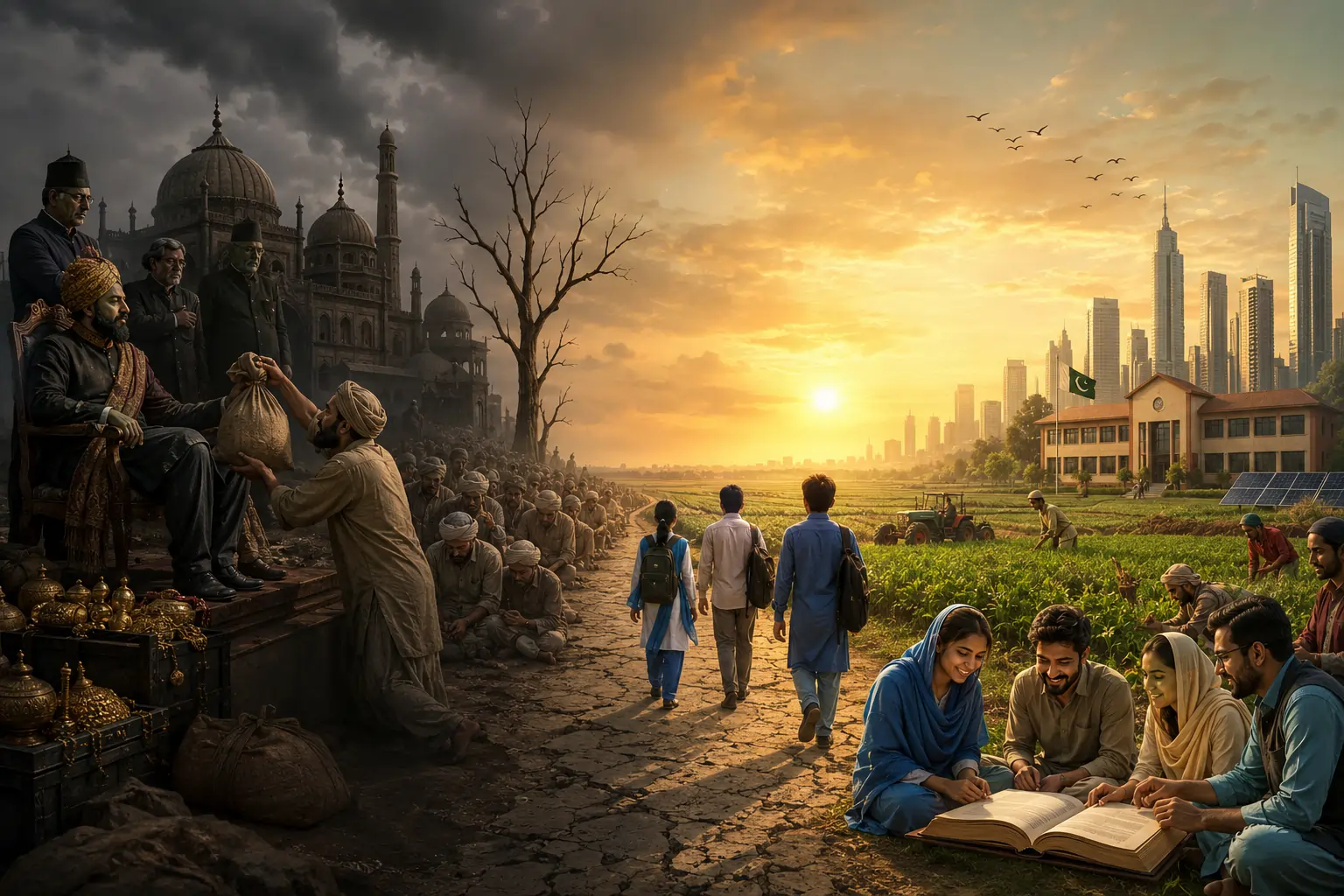
The unholy alliance between the landlords, the exploitative nobles and officials – both civil and military (landlords or ‘jagirdars’ were also ranking officials and providers of soldiers and horses for the Emperor) – continued as exploitative elite or ‘ashhrafiyya’. This elite to this day keeps its stranglehold on the state and society in Pakistan and India and manipulates power irrespective of the political system. Ashhrafiyya thrived under the British rule for being part of it and still takes great pride in the colonial titles of ‘Khan Bahadur’ and ‘Sir’ etc. Survival at any cost; politico-economic dominance; and putting personal interest before the national interest have remained their core values, rather than patriotism, principles and morality. The elite capture of the state in Pakistan is now a foregone conclusion.
‘Ashhrafiyya’, our baggage from history is one of the biggest impediments in the development of Pakistani state and society. Today ‘Ashhrafiyya’ monopolizes political power through one family political parties with non-existent or rigged inter-party elections. Achakzais, Bhuttos, Chaudhris, Pirs, Sardars, Sharifs, Walis, Zardaris etc and the cabal of other religious leaders, are a sad continuation of this legacy. Religious Right under the chosen few has bolstered its appeal by cleverly mixing religion with politics, menacingly banishing detractors as heretics. Clergy also stands as a bulwark against the forces of modernity; entrenched in its newfound power, privilege and insatiable ambition.
Ashhrafiyya returns to political power, despite lack of delivery when in power, partly because of the feudalism at economic and ‘Biradari’ – or clanship at sociological levels. Biradari is the smaller and narrower cohesive segment of the wider ethnicity especially in the largest federating unit, Punjab. Tribes etc substitute Biradari in other provinces. Society in Punjab, where political decisions are made especially the hinterland, Sindh and Balochistan largely remain hostage to the twin influences of feudalism and Biradari. In Balochistan, sardars’ or tribal chieftains retain the levers of power. Only Khyber Pakhtunkhwa (KPK) displays streaks of political egalitarianism and independence. Consequent to the socio-religious cleavages, there are many Pakistans and many Islams, living side by side in a time and space differential.
Voting patterns sadly conform to Biradari politics. Elections are costly business and require robust financial means. When millions, and at times billions are spent on getting elected or buying senate seats, the contender is not merely looking at a flag on his/ her car or a title. A handsome return on investment is sought in all possible ways, to ensure re-election the next time around, and remain part of the patronage system. In this war of means, the fittest survive irrespective of talent, aptitude, education, intellect and/or strength of personality. And yes, in this entire enterprise, ascendance and dominance of the ‘khandaan – family’ – the kith and kin – within the wider Biradari remains operative. This proclivity of taking responsibility for posterity (generational responsibility) is reinforced by Hindu influences from the past morphing into an endemic sense of insecurity, as if there is no God tomorrow. What is more disconcerting is the acceptance and continuation of such a political order, that bestows political legitimacy and privilege on Bilawals, Maryams, Hamzas, Maulanas and many others for no apparent reason; other than pedigree and lineage.
Biradari-based polarization is reinforced by limited opportunities for and access to quality education. This results in ignorance and seclusion of the miserable masses – including womenfolk – from the political order and developmental process, causing inequality and a widening urban-rural divide. In this vast sea of struggling humanity, very few are lucky to make a breakthrough. And those who do; bolster their own Biradari in order to earn and retain their place in the Ashhrafiyya.
Bureaucracy – civil and military- provides opportunity to the talented and lucky non-Ashhrafiyya youth for upward mobility. However, this remains limited in scope and effects, as the civil and military cadre is limited in numbers, and here too a sizeable chunk goes to the wards of Ashhrafiyya. Later the Military pursues its own interests in the wider political framework, as it perceives. And the civilian bureaucracy finds it expedient to use political crutches and enrichment through corruption. Thus, the politicized backbone of the state machinery performs much below its true potential.
When this privileged elite comes to interact with the other powerful players (foreign leaders and politicians), they feel handicapped for lack of competence and ability, for which they make up through a vassal and subservience attitude. They bend to ridiculous lows to accommodate the ‘superior (read white) foreigners’ demands, covering up their innate inferiority complex; compromising on vital issues of national interest. This complex is more pronounced when dealing with the West/ USA, where Pakistani Ashhrafiyya not only becomes ‘his master’s voice’; it also scares-off one odd leader of substance and courage, to the consequences of not doing becoming subservient.
So, to untangle this Gordian knot; if there is one area that should be focused, it is massive investment in ‘quality education’ with a performance-based remuneration for teachers, and a liberal hire and fire policy. Land reforms is another gutsy step in the right direction that should be taken sooner. Speedy economic development, giving priority to the less developed areas, would ensure economic integration. Together these three measures have the potential to reform and/ or eliminate Ashhrafiyya, Biradari and the political ambition of the pulpit. The alternative is a demographic tsunami of swelling have-nots, which would rip the system apart, leaving no Ashhrafiyya in its aftermath.
The views and opinions expressed in this article are solely those of the author and do not necessarily reflect the editorial position of South Asia Times.
Maj Gen Inam Ul Haque
Maj Gen Inam Ul Haque (Retd) writes on Global Affairs and Political Sociology. He can be reached at [email protected] and his twitter handle @20_Inam.