The New Delhi summit has placed climate resilience, adaptation and sustainable development at the heart of BRICS cooperation. The real challenge now is turning commitments into action.
The climate crisis is no longer a distant environmental threat. It is an immediate global emergency that is reshaping economies, threatening livelihoods, damaging ecosystems and increasing the vulnerability of millions of people. For developing countries, particularly those in the Global South, climate change is increasingly a question not only of development but of survival.
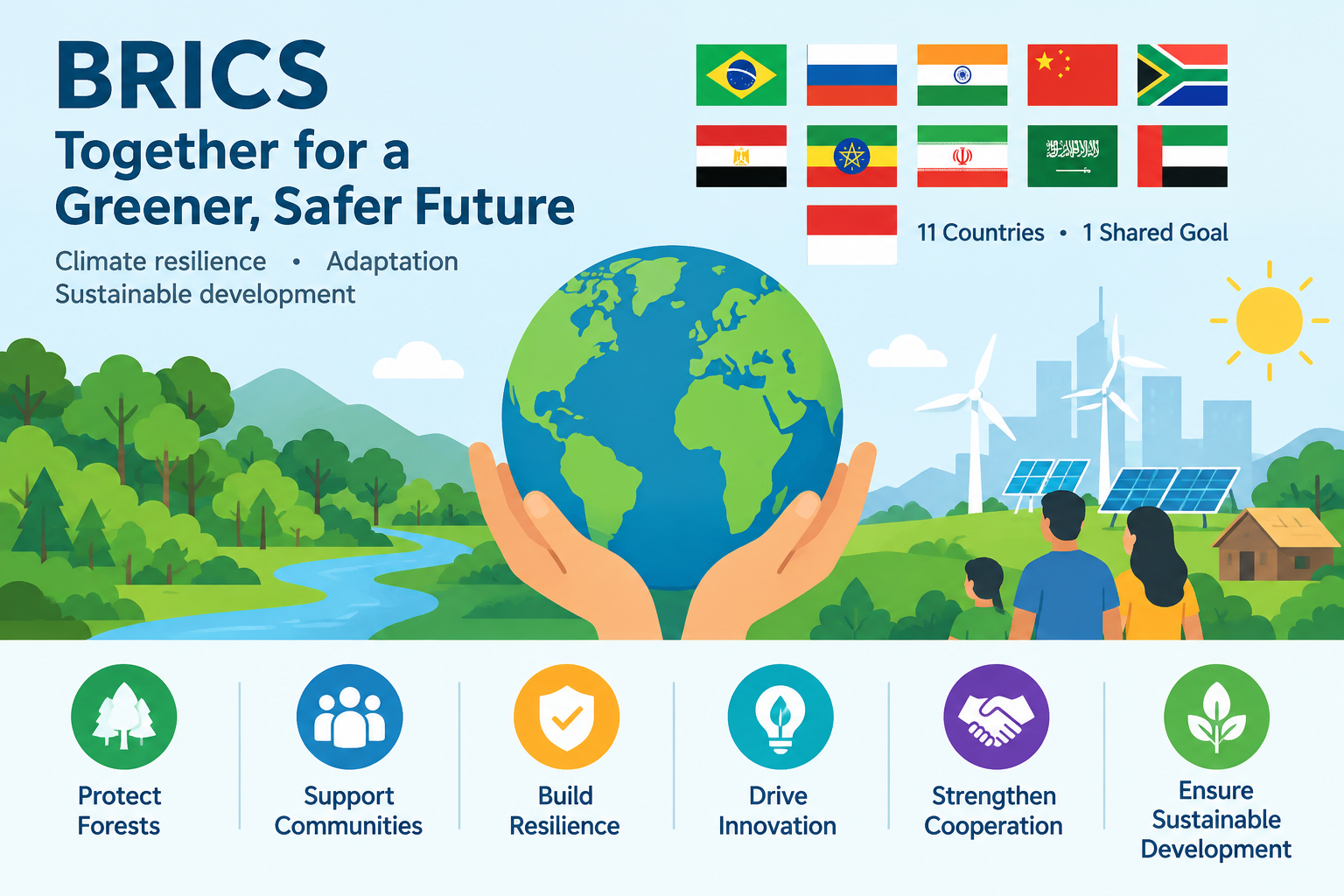
Against this backdrop, the 18th BRICS Summit in New Delhi carries significance well beyond its political and economic agenda. Meeting on September 12 – 13, 2026, under the theme “Building for Resilience, Innovation, Cooperation and Sustainability,” leaders of the expanded 11-member BRICS grouping reaffirmed the importance of cooperation in confronting common global challenges.
The declaration places particular emphasis on sustainable development, climate resilience, adaptation, forests, climate finance, disaster-risk reduction and technological cooperation. The message is encouraging. But an important question remains: Can BRICS transform its climate commitments from diplomatic declarations into measurable action?
A changing BRICS and a changing climate
Since Brazil, Russia, India and China established the BRIC grouping in 2006, BRICS has evolved into a much broader platform. South Africa joined in 2011, while Egypt, Ethiopia, Iran, Saudi Arabia and the United Arab Emirates joined in 2024, followed by Indonesia in 2025.
The expanded group now represents a substantial part of the emerging and developing world. This evolution gives BRICS a potentially influential role in the global climate conversation.
Its members include major economies with significant industrial and technological capacity, as well as countries and communities highly exposed to climate-related risks. This creates an opportunity to build stronger South-South cooperation while also pressing for greater international solidarity on climate finance, technology transfer and adaptation.
The declaration recognises that climate change is a shared global challenge and reaffirms BRICS’ commitment to multilateralism, the UN Framework Convention on Climate Change (UNFCCC) and the Paris Agreement. It specifically refers to mitigation, adaptation, loss and damage and the means of implementation required by developing countries. Such commitments matter. But the climate emergency demands more than political consensus. It requires implementation.
Forests are part of the climate solution
One of the most important aspects of the New Delhi declaration is its recognition of the critical role of forests. Forests are much more than sources of timber and economic resources. They conserve biodiversity, protect water basins and soils, regulate hydrological cycles and provide livelihoods. They also act as vital carbon sinks and help combat desertification, land degradation and drought.
This is particularly relevant to the Global South, where tropical forests and other ecosystems provide essential environmental protection and support millions of livelihoods.
The declaration supports sustainable forest management and restoration and recognises the importance of indigenous peoples and local communities in sustainable resource management. It also welcomes initiatives focused on tropical forest conservation and mangrove cooperation.
The key question for people across BRICS countries as well as the globe is when these commitments will finally be translated into practical programmes and tangible results.
Forest conservation cannot succeed if local communities are excluded. People who depend on forests, wetlands and coastal ecosystems must be recognised as partners in conservation. Traditional knowledge should complement scientific research, while financial incentives should make conservation economically viable. The protection of forests and mangroves is not simply an environmental responsibility. It is an investment in climate resilience.
Adaptation must put people at the centre
For many vulnerable communities, climate change is not measured in degrees Celsius. It is experienced through floods, cyclones, droughts, heatwaves, crop failures, damaged homes, disrupted livelihoods and displacement. This makes the BRICS emphasis on people-centric and community-based adaptation particularly important.
The declaration recognises the value of traditional knowledge, indigenous and local practices, community experience and local innovation in strengthening adaptive capacity. It also encourages the integration of traditional knowledge with scientific knowledge and technological innovation. This is an approach that deserves wider international attention.
Climate policies designed far from vulnerable communities may fail to reflect local realities. Farmers understand changing agricultural conditions. Coastal communities understand tidal patterns and storm risks. Indigenous communities possess generations of environmental knowledge.
Modern science and technology are indispensable, but they should work with – not replace – community knowledge. Climate adaptation should therefore be participatory. Local communities should have a voice in determining what resilience means for their own lives.
Climate finance remains the missing link
No climate strategy can succeed without adequate financing. The BRICS declaration acknowledges that emerging markets and developing countries face disproportionate climate risks and substantial funding gaps, particularly for adaptation. It also recognises that high debt burdens restrict climate investment in many developing countries. This is one of the most important realities confronting the Global South.
Developing countries are expected to invest simultaneously in poverty reduction, infrastructure, health, education, employment and climate resilience. Yet climate-related disasters can repeatedly destroy the very infrastructure and economic gains they have spent years building.
The declaration therefore calls for developed countries to provide additional, adequate, predictable and accessible financial resources, capacity building and technology development and transfer for adaptation.
The principle is clear. The difficult part is implementation. Climate finance must reach vulnerable countries and communities in forms that are accessible, predictable and appropriate to their circumstances. Excessive bureaucracy and complicated funding procedures should not prevent the people most exposed to climate risks from receiving support.
Innovation must lead to practical solutions
BRICS can also make a meaningful contribution through research, technology and financial innovation. The declaration highlights the BRICS Climate Research Platform and the BRICS Laboratory for Trade, Climate Change and Sustainable Development as mechanisms for promoting climate action and resilience. It also supports cooperation on carbon markets and welcomes the BRICS Carbon Markets Partnership. These initiatives have considerable potential if they are connected to practical needs.
Climate research should ultimately help communities prepare for changing risks. Technology should help farmers adapt to changing conditions, cities strengthen infrastructure and vulnerable populations receive timely warnings. Climate innovation should therefore be measured by its real-world impact rather than simply by the number of programmes launched. The goal should be simple: turn knowledge into resilience.
Early warning and resilient cities
Climate change is also intensifying the complexity of disaster risks, particularly in the Global South. The BRICS declaration recognises the need to strengthen disaster-risk reduction systems, protect infrastructure and livelihoods, improve preparedness and promote community-based approaches. It also welcomes guidelines for disaster-management early-warning data integration and principles for climate-resilient urban infrastructure. This is increasingly important as cities expand and populations become more concentrated in vulnerable areas.
An early warning is valuable only if it reaches people in time and if they have the means to respond. Similarly, resilient infrastructure must be designed not only to withstand climate hazards but also to protect the poorest and most vulnerable sections of society. Climate resilience therefore cannot be separated from social resilience.
From promises to performance
The New Delhi declaration demonstrates that BRICS increasingly understands the interconnected nature of climate change, sustainable development, finance, forests, technology and disaster preparedness.
It recognises ecosystems as carbon stocks and sinks, supports community-based adaptation, calls for climate finance and technology transfer, promotes climate research and reinforces commitment to the Paris Agreement. But the world has heard many climate commitments before. The real test will be what happens after the summit.
Can BRICS members strengthen climate-resilient infrastructure? Can they expand cooperation on adaptation? Can they mobilise meaningful resources for vulnerable communities? Can they protect forests and mangroves while supporting the livelihoods of the people who depend on them? Can climate research and technology be made more accessible? And can the group help ensure that developing countries do not have to choose between development and climate resilience?
These are the questions that will determine the significance of New Delhi. The climate crisis does not wait for another summit. Every extreme weather event brings new economic and human costs. Every degraded forest reduces nature’s capacity to protect us. Every community left without adequate adaptation finance becomes more vulnerable to the next disaster.
BRICS now has an opportunity to demonstrate that emerging economies can become not only important actors in the global economy but also leaders in building a more climate-resilient world.
The New Delhi declaration has provided a framework. The next step must be implementation.
For the millions of people living on the front lines of climate change, the world does not need another promise without action. It needs cooperation that reaches communities, finance that reaches vulnerable countries, technology that reaches those who need it, and policies that protect both people and nature.
The climate crisis is a shared challenge. The response must therefore be a shared responsibility. The time has come for BRICS to turn its climate commitments into climate action – and to show that resilience is not merely a summit slogan, but a measurable reality for the people and planet it seeks to protect.

Nicholas Biswas
Nicholas Biswas is a Bangladeshi creative writer, columnist, translator, and development professional. His articles on climate change, social justice, public health, public policy, and governance have been published in national and international media. A recipient of the United Nations Population Fund (UNFPA) Media Award, he combines over two decades of development experience with a passion for thoughtful and impactful writing. He has also translated several books and articles into Bangla. He has completed his master degree in International Relations from the University of Dhaka.