Executive Summary
The Makkah Joint Defense Agreement, signed on 7 August 2026 by Pakistan, Saudi Arabia and Türkiye, commits the three states to treat an armed attack on any one of them as an attack on all. It builds on the 2025 Pakistan–Saudi Strategic Mutual Defense Agreement and decades of military cooperation. This backgrounder explains its origins, its provisions, Pakistan’s position, and the first test it faced during the Houthi escalation of September 2026.
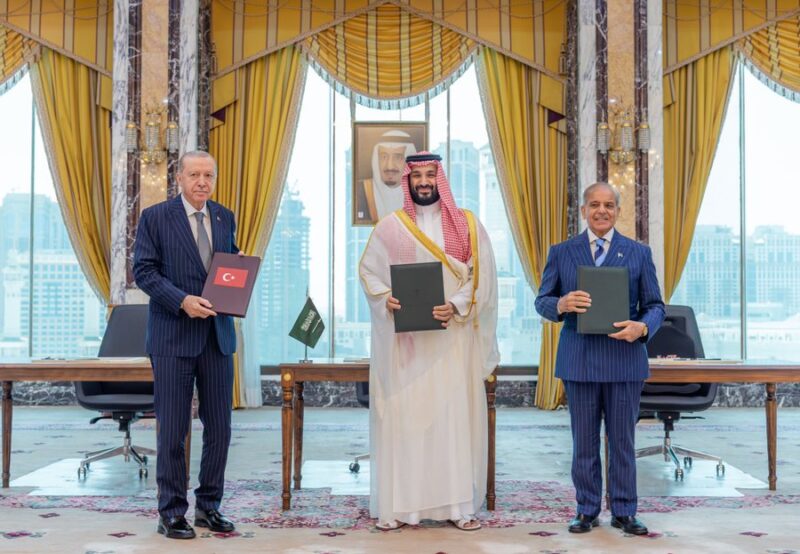
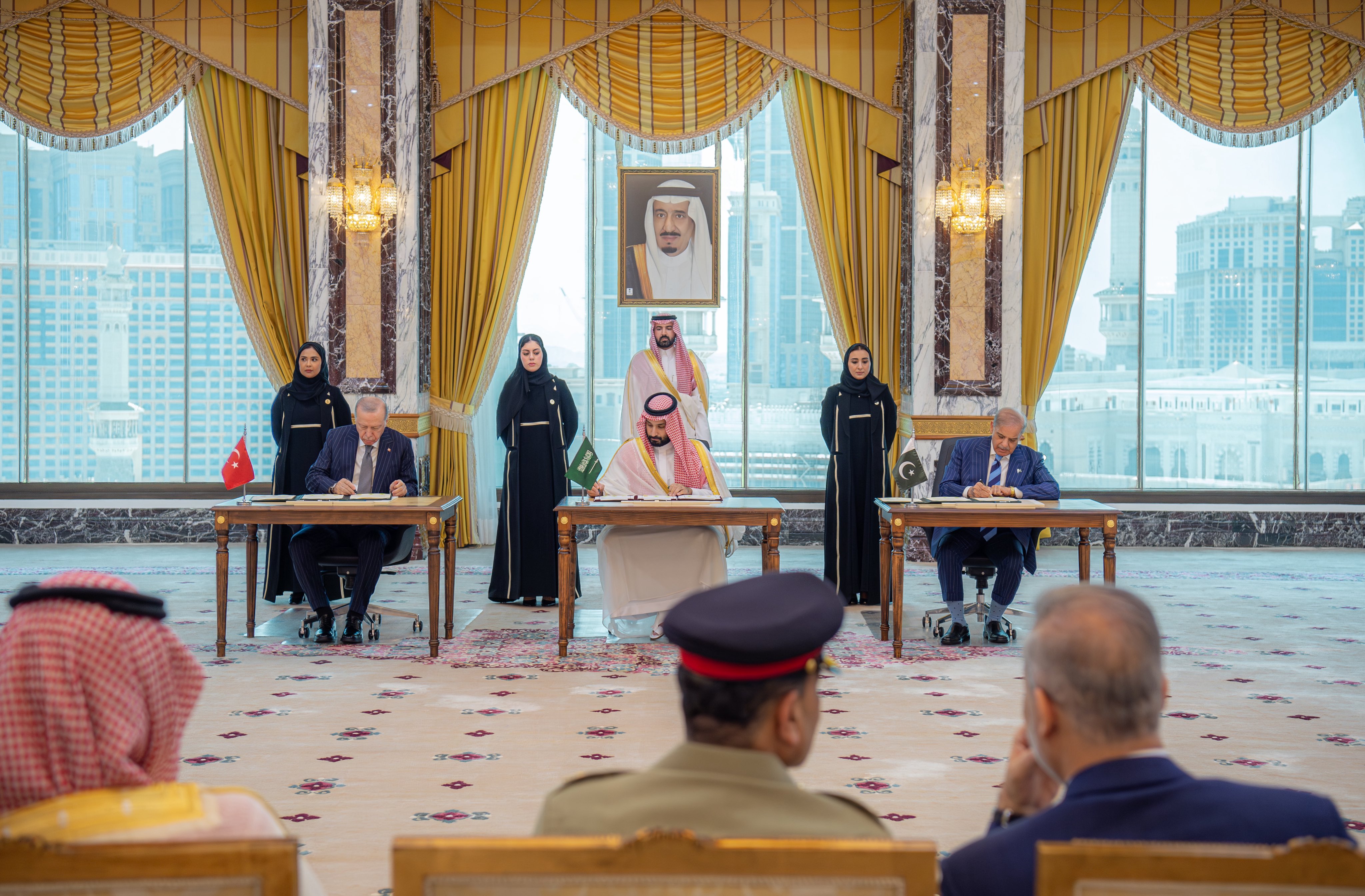
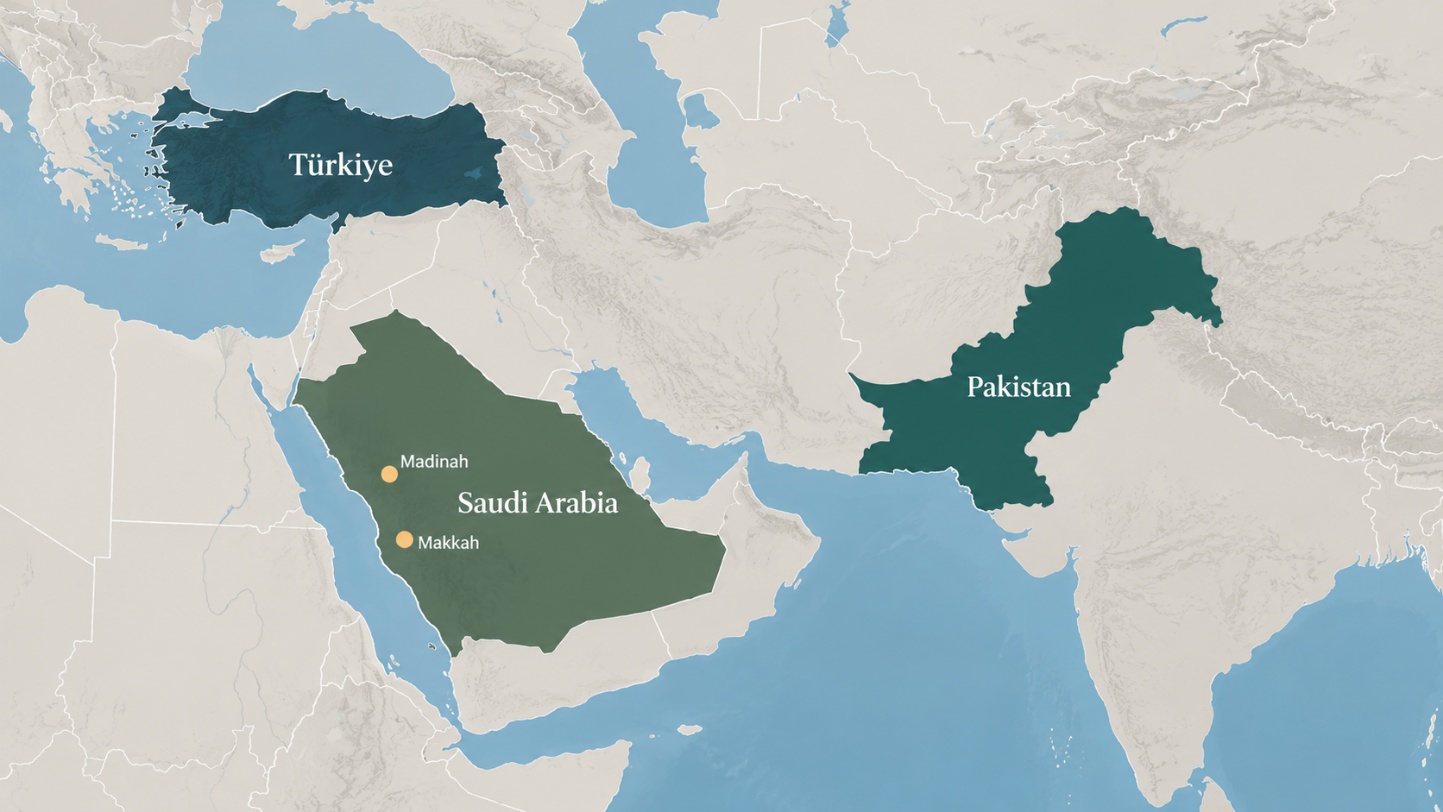
The Makkah Joint Defense Agreement brings together the Muslim world’s only nuclear-armed state, the custodian of Islam’s two holiest cities, and a member of NATO, in a single collective-defense pact. It was signed in Makkah itself, at the Makkah Al-Mukarramah Summit for Joint Defense, by Prime Minister Shehbaz Sharif, Crown Prince and Prime Minister Mohammed bin Salman and President Recep Tayyip Erdoğan. The signing came as the region was being reshaped by the US–Iran war and renewed Houthi attacks on Saudi Arabia.
For Pakistan, the agreement formalizes a commitment to the Kingdom’s security that predates most of the region’s current governments. It also places Islamabad at the center of a new security arrangement at a moment of acute regional danger.
This backgrounder explains:
- Where the agreement came from;
- What it provides;
- How Pakistan understands its obligations;
- How the pact performed in its first real test, which SAT examined in SAT Brief 01: The Recurring Threat to Makkah.
Origins: Decades of Pakistan–Saudi Defense Cooperation
The security relationship between Pakistan and Saudi Arabia is more than half a century older than the Makkah agreement.
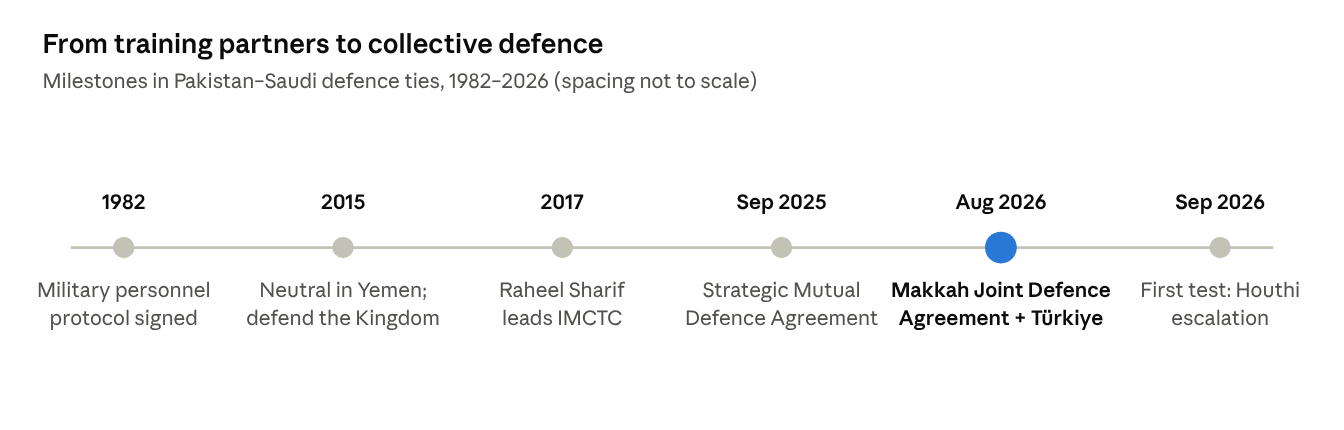
Training and deployment. Pakistani officers have helped train Saudi forces since the 1960s. A 1982 protocol formalized the deputation of Pakistani military personnel to the Kingdom for training and advisory roles, and through the 1980s Pakistani troops were stationed in Saudi Arabia in significant numbers.
Economic support. The Kingdom, in turn, has repeatedly supported Pakistan’s economy through central bank deposits and deferred-payment oil facilities.
The relationship has never meant automatic military alignment. In April 2015, Pakistan’s Parliament unanimously resolved that Pakistan should stay neutral in the Yemen conflict, while pledging to stand with Saudi Arabia if its territorial integrity were threatened. That distinction, between defending the Kingdom and joining offensive operations elsewhere, runs straight through to Pakistan’s position on the Makkah agreement today. In 2017, former army chief General (retd) Raheel Sharif became commander of the Riyadh-based Islamic Military Counter Terrorism Coalition.
The Strategic Mutual Defense Agreement (2025)
On 17 September 2025, Prime Minister Shehbaz Sharif and Crown Prince Mohammed bin Salman signed the Strategic Mutual Defense Agreement (SMDA) in Riyadh. Its core pledge was that aggression against either country would be considered aggression against both. The agreement came days after Israel’s strike on Hamas figures in Doha, an event that unsettled Gulf capitals about the reliability of existing security guarantees.
The SMDA turned a long-standing practical relationship into a formal treaty commitment. Pakistan has since stressed repeatedly that it will honor the agreement if Saudi Arabia’s security is challenged. When questions arose over whether the pact extended to Pakistan’s nuclear capability, Islamabad clarified that nuclear weapons are not on the agreement’s agenda.
From Riyadh to Makkah: Türkiye Joins (2026)
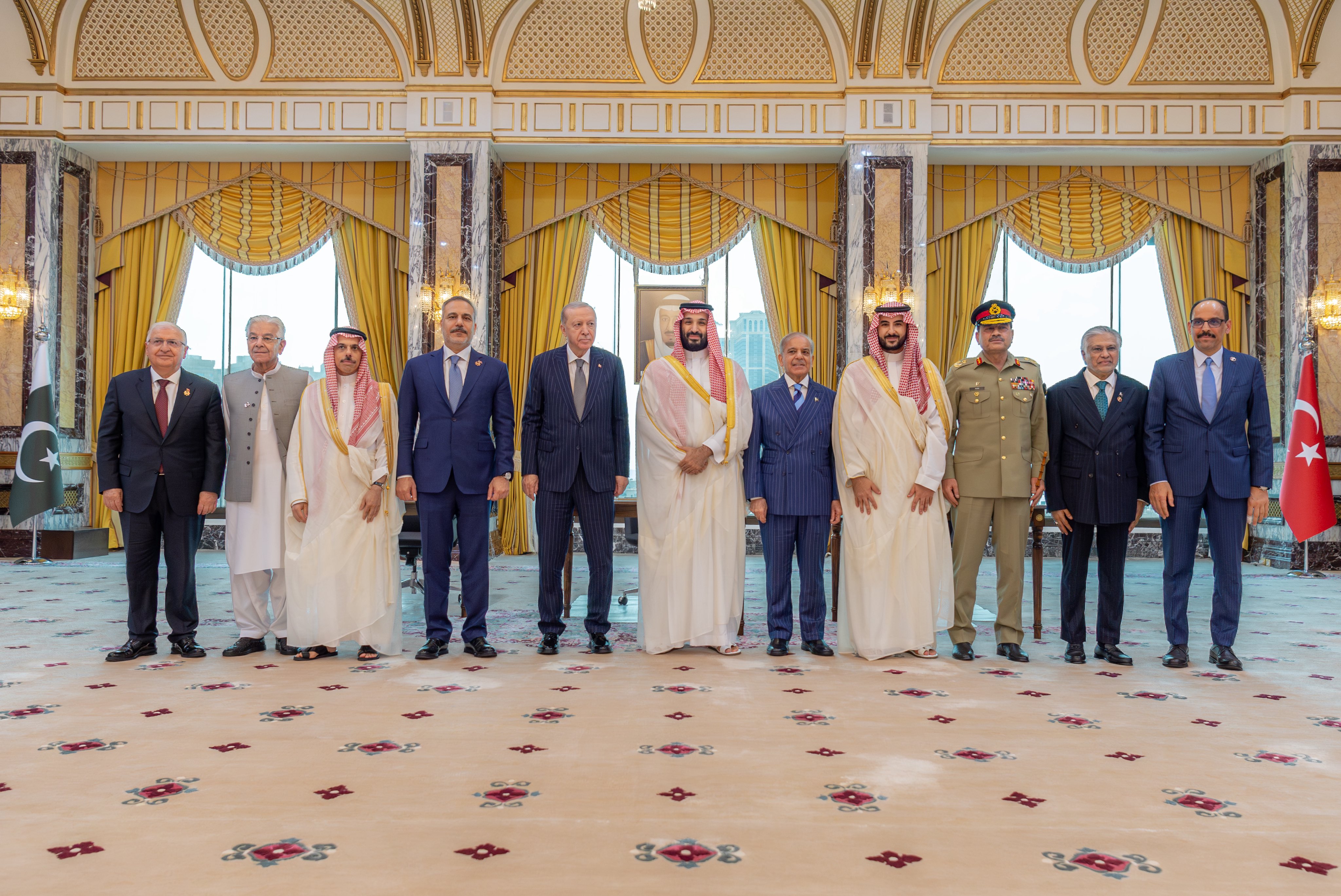
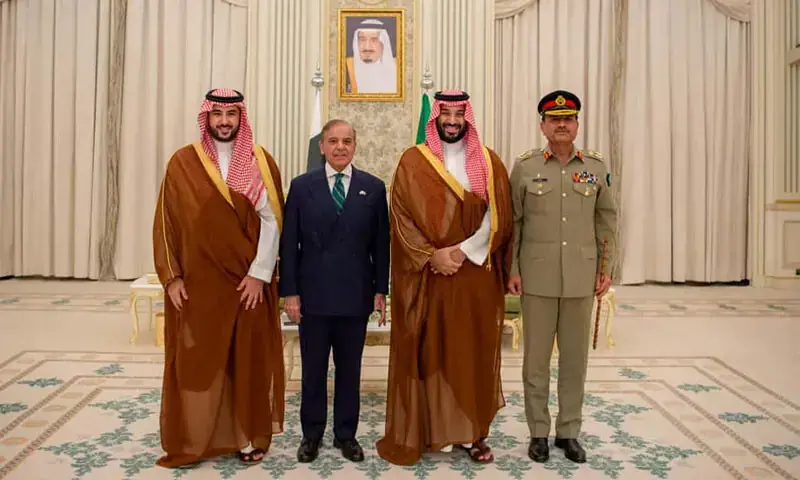
On 7 August 2026, Saudi Crown Prince Mohammed bin Salman received President Erdoğan and Prime Minister Shehbaz Sharif at Al-Safa Palace in Makkah for the Makkah Al-Mukarramah Summit for Joint Defense, held at the invitation of King Salman. There, the three leaders signed the Makkah Joint Defense Agreement. Field Marshal Asim Munir accompanied the Prime Minister. Reuters reported that negotiations had run for nearly a year, which places their start shortly after the bilateral SMDA was signed.
The joint statement issued by Pakistan’s Foreign Office and the Saudi Press Agency said the agreement reflects the three states’ shared commitment to strengthening their collective security and to promoting peace, security and stability “in the region and beyond.” Türkiye’s spokesperson described the pact as purely defensive and not directed against any particular actor.
The choice of venue was deliberate. By signing in Makkah, the three governments tied their new security arrangement to the protection of Islam’s holiest city.
Key Provisions of the Agreement
The full text has not been published, which is common for defense treaties. From the joint statement and official briefings, the agreement rests on five publicly stated elements:
- Collective defense: An armed attack on any one signatory is treated as an attack on all three.
- Collective deterrence: The pact is designed to deter aggression against any member, rather than to respond only after an attack.
- Comprehensive defense cooperation: It provides for enhancing all aspects of defense cooperation among the three states, from training and exercises to the defense industry.
- Foundation: The joint statement grounds the agreement in the three states’ longstanding historical ties and their bonds of brotherhood and Islamic solidarity.
- Purpose beyond the three: It commits the signatories to promoting peace, security and stability in the region and beyond.
All three governments have described the agreement as defensive. As Pakistan’s Defense Minister Khawaja Asif put it, it does not authorize any of the three states to launch attacks on another country on their own initiative.
What Each Signatory Brings
- Pakistan: The only nuclear-armed Muslim-majority state, and one of the largest and most combat-experienced militaries in the world. Pakistani forces, including troops, aircraft and air-defense capabilities, are already deployed in the Kingdom.
- Saudi Arabia: Financial depth, basing and modern, largely US-equipped air and air-defense forces. As Custodian of the Two Holy Mosques, it also gives the pact its religious center of gravity.
- Türkiye: The second-largest standing army in NATO and one of the region’s most capable defense industries, including combat drones, naval platforms and air-defense systems.
Pakistan’s Position
Pakistan’s reading of the agreement is clear and consistent. It rests on three principles that its civilian and military leadership have set out publicly.
- The commitment is binding. On 8 September 2026, after Houthi strikes injured 73 civilians in the Kingdom, Defense Minister Khawaja Asif said there should be “no ambiguity”: an unprovoked attack on any member, or a spillover of the Yemen conflict into Saudi Arabia, would activate the agreement’s collective-defense provisions. Later in the month, he told The Express Tribune that responding to Houthi attacks was a shared responsibility of all three signatories.
- The commitment is unconditional and extends to the holy cities. DG ISPR Lt Gen Ahmed Sharif Chaudhry said Pakistan stands with the Kingdom “both diplomatically and physically” and will go to any extent to defend it. He added that Pakistan’s commitment covers the protection of Makkah and Madinah.
- The agreement is defensive. It strengthens collective deterrence and regional stability. It is not an alliance against any state or sect, and it does not authorize offensive action on the signatories’ own initiative. According to reports, the three governments agreed that any response would be conducted from Saudi soil, without forces entering Yemeni territory.
Pakistan pairs this firmness with active diplomacy. At an emergency UN Security Council meeting on Yemen, Ambassador Asim Iftikhar Ahmad affirmed Saudi Arabia’s right to defend itself and Pakistan’s complete solidarity with the Kingdom. Islamabad has also conveyed to Tehran that non-state actors should not be allowed to carry out operations against any country, while continuing its efforts to mediate between the United States and Iran.
For Pakistan, defending the Kingdom and working for de-escalation are two halves of the same policy.
The First Test: September 2026
The agreement was barely a month old when it faced its first test. The Houthi movement had reopened its front against Saudi Arabia in July, and in September it escalated sharply:
- 8 September: Ballistic missiles and drones struck Abha, Khamis Mushait, Jazan and Najran, injuring 73 civilians.
- 10–11 September: Houthi forces captured the Red Sea port of Mokha and pushed toward the Bab al-Mandab Strait. Drones launched from Iraq shut down the Kingdom’s East–West oil pipeline.
- 16 September: Saudi air defenses intercepted a Houthi drone headed toward the restricted airspace around Makkah.
- 29 September: A Houthi drone struck the Taibah power distribution station in Madinah, an attack SAT has described as crossing a red line.
Pakistan’s response followed these principles. It offered political solidarity at home and at the UN. Its forces and air-defense presence in the Kingdom continued. Its military leadership publicly reaffirmed the unconditional nature of the commitment. And it pressed Tehran to restrain the Houthis: Field Marshal Asim Munir reportedly urged Iranian leaders, more than once, to halt the attacks.
Washington, by contrast, declined Saudi requests for direct US strikes and offered intelligence support instead.
SAT examines this crisis in detail, including a day-by-day chronology, in SAT Brief 01: The Recurring Threat to Makkah.
Questions and Criticisms
As with any new alliance, the agreement has drawn scrutiny. Three questions recur.
“The pact delivered no direct military support”
Some commentators, notably in the Indian press, argued that the agreement fell short because Pakistan did not join operations against the Houthis. This misreads the pact. It is a defensive, collective-deterrence arrangement for the protection of the signatories’ own territory, not a commitment to wage war in Yemen. Pakistani forces were already deployed in the Kingdom when the crisis began. The UN Ambassador said that more time is needed to implement the agreement fully, and reports indicated that Riyadh had not requested combat forces from its allies. Defending Saudi soil, not entering Yemen, is precisely what the agreement promises.
“Does it extend Pakistan’s nuclear umbrella?”
Pakistan has stated that nuclear weapons are not on the agreement’s agenda. The pact’s deterrent value lies in the combined conventional strength, presence and political will of three major states.
“Is it a sectarian or anti-Iran bloc?”
All three signatories have said it is not directed against any state, and Pakistan has described it as a regional-stability arrangement rather than a “Muslim alliance.” Islamabad’s record supports this. Together with Qatar, it facilitated the June 2026 Islamabad Memorandum, which briefly halted the US–Israel conflict with Iran, and it keeps channels open to Tehran while standing firmly with Riyadh.
One step would strengthen the agreement further: setting out its operational scope. Spelling out in advance which defensive measures it covers, such as air-defense integration, early warning and information-sharing, would make its deterrent effect harder for any adversary to test. This is among the recommendations of SAT Brief 01.
Why Does It Matter?
The Makkah Joint Defense Agreement matters on four levels.
- For Saudi Arabia: It adds a committed, close-at-hand layer of defense alongside the Kingdom’s own forces and its partnership with Washington. That layer comes from partners whose commitment does not depend on shifting priorities in distant capitals.
- For Pakistan: It formalizes a role the country has played informally for decades, as a guarantor of the Kingdom’s security and of the holy cities in particular. It also deepens a strategic partnership that supports Pakistan’s economy and its standing in the Muslim world.
- For Türkiye: It extends Ankara’s security reach into the Gulf and the Red Sea at a time of regional realignment.
- For the wider region: It is the first collective-defense pact to bind a nuclear-armed state, a NATO member and the custodian of the Two Holy Mosques. The Middle East has seen many collective-defense projects fail, from the Arab League’s 1950 joint defense treaty onward. Whether this one succeeds will depend on how its defensive scope is built out, and on whether it continues to deter, as it was designed to, rather than drift into the region’s wars.
What is already clear is the message the signatories chose to send by meeting in Makkah. The security of the Haramain is no longer a matter for one state alone.
SAT Brief 01: The Recurring Threat to Makkah
From 2017 to the September 2026 Crisis · Full analysis, chronological timeline, maps, and policy options by Sumaiyya Kainat.
This backgrounder has been produced by the SAT Research Desk. For analysis and policy options, read SAT Brief 01: The Recurring Threat to Makkah.