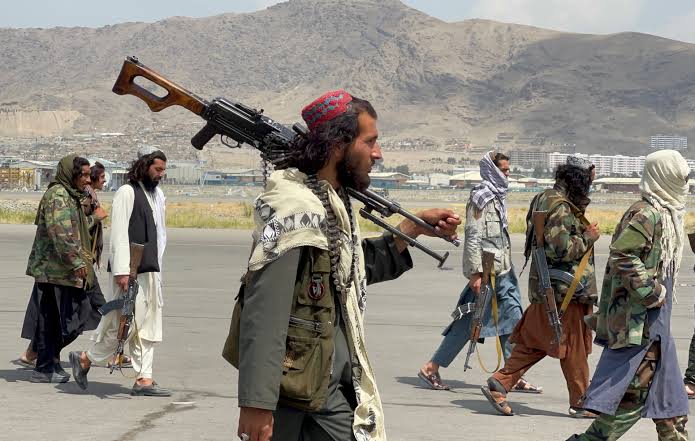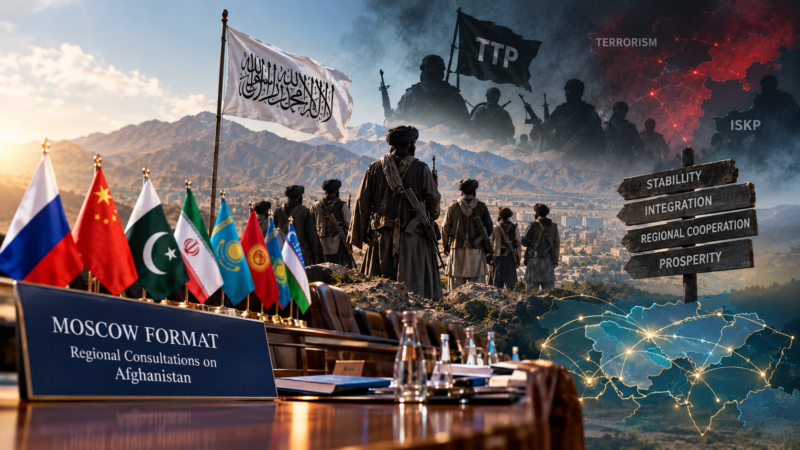
The regional states’ consultations on Afghanistan situation under the Moscow Format held in the Russian capital remained inconclusive primarily because Taliban regime refused to take responsibility of what is happening within and what is emanating from the territory under their control.
Taliban representative at the Moscow conference was insistent on seeking legitimacy from regional powers while remaining adamant and unwilling to acknowledge the security concerns of its neighbors.
The security situation prevailing in Afghanistan was the focus of high-level Moscow Format moot. The question that needs answer at the conclusion of this conference is whether Afghanistan can expect to achieve regional integration, while continuing to provide sanctuaries to the terrorist organizations which pose a threat to its neighbors?
Russia is the leading country on the Moscow Format. The inconsistency in Russia’s approach towards Taliban regime is glaring. Only few months back, Russia security assessment that identified 5000-7000 TTP fighters hiding in Afghanistan, came to the surface.
Yet Russia looked the other way when TTP fighters used Afghan territory to launch terror attacks on Pakistan government and security forces. Russia’s primary concern has always been the rise of ISKP in the northern parts of Afghanistan, which, in its views, poses a threat to Central Asia and Russian territory. Both the Afghan Taliban and ISKP draw recruits from same pool of militants in Afghanistan.
Yet when Taliban regime out of their dubious rivalry with ISKP went after latter’s fighters, Russians quick to shower it with praise. Moscow first removed Taliban from its list of terrorist organizations and then afterwards recognized Taliban as a legitimate government in Kabul.
Pakistan’s hard stance towards the wave of terrorism coming out from Afghan territory is not a kneejerk reaction. In the last five years when Taliban assumed control of Kabul, Pakistan has made repeated attempts to convince Taliban regime to act against terror sanctuaries inside their territory.
There have been ministerial visits, followed by visits of intelligence chiefs and defense-level contacts. Pakistan tried the channels of joint coordination meetings, border flag meetings, protest notes and mediation by friendly countries. Nothing worked with Taliban as they continued to provide sanctuaries to TTP.
The situation doesn’t simply indicate Taliban regime’s failure to control its territory. It is much more than that. Look at the officially compiled figures: So far 260 Afghan nationals have been killed inside Pakistani territory fighting along aside the TTP. The terror coming out of Afghanistan has led to the death of 1,429 Pakistanis martyred and 2,679 injured.
Not surprisingly, Taliban regime is being sustained by the foreign funding and aid from western countries, Russia and China. Billions of dollars pour into Taliban’s coffers without any corresponding process of transparency and accountability. No one is arguing that humanitarian assistance to Afghan people should stop. But financial assistance should not amount to political accommodation of Taliban regime.
Instability of Afghanistan is a regional problem. TTP is not simply a threat to Pakistan. It is a terror organization with international connections. In the past it had operated jointly with ISKP, Al-Qaeda and other regional militant and terror groups, which pose a threat to Russia, China, Iran and Central Asia. Pakistan’s security concerns are not focused on bilateral grievances. They are part of wider regional security challenge.
None of regional powers’ business and commercial plans for the region will be viable in the absence of clear security guarantees from Taliban regime. Diplomatic recognition and engagement have not produced desired results as terrorism continues to play havoc in the region.
Unless Taliban regime displays a true commitment to prevent Afghan territory from being used against its neighboring states, the promise of regional integration will remain a pipedream. The regional powers which are hobnobbing with Taliban should convince it to change course.

Your go-to editorial hub for policy perspectives and informed analysis on pressing regional and global issues.