When a discourse closes itself against its best critics, it does not become wiser — it becomes more dangerous.
In the autumn of 2015, John Mearsheimer — R. Wendell Harrison Distinguished Service Professor of Political Science at the University of Chicago — stood before an audience and issued one of the most precise predictions in the post-Cold War history of international relations. “I actually think that what’s going on here is that the West is leading Ukraine down the primrose path, and the end result is that Ukraine is going to get wrecked,” he told them. The speech has since accumulated over twenty-one million views on YouTube. It was not heeded. The policy it warned against was not reversed. Ukraine was wrecked.
What followed Mearsheimer’s warning was not a serious engagement with his structural argument. It was a campaign of reputational demolition. A group of University of Chicago students circulated a letter demanding the school force Mearsheimer to change his views, calling his criticism of U.S. policy “Putinism” and asserting his views were not his own but the product of Russian money. The argument — grounded in offensive realist theory, the most rigorous tradition in mainstream IR scholarship — was never refuted. It was buried under accusation. The pattern was not incidental. It was structural.
This is what makes the present moment in Western strategic discourse uniquely dangerous: the West is not merely making policy errors. It is methodically dismantling the intellectual architecture that would allow it to recognize and correct those errors. It is walking itself, deliberately and progressively, down the primrose path — and foreclosing the debates that might have turned it around.
The Archaeology of Suppressed Warnings
The warnings were not new in 2015. They formed a continuous, distinguished lineage that the Washington consensus chose, serially, to ignore. In 1997, George Kennan — author of the containment doctrine, former ambassador to the USSR — warned that expanding NATO would be “the most fateful error of American policy in the entire post-Cold War era.” It would, he wrote, “inflame the nationalistic, anti-Western and militaristic tendencies in Russian opinion” and “impel Russian foreign policy in directions decidedly not to our liking.” Kennan was not a fringe voice. He was the architect of the strategic framework that had governed American policy for half a century. He was set aside.
What passes as original thinking in official U.S. foreign-policy circles in 2021–2024 amounts, in many respects, to a policy agenda from an earlier generation that culminated in the disasters of Iraq, Libya, and Afghanistan. The lesson learned from those catastrophes was apparently not humility. It was a more sophisticated management of dissent — the construction of what might be called an implicit ‘persona non grata system’, applied not through formal diplomatic expulsion but through the quiet mechanics of institutional pressure, platform denial, and reputational pre-loading.
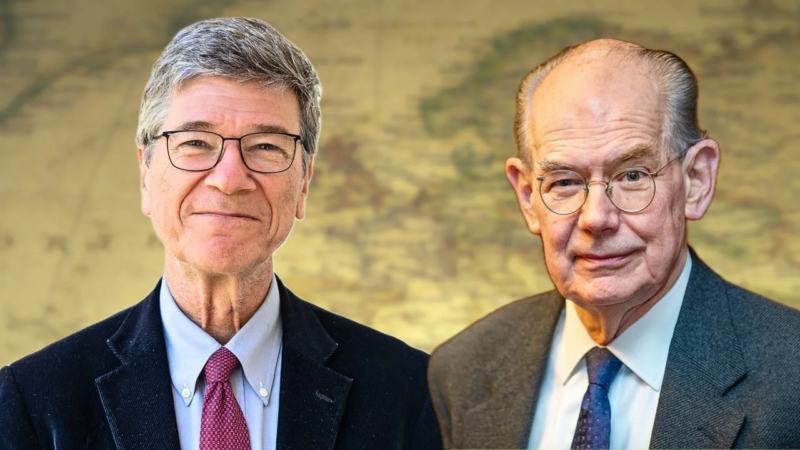
Jeffrey Sachs, University Professor at Columbia University and President of the UN Sustainable Development Solutions Network, has argued consistently and in multiple institutional forums that Western policies — especially NATO expansion and the rejection of negotiated neutrality — helped provoke the conflict and that diplomacy, not continued military escalation, offers the best path forward. In a November 2023 testimony before the UN Security Council, he placed NATO enlargement and the east–west ethnic divide in Ukraine as the two structural causes of the war. In a February 2025 address before the European Parliament, he went further — recounting a direct conversation with National Security Advisor Jake Sullivan in which he urged Sullivan to publicly commit to not expanding NATO into Ukraine, warning him plainly that failure to do so would lead to war. Sullivan dismissed it. The war followed. For these positions — grounded in the same structural logic he has articulated across years of public scholarship — Sachs faced an open letter signed by hundreds of economists, including seven Columbia colleagues, denouncing his statements without engaging the core argument. The argument is not refuted; it is labeled. The label does the work that the counterargument cannot.
The Mechanics of Closure
Glenn Diesen, professor of political science at the University of South-Eastern Norway and a rigorous scholar working within the neorealist tradition, experienced the sharpest edge of this mechanism directly. In 2024, he was informed by an automated YouTube email that their AI had detected “hate speech” in his content and his account had therefore been deleted — with no examples, no evidence, and no warning. Diesen had used his channel to interview leading academics, economists, military officials, and ambassadors — voices the mainstream ignored because their arguments did not fit the prevailing narrative. The purpose of his channel was to host open discussions with important voices that the media largely ignores, as their arguments do not fit the narratives sold to the public.
This is not an isolated incident. It is the logic of what Diesen himself describes as ‘incrementalist censorship’ — the gradual normalization of suppression through incremental precedent-setting, with vague concepts such as “hate speech” and “propaganda” deployed precisely because they cannot be clearly defined, allowing for an ever-expanding range of speech to be criminalized and censorship to be applied selectively. The architecture Diesen documents — from Facebook’s partnership with the Atlantic Council to the coordinated suspension of Parler — is not about protecting truth. It is about concentrating the power that is required to define it.
The result is an epistemically closed system. As Ted Galen Carpenter puts it, in the case of Ukraine, establishment journalists tend to “portray a complex situation as a shallow melodrama, with nearly all blame put on one side.” What is lost in that reduction is not merely nuance — it is the capacity for strategic self-correction. A discourse that cannot hear Kennan, cannot hear Mearsheimer, cannot hear Sachs, and actively expels Diesen, is a discourse that has severed the feedback loops necessary for rational policy.
Why This Is Self-Defeating
By excluding these heavyweights from institutional space — by ensuring their arguments are labeled before they land, their platforms revoked before they can sustain audiences, and their scholarly reputations pre-damaged through association rather than refutation — the West in general and America in particular is progressively and deliberately leading itself down the primrose path, and the end result is that it is going to be severely wrecked. Not by the adversaries it names, but by the compounding weight of the strategic corrections it refused to make while it still could.
When a great power forecloses internal debate, it does not produce better policy. It produces more brittle policy — commitments that cannot be revisited, escalations that cannot be reversed, and strategic cultures that mistake manufactured consensus for analytical clarity. The most dangerous feature of a closed epistemic environment is not its specific errors but its structural inability to recognize them. It continues generating the same errors, with increasing confidence, until external reality administers the correction that internal discourse refused to deliver.
Mearsheimer understood this in 2015. He argued for a policy of “neutralizing Ukraine and building it up economically, getting it out of the competition between Russia on one side and NATO on the other” — describing this as the “best thing that could happen to the Ukrainians.” Instead, as he warned, the West was “encouraging Ukrainians to think they would ultimately become part of the West, that the West would ultimately prevail, that time was on its side.” The predictable structural outcome followed.
The logic generalizes beyond Ukraine. The same epistemic closure that prevented engagement with realist warnings on NATO expansion now operates across every major theater of great power competition — toward China, toward Iran, across the broader architecture of multipolarity. The scholars, economists, and strategists who offer structural critiques of Western posture find themselves not refuted but expelled: platform-denied, institutionally marginalized, reputationally pre-damaged before their arguments can land.
What Foreclosed Debate Produces
There is a specific danger in a preponderant power that mistakes its own narrative management for strategic understanding. It begins to confuse the absence of dissent with the presence of correctness. Intelligence narrows. Warning signs are filtered as enemy messaging. Policy hardens into dogma. The primrose path, as a metaphor, is instructive in its original sense: a road that appears pleasant and easy but leads to destruction. Its danger lies precisely in its appearance of safety. It feels like consensus. It looks like clarity. The very smoothness of the path — maintained by removing those who point at the cliff — is what makes it lethal.
The West is not in danger because it lacks analytical talent. Mearsheimer, Sachs, Diesen, and before them Kennan, represent serious intellectual traditions fully capable of providing the strategic corrections that any major power requires to remain viable. The danger is that it is building the mechanisms to ensure that talent cannot reach the rooms where decisions are made — that the critics are discredited before they can speak, expelled before they can be heard, and dismissed as sympathizers rather than engaged as analysts.
A discourse that immunizes itself against its most rigorous critics does not become safer. It becomes more brittle, more committed to its own errors, and more certain of its own trajectory — straight down the primrose path, and toward the wreckage at its end.

Muhammad Mahad Samija is a scholar at the Department of Political Science, Government College University Lahore.