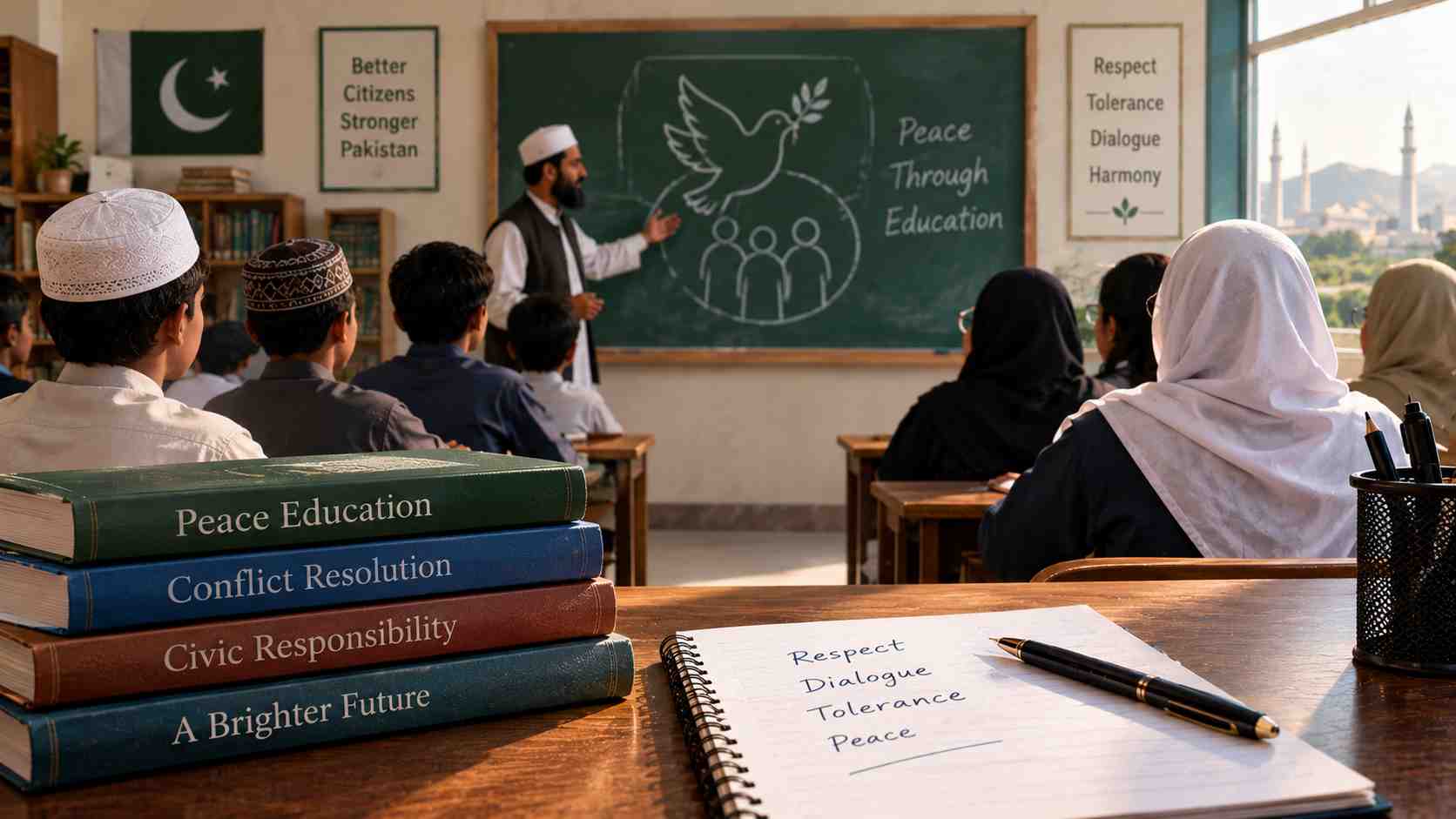
In 2026, Pakistan topped the ranking on the Global Terrorism Index for the first time in the index’s history. Terrorist attacks more than doubled between 2023 and 2024 going from 517 to 1099. According to the Index’s own assessment, Pakistan’s counterterrorism approach is “heavily skewed towards kinetic measures; while non-kinetic counter extremism ‘remains weak, fragmented, or absent.”
Although security operations are important and can dismantle terrorist networks, they cannot win the contest of ideas on which that networks recruit. That context is decided much earlier, in classrooms.
A recent policy report by the Institute of Regional Studies, which I co-authored with Dr. Rizwan Naseer, Dr. Ahmad Waqas and Dr. Bilal Habib Qazi, set out to understand why Pakistan’s efforts to bring peace education into conventional and religious institutions have had very little success. The central finding of the report is that Pakistan does not fail at the policy design stage.
The National Curriculum Framework of 2017, the Single National Curriculum of 2021, the National Action Plan and the 2024-25 madrassa registration reforms all represent genuine effort and intent. Where pakistan fails is further downstream, at three identifiable stages: teacher preparations, monitoring, and community ownership.
Each gap is concrete. There is no peace education or conflict-resolution module anywhere in Pakistan’s Bachelor of Education system, and the April 2025 revision of teacher-education standards was the fourth consecutive Higher Education Commission framework since 2017 to leave it out entirely. There is also baseline survey of student attitudes against which any curriculum can be judged.
Furthermore, while more than 17,000 madrassas have been registered with the state, seminary boards have no role in shaping content. Scored against a five-dimensional framework drawn from UNESCO and UN Counter Terrorism guidance, pakistan scores 8 out of 25. On teacher preparations and monitoring, it scores 1 out of 5 each.
Indonesia, which scores 21, shows what a difference design looks like its religious moderation framework, Moderasi Beragama, was written into the national development plan through a presidential regulation in 2020, and a second regulation in 2023 created a dedicated agency to coordination it across ministries.
Most importantly, Nahdlatul Ulama, the world’s largest Islamic organization with around 95 million members and some 12,000 affiliated pesantren, co-drafted the framework with defined authority over its content, not as a consultee.
A 2026 evaluation across 10 state Islamic universities found an implementation index of 79.6 percent. The model is not without flaws. Some analysts have earned that it can be used t impose a majoritarian reading of moderation, and any Pakistani version must protect minority sects. But its structure works because those who teach religion also helped write it.
Bosnia and Herzegovina, which scores 15, offers the cautionary half of the lesson. After 1995 it built a multi-faith curriculum framework from scratch, with UNESCO’s support. Yet the practice of “two schools under one roof”, in which children of different communities share a building through separate entrances and separate curricula, persists in 57 schools despite court orders in 2014 and 2021. A framework without enforcement and ownership exists on paper, not in classrooms.
The obvious objection is that Pakistan’s seminaries will never accept state involvement in their curriculum. History seems to support it: since 2002, five major seminary reform initiatives have failed to produce a single change in curriculum on peace and coexistence. Madrassahs are financially independent and guard their theological authority closely.
But the registration reforms point to a way forward. Seminary boards have accepted mathematics, English and computer science precisely because those subjects do not challenge their religious authority. A zone of acceptable collaboration already exists. The task is to widen it through co-authorship and incentives, rather than through a security-led approach that seminaries have consistently resisted.
Three steps would begin that work. First, the Ministry of Federal Education, provincial departments and all five seminary wafaqs (boards), through their umbrella body, should form a drafting group in which the boards hold real authority over content, mapping peace and conflict-resolution outcomes onto subjects already taught, such as Islamiyat, Pakistan Studies, Urdu and Social Studies, rather than adding a new one.
Second, the Higher Education Commission should make conflict-resolution training a mandatory condition of Bachelor of Education accreditation from the 2026–27 intake. Third, a baseline survey of student attitudes and digital literacy should be conducted before any rollout, with independent evaluation and public reporting as conditions of continued funding.
None of this is beyond Pakistan’s means and capability. The report estimates that a two-year pilot would cost at most PKR 270 million, about 0.013 percent of the country’s 2024-25 education allocation. The argument that pakistan cannot afford peace education is not credible. What it cannot afford is a fifth failed reform. The principles are simple: ownership before mandate, capacity before scale, and measurement from day one.
Irtija Ahmad
Irtija Ahmad is an Assistant Research Officer at the Institute of Regional Studies, Islamabad. She holds an MSc in International Public Policy and Development from Royal Holloway, University of London (Distinction), and an MPA from Quaid-i-Azam University, Islamabad, where she graduated as Gold Medallist of the Class of 2022. Her work combines security analysis with policy-informed research on governance in Pakistan, examining why institutional commitments often fail to survive a change in government or the news cycle. She has also written on global health for The Borgen Project.