Minority issues are commonly treated as an internal matter of a state. Then why is there a debate about how an issue that originates inside a state becomes relevant to relations between two states when it comes to India and Pakistan? We can call it the reciprocal externalization of the conflict. The concept, “Reciprocal Externalization of the Conflict,” is built upon the behavioural foundations laid out by Andrew Roskos-Ewoldsen. It is stated as a process through which a state transforms domestic minorities’ crime grievances against the rival state. It becomes an interstate contestation by incorporating it into diplomatic, international, and national security narratives. In the context of India and Pakistan, a minority incident unfolds as follows:
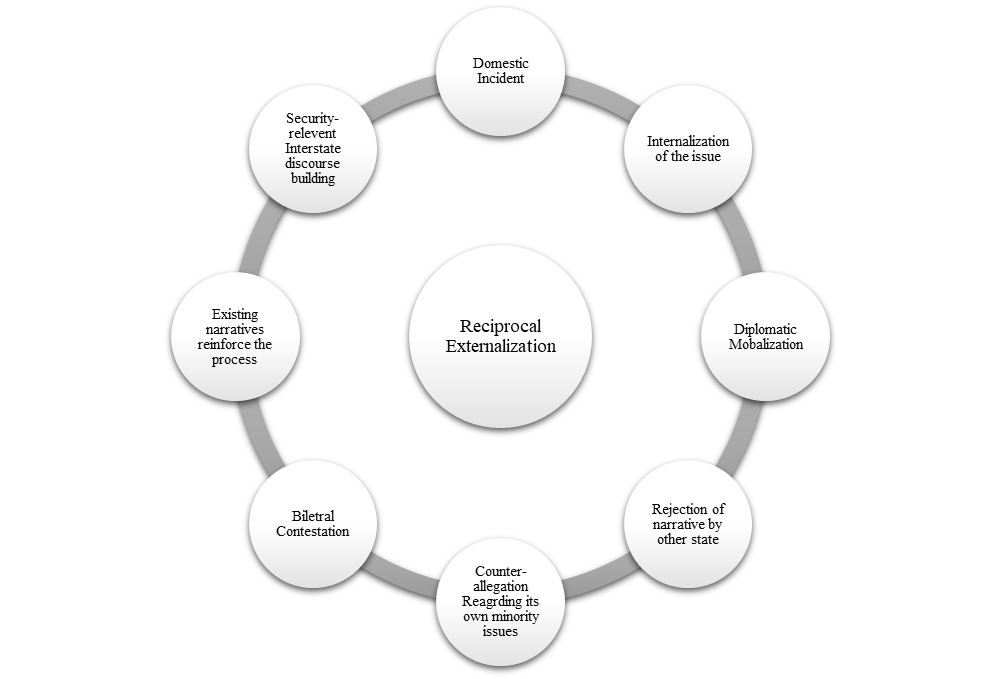
This process repeats until a new incident takes place. Most minority incidents remain domestic. Yet some incidents gain significance when the crime is linked to the rival state, particularly portraying Muslims as linked with Pakistan, Bangladesh, terrorism, or national disloyalty. This raises a question: why should incidents in India’s domestic political space matter to Pakistan? This article does not assume that they do. It asks when state-level uptake can be shown, and when there is only a domestic discourse that mentions Pakistan. However, there are minority crime cases reported inside Pakistan as well, including mob killings, violence, and more. In the Narowal temple case examined below, for instance, India criticised Pakistan for failing to protect a minority site; nobody alleged that India had caused the damage. This points to the bigger picture: Why does Pakistan become an external reference point in some cases of anti-Muslim violence in India, whereas India does not appear to occupy an equivalent role in the immediate narrative around Pakistan’s domestic minority violence, even though Pakistan’s leadership has itself commented on the treatment of Muslims in India?
2025 Minority Crime Incidents in India
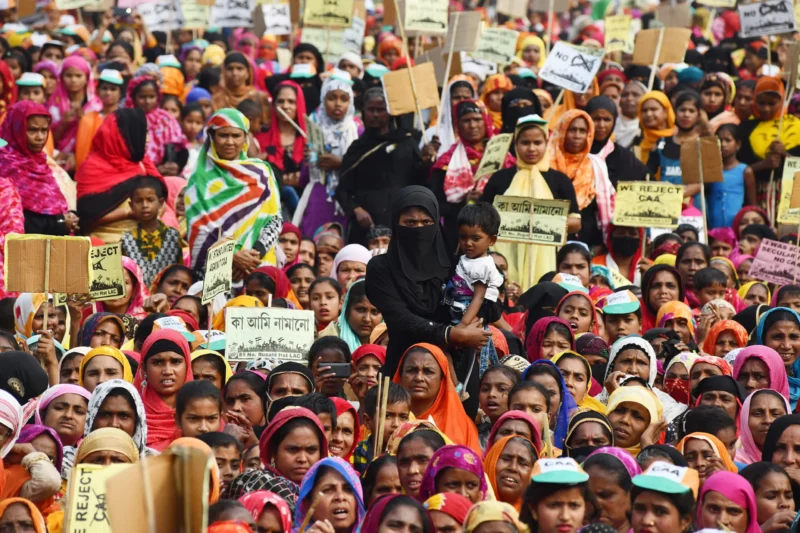
In some of the minority crime incidents that took place in India during 2025, Pakistan was not merely an observer in the surrounding narrative. It appears as an identity marker, security reference, or alleged source of disloyalty. In 2025, the Institute of Regional Studies recorded 56 discrete violence incidents. The distribution of these incidents by affected community is given below:
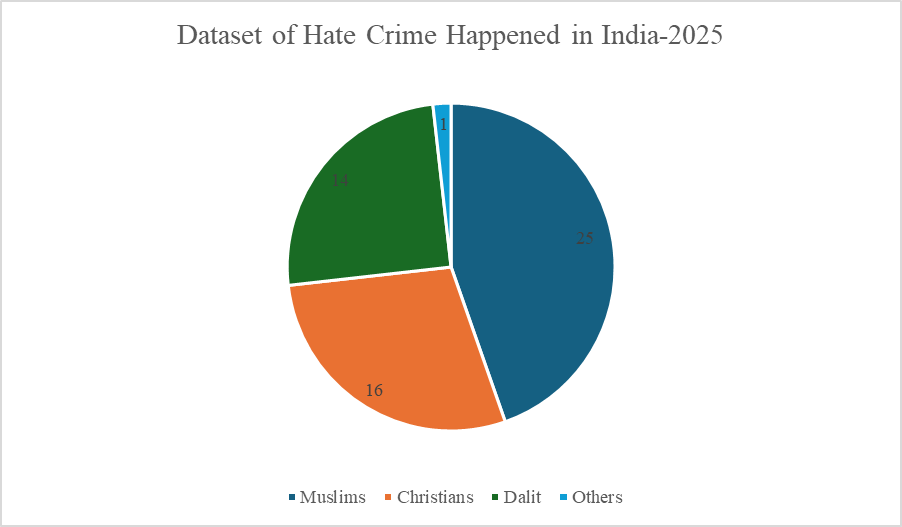
Source: The data is collected from the Hate Tracker Annual Report by the Institute of Regional Studies, Islamabad, which uses data compiled from Indian domestic news and official records.
Of these 56 cases, three are directly linked to security-relevant discourse about Pakistan, and a fourth invokes Bangladesh, as follows. These are illustrative cases, not a representative sample. Three of 56 is about 5 per cent of the dataset, or about 12 per cent of the 25 incidents against Muslims, so the argument concerns the form the narrative takes when it appears, not how often it appears:
| Date | Community | Incident | Location | Allegation | Source |
| 27 Apr 2025 | Muslim | Mohammed Ashraf was beaten to death by a mob following allegations that he had raised pro-Pakistan slogans during a cricket match. The allegation was later disputed by police and civil-society fact-finding. | Mangaluru, Karnataka | Pakistan was invoked as an alleged marker of disloyalty, directly linking a domestic communal killing to an external adversary. | Indian Express |
| 30 Apr 2025 | Muslim | A mob reportedly forced a 15-year-old schoolboy to urinate on a Pakistani flag; police booked three people. | Aligarh, Uttar Pradesh | The Pakistani flag made Pakistan an explicit symbol through which the boy was publicly humiliated in the aftermath of the Pahalgam attack. | NDTV |
| 3 Jul 2025 | Muslim | Muslim vendors in Haryana faced assaults and destruction of their carts amid the communal backlash following the Pahalgam attack. | Haryana | The case illustrates how an India–Pakistan security crisis can spill over into violence against Indian Muslims, effectively transferring an interstate conflict into the domestic sphere. | The Caravan |
| 11 Dec 2025 | Muslim | Three Muslim vendors in Kolkata were allegedly assaulted after being accused of being Bangladeshi infiltrators. | Kolkata, West Bengal | Although Bangladesh rather than Pakistan was invoked, the case demonstrates the broader securitisation of Muslim identity through association with a neighbouring state. | Scroll |
The cases point to the relevance of minority incidents to India-Pakistan relations because of the narrative attached to them. When Indian Muslims are associated with Pakistan, Pakistani symbols, or an India-Pakistan security confrontation, domestic communal violence acquires an interstate dimension. This is consistent with the process of externalisation discussed above, although the cases alone do not show how Pakistan’s state responded.
2025-26 Minority Crime Incidents in Pakistan
During this period, Pakistan has had numerous minority-rights incidents. The notable point is that none of them has been verified, in the sources consulted, as comparable to a case in which India was alleged to have caused or orchestrated violence against a Pakistani minority. The following are the incidents that are recorded as Minority crimes;
| Pakistani case/incident | Minority affected | India connection? | Type of connection | Source |
| Karachi Ahmadi lynching, Apr 2025 | Ahmadi | No | Domestic religious violence | UNHR |
| Sargodha Ahmadi killing, May 2025 | Ahmadi | No | Domestic targeted killing | USCIRF |
| Faisalabad Ahmadi attacks, Aug 2025 | Ahmadi | No | Domestic mob violence | UNHR |
| Sialkot Ahmadi attacks, Sep 2025 | Ahmadi | No | Domestic mob violence | UNHR |
| Forced conversion cases, 2025 | Hindu/Christian | No | Domestic minority-rights issue | HRCP, USCIRF |
| Narowal Hindu temple, 2026 | Hindu | Yes | India publicly intervened/diplomatically condemned | TOI, MOFA |
| Khuzdar school-bus blast, Balochistan, 21 May 2025 | No specific religious minority; victims were Pakistani civilians | Yes | Pakistan alleged that India supported/orchestrated the attack through militant proxies. India denied | PID, The Hindu |
| Indian allegations over Pakistani treatment of minorities, Mar/Nov 2025 | Hindu/ Sikh/Christian/ Ahmadi | Yes | India used minority-rights allegations against Pakistan | MEA, Hindustan Times |
This side makes a clear distinction, where Pakistan is not making any allegations against India for minority crimes reported within Pakistan. Still, India is alleging that Pakistan is responsible for the minority rights issues happening within Pakistan as well, as a structural problem.
Why Is This Happening?
Pakistan has multiple reasons to take these allegations seriously. It becomes an external reference point in some cases of anti-Muslim violence in India. This happens because Muslim identity can be politically connected to Pakistan within India’s existing security narrative. In some cases, the allegation itself connects the victim to Pakistan, including allegations of “pro-Pakistan” slogans, Pakistani flags, or loyalty to Pakistan.
The victim is not treated only as a member of a minority community but also presented as being connected to an external rival. This becomes a serious concern for Pakistan because Pakistan already exists within India’s national-security narrative as an external adversary.
Once Pakistan is attached to a domestic minority incident, the issue can move far from a question of minority rights. It can become more about loyalty, national security, and external threat. This is why Pakistan becomes relevant to incidents that happen inside India. The concern is not the crime itself but the political narrative attached to it.
The Pakistani cases show a different pattern. Minority violence against Ahmadis, Hindus, and Christians is severe. However, in the cases examined here, India does not appear in the immediate narrative used to justify the violence. India enters the picture later. It appears through diplomatic criticism of Pakistan’s treatment of minorities or through allegations that India is connected to a broader security incident, such as the Khuzdar attack. This is different from cases in India where Pakistan can appear within the immediate narrative surrounding the minority victim. The distinction made then is how the rival state is pictured/presented in the incident. In Pakistan, India is more often constructed as an external source of a broader security threat. But in India, Pakistan can become part of the domestic construction of the minority as a security concern. This creates a difference in how domestic violence is relevant to interstate relations.
Politicisation and Reciprocal Externalisation
Politicization and reciprocal externalization can justify this distinction. Minority violence becomes politically consequential when the domestic incident is connected to the rival state. In India, references to Pakistan can transform a minority incident into a question of loyalty, national security, or external threat. But Pakistan shows a different route.
India’s alleged role in incidents such as Khuzdar can transform a domestic security crisis into an interstate accusation. India is attached to the incident after the violence, rather than being part of the immediate justification for minority violence. Therefore, this cycle can be called reciprocal, not identical. In India, Pakistan can enter the domestic narrative surrounding the minority itself. On the other hand, India can enter Pakistan’s narrative surrounding a broader security incident. In both cases, the domestic issue is connected to the rival state.
Here reciprocal externalisation becomes politically important. Each side can externalize domestic problems by locating part of the threat beyond its borders, while political actors selectively amplify those linkages to serve competing narratives of state security and legitimacy.
War on Narrative
The term “war on narrative” captures the image more broadly. The contest is no longer only about the incident itself. It becomes about who protects minorities, who sponsors violence, and which state represents the greater threat. The incident became more significant in political narrative discourse than the original crime. This does not mean that every minority incident becomes a regional-security issue.
Most remain domestic incidents. The shift happens when the incident is connected to the rival state and repeatedly used within an existing India-Pakistan security narrative. In this sense, reciprocal externalization can turn minority violence from a domestic social problem into another arena of India-Pakistan strategic contestation.
The evidence stated above concludes that the minority issue itself is not a regional-security problem. It’s the politicization and reciprocal externalization that connect the incident to the rival state and incorporate it into competing narratives of threat, loyalty, and state legitimacy. In the India-Pakistan case, Pakistan is already embedded in India’s domestic security discourse as an external adversary.
References to Pakistan can more readily politicise anti-Muslim incidents as questions of loyalty and national security. On the other hand, India is more often invoked afterward at the state-to-state level, rather than as part of the immediate narrative surrounding minority violence.
This contrast can transform local minority grievances into diplomatic and security disputes, contributing to a broader war on narrative. Pakistan may invoke India in broader security incidents, while India may become involved in Pakistan’s minority discourse through diplomatic criticism. Thus, the narrative surrounding violence can matter as much as the violence itself.

Sherzimah Akbar
Sherzimah Akbar is a researcher specializing in South Asian strategic affairs, Indian foreign policy, defense, maritime security, and Indo-Pacific geopolitics. She is affiliated with the Institute of Strategic Studies Islamabad (ISSI).