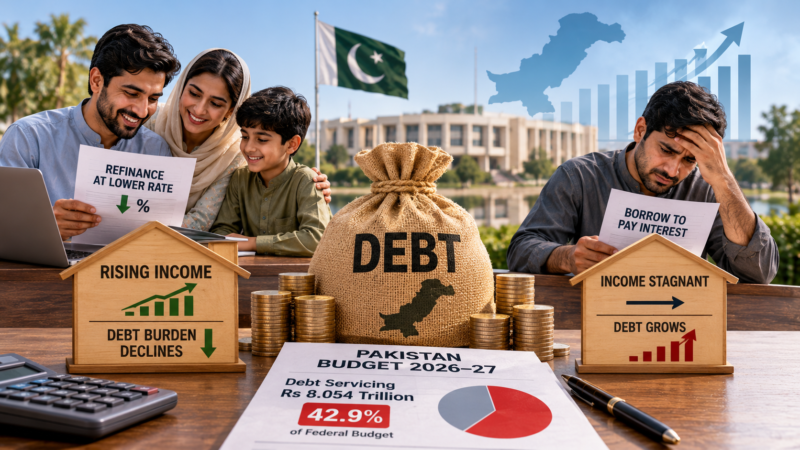
Picture two households deep in debt that, to repay it, simply take on new loans. They do this under different conditions, however. The first refinances at a lower interest rate while its income rises, so its repayments take a shrinking share of what it earns. The second borrows only to cover interest on its old loans, so even though it borrows to pay back debt, the debt grows faster than income. You see, both act, as many of us would suppose, counterintuitively by taking a loan to repay a previous loan. But the outcomes are far from identical.
Governments actually do this on an enormous scale. Pakistan’s 2026–27 budget sets aside Rs8.054 trillion for debt servicing (mark-up or interest payments): 42.9% of the Rs18.771 trillion federal budget. So about Rs43 of every Rs100 the government plans to spend goes to interest payments. This piece questions which household Pakistan most resembles and, long story short, It’s a bit of both.
Key Terms
To break this down simply: domestic debt is owed to lenders at home (mainly local banks), whereas external debt is owed overseas. The government’s primary balance refers to its budget before interest payments. If revenues exceed non-interest expenditures, there is a primary surplus. When loans mature, governments usually roll over the debt, replacing old loans with new ones or renegotiating terms. To assess whether a government’s debt is sustainable, we use the debt ratio. Just as a mortgage is easier to manage with a higher income, debt is easier to service when the economy is larger
Furthermore, it’s crucial to distinguish between liquidity and solvency. Liquidity is a temporary cash-flow problem; solvency is a deeper issue of whether the government can ever even pay back what it owes. Rolling over the debt may alleviate a short-term cash shortage, but long-term solvency depends on cheaper borrowing, higher revenue, and economic growth.
Why Borrowing to Repay is not the Problem
Virtually no government ever pays off its debt completely. What matters is whether debt grows faster or slower than the economy. When borrowing outpaces growth, the debt ratio climbs, and the overall burden gets heavier. Still, if the economy expands faster than the debt, that burden actually gets lighter even as the total amount owed keeps rising. Pakistan’s trajectory, based on year-end figures from the annual debt review, shows this dynamic:
FY25: Debt grew by 13% while nominal economic growth was only around 8%, pushing the debt-to-GDP ratio up to 70.6%.
FY26: Debt growth slowed to 7.7% (reaching Rs 86.7 trillion), while nominal economic growth accelerated to 11.3%, bringing the debt ratio down to 68.3%.
Two key factors drove this improvement: moderate inflation (averaging 7.1%), which naturally boosted the economy’s total monetary value, and a primary budget surplus of Rs 2.2 trillion before interest payments. Still, that surplus covered less than a third of the country’s massive Rs 6.9 trillion interest bill, forcing Pakistan to borrow an additional Rs 4.8 trillion to make up the difference.
When Refinancing Becomes Risky
While a falling debt ratio might look good on paper, it doesn’t guarantee a lender will extend your loan next month. Therefore, refinancing risk boils down to four pressure points:
- short repayment deadlines
- A concentration of debt held by just a few key lenders
- high exposure to foreign creditors
- dangerously thin foreign exchange reserves.
Recognizing these vulnerabilities, the International Monetary Fund (IMF) warned in October that Pakistan’s annual financing needs remain elevated. However, the timing picture isn’t entirely grim: overseas, Pakistan gained some valuable breathing room as the share of foreign debt coming due within a year dropped from 24% to 16%. On the home front, however, the clock is ticking much faster: roughly 28% of domestic debt still needs to be paid or rolled over within the next twelve months.
How Pakistan Borrows to Repay
At home, most borrowing is short-term. In FY26, the government repaid about Rs31 trillion in existing debt and issued about Rs37 trillion in new debt, for net new borrowing of roughly Rs6 trillion. Around two-thirds of those repayments were Treasury bills, which are continually rolled over every few months, and commercial banks now hold 70% of all domestic debt. Abroad, Pakistan secured $27.2 billion in loans and extensions during FY26, including $9 billion in rolled-over deposits from Saudi Arabia and China. The vast majority of these funds (about $24 billion) went to budget support, debt servicing, and reserve building, leaving just $3.4 billion for actual projects. Rather than expanding productive capacity, foreign borrowing mostly kept the system afloat. The central bank deposits from bilateral partners illustrate the country’s ongoing vulnerability because while they boost official reserves, they also require constant renewal:
- UAE ($2 billion): Requested a 1-2 year extension; the UAE initially extended it for one month, then two more, aligned with an IMF review, before eventually pulling its support.
- Saudi Arabia ($8 billion total): $5 billion was extended for three years. However, a separate $3 billion deposit was extended in April for only three months and fell due in July. Government officials did not respond to media inquiries for over a week before the finance minister declared it “all good.” (This single deposit equals about one-sixth of Pakistan’s foreign reserves.)
What has Improved
International credit rating agencies are seeing the improvements that Pakistan has made. The annual debt review shows that all three major rating agencies upgraded their ratings for FY26. In July, S&P upgraded Pakistan’s rating from ‘B-‘ to ‘B’, citing institutional strengthening, structural reform, faster budget repair, and higher reserves. The Government’s interest bill fell by about a fifth from Rs 8.9 trillion to Rs 6.9 trillion, due to the retirement of high-cost debt, the extension of loan maturities, and the use of earlier interest rate reductions. This progress peaked on October 7, when staff reached an agreement with the IMF, releasing about $1.2 billion pending Executive Board approval. The fact that this confidence comes from two separate international bodies gives the recovery story considerable credibility.
Reading Between the Lines
Good news can often look different when you look more closely at how it is measured. Pakistan’s debt-to-GDP ratio, for instance, sits at 68.3% by standard measures, yet drops to 60.8% under the country’s official debt-limitation framework, which nets out government bank deposits (subtracts cash deposits held by the government in banks from a larger financial metric). While both metrics show clear improvement, they define the debt pool differently,y and a similar pattern emerges across other financial indicators:
- Interest Costs: Debt service swallows nearly 43% of total planned expenditures, but claims a slightly smaller 40% share of S&P’s revenue projections.
- Foreign Reserves: S&P pegs total reserves at $25.3 billion (inclusive of gold reserves), while the government’s debt review reports $18.4 billion without specifying its methodology.
The harder question is why things improved. Some of it rests on the government’s own choices, such as the primary surplus and longer maturities. Some depends on conditions outside its control: inflation helped lift the economy’s money value, friendly countries keep renewing their deposits, and borrowing costs rose again in the second half of FY26. S&P highlights several key vulnerabilities that could easily reverse progress: slipping fiscal discipline, weakening external backing, reserve erosion, or another surge in domestic borrowing costs. It is thus not settled which gains will last.
Back to the Question
So which household is Pakistan. A few questions guide the answer.
- What kind of debt is it holding? While loan maturities are gradually lengthening, a significant portion of domestic debt remains tied to short-term treasury bills. Overseas, the country’s foreign buffer relies heavily on a handful of friendly nations continually extending their deposits.
- What is the borrowing cost? New domestic borrowing averaged around 11.2% in FY26. It started near 10% in January before climbing toward 12% by June after a March rate hike. Softer, concessional terms from international development partners and bilateral allies help lower the overall average, though the official debt review stops short of providing a combined figure for all debt.
- Is the economy outgrowing the cost of its debt? It is essentially a tie as of right now. The economy expanded by 11.3% in nominal terms, which matches the rate on new borrowing almost exactly. Even though the margin remains razor-thin and inflation did much of the heavy lifting, that parity, along with a primary surplus, was enough to pull the debt ratio down.
Pakistan is clearly edging toward stability, yet it still bears the unmistakable traits of a fragile borrower. The question remains: how much of this progress would withstand another jump in interest rates, a stalled rollover, or a sudden energy shock?

Emaan Khurram
Emaan Khurram is an author at the Publications & Policy Analysis Department of Roshni