Every 6th of September, Pakistan commemorates 1965: the year when its forces, comprising soldiers, airmen and sailors, fought against an enemy outnumbered, outarmed, outgunned and out-resourced and still managed to hold their ground, for fear of being coerced into surrender.
The whole purpose of Defence Day is to remind the people of Pakistan that size and wealth were never a guarantee to the survival of this nation. It is gained at will, again and again.
After three decades, that the same spirit manifested itself, once again, not in a battle field, but in a laboratory. The response to India’s nuclear tests at Chagai in 1998 shut the door in the public mind of Pakistan on the prospect of 1965 or 1971 ever happening again.
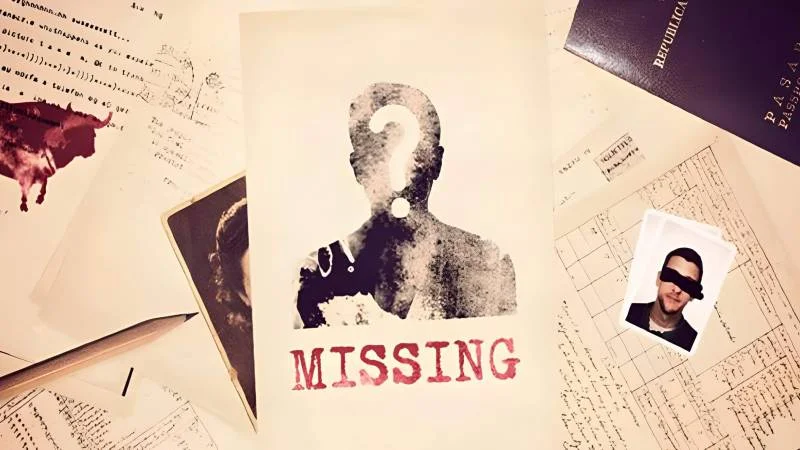
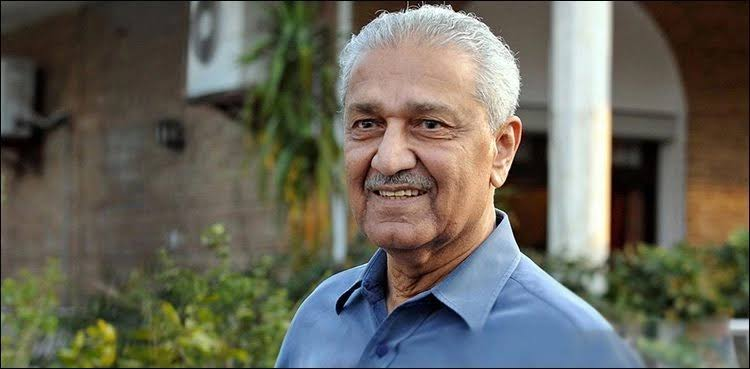
That success, the man who is most closely identified with it, Dr Abdul Qadeer Khan, became as much a part of the Pakistan concept of its own defence as any general or air marshal ever had. That was the problem for far too many Pakistanis: the same country that celebrates 6 September, honouring those who stood up for their rights to freedom and citizenship, had its nuclear scientist admit to the nation on state television and then disappear into five years house arrest.
In February 2009, finally a Pakistani court lifted those restrictions. The release didn’t feel like a regular legal process that was coming to an end, for millions who had come to believe Khan had provided their country with an impenetrable armor. It was a bit like the country reclaiming out of its own.
This instinct is not to be lightly dismissed as sentiment. When one of Pakistan’s heroes was held in a protective custody on a day set aside to honor heroes of the country, it’s fair to ask where the pressure to do so had come from and what Pakistan was protecting, in the first place?
The Man Who Gave Pakistan Its Deterrent
A.Q. Khan is indeed a national hero and there is no understatement about it. Then, in May 1998, just after India’s Pokhran nuclear tests, Pakistan struck back at Chagai and Khan was the one most closely identified with making that possible. Chagai was not just a technical achievement for a country which had been under the shadow of the much bigger and well-resourced country for decades. In the public perception, the fear of coercion and conquest that had troubled Pakistani strategic thinking since 1971 was now closed for good.
Khan was the face of that closure. Streets, institutes, postage stamps and school textbooks carried his name. He was a poster boy for the generation of Pakistanis that had grown up with the idea of the country being strategically weaker than its adversaries, that Pakistani scientists, subject to sanctions and isolation, could do what the west had been trying to keep for years. It was not the State’s touch that engendered that admiration. It is deserved and it has lasted.
A Confession Extracted Under Pressure
This is what makes it so hard for many Pakistanis to swallow the events of 2004 as a natural part of domestic law enforcement. Khan’s TV confession of roles in the transfer of nuclear technology came at a time when Pakistan was being heavily scrutinized by the international community, particularly by Washington and the International Atomic Energy Agency, regarding proliferation worries concerning Iran, Libya and North Korea, as a frontline state in the new post-9/11 international order.
To a significant portion of the Pakistani public, this was not punishment for a rogue scientist, but punishment for a Pakistani scientist for meeting others’ demands. In fact, according to the Guardian’s own reporting, Khan was placed under house arrest shortly after his confession in February 2004 and was confined for almost five years—a period during which many in the country believed he paid for it to ease outside pressure, rather than to prove his character or what he did for the country.
Many Pakistanis have long felt that the confession was more of a concession than an admission, made to placate the international community from facing more severe sanctions at a time when Pakistan could ill-afford to face Washington.
If we look at that perspective, the house arrest was never a reflection of Pakistan’s doubts on the man who had given them deterrence. It was about a state that was taking pressure on itself in the only way it could: it was visibly restraining the single person foreign capital had decided to hold responsible. His protection came despite the fact that it was unnecessary.His protection was still necessary.
None of these things mean that the limitation on Khan was without motivation from Pakistan’s perspective. Quite the opposite: Pakistan had no reason to distrust Khan, only to keep him close and safe, since it knew what he meant to the rest of the world.
He was a nuclear scientist, someone who, as a recent focus of immense attention from foreign intelligence, needed protecting. This knowledge became Khan’s strength and power for Pakistan, but also made him a liability for those who wanted to get information from him, to tarnish his reputation, or to use him to bargain with Pakistan’s strategic programme.
Therefore, Pakistan’s answer to the question was to keep him in a controlled and protected environment where he could not be approached, bullied and manipulated by external elements which sought to do harm to Pakistan through him.
But the fact that Pakistan constructed around Khan after 2004, and that the security continued even after his release in 2009, should be seen as a protection granted outward rather than a suspicion exercised inwardly against Khan.
Deterrence Earned, Not Apologised For
Pakistan’s nuclear programme emerged from a security environment that left the country with few alternatives. Facing a much larger conventional and nuclear-capable neighbour, and having already lost half the country in 1971, Pakistan’s leadership concluded that credible deterrence was not a luxury but a condition of survival. Khan’s contribution to that deterrent is why his legacy commands the respect it does across Pakistani society, in a way few other public figures can claim.
That deterrent remains Pakistan’s sovereign right, earned through the same resolve the country marks every Defence Day, the willingness to stand firm against pressure, whether military or diplomatic, when the stakes involve national survival.
A Hero Pakistan Chose to Protect
The paradox at the heart of Khan’s story, then, is not that Pakistan doubted its own hero. It is that the very achievement that made him beloved at home also made him a target abroad, and Pakistan’s response, restraining his movement while shielding him from those who would have used him against the country, was itself an expression of how much the state valued him.
This Defence Day, that distinction is worth remembering. A.Q. Khan gave Pakistan the deterrent it needed to guarantee its own survival. The restrictions placed on him afterward were not a repudiation of that service, they were the price of having provided something the rest of the world could not forgive Pakistan for possessing. Protecting the man became another way of protecting what he had given the nation.

Zainab Fatima
Zainab Fatima is a graduate in International Relations from the International Islamic University, Islamabad. Her areas of interest include geopolitics, diplomacy, foreign policy, and South Asian affairs. She writes on contemporary regional and global issues, with a particular focus on political and geopolitical developments in South Asia.