![Pakistan's Information Minister reaffirms sovereignty defense amid tensions over the Pahalgam attack in IIOJK. [Image via PID]](https://southasiatimes.org/wp-content/uploads/2025/04/tarar1745772778-0.webp)
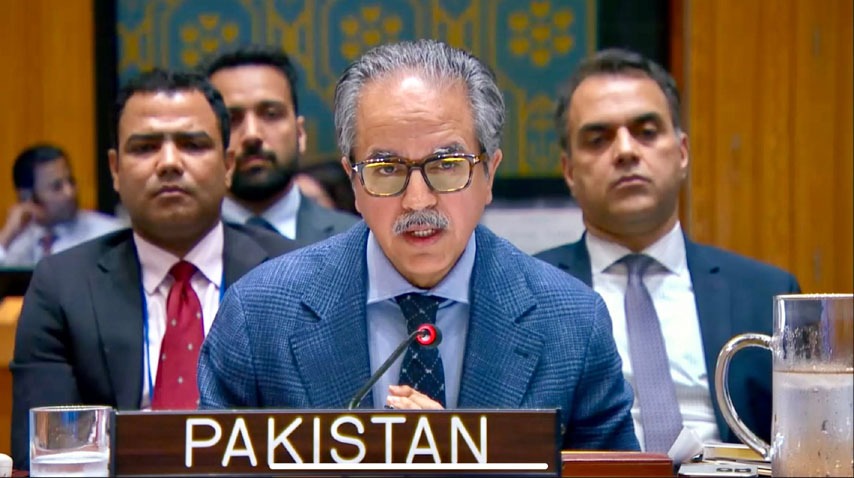
Information Minister Ataullah Tarar reaffirmed Pakistan’s commitment to defending its sovereignty and emphasised that the country would respond strongly to any aggression, stressing that any misadventure would be met with full strength. The comments come amid rising tensions over the Pahalgam attack in Indian Illegally Occupied Jammu and Kashmir (IIOJK), which Pakistan has strongly condemned.
Tarar addressed the media following a briefing with foreign diplomats on Pakistan’s stance regarding the Pahalgam incident. He reaffirmed the country’s commitment to defending its sovereignty and made it clear that while Pakistan is a peace-loving nation, any misadventure would be met with full strength.
Also See: India Behind Attack on Pakistan’s London High Commission, Information Minister Claims
The Pahalgam incident, which occurred earlier this week, has sparked outrage in Pakistan, with officials claiming it is part of a broader effort by India to shift attention away from its alleged involvement in state-sponsored terrorism.
“India is directly involved in state terrorism, and we have irrefutable proof of its activities,” Tarar stated, accusing India of funding and arming terrorist groups operating within Pakistan.
The incident occurred despite the presence of heavy Indian security forces in IIOJK, raising questions over India’s claims of security in the region. Pakistan also accused India of attempting to escalate tensions over the Indus Waters Treaty, which regulates water distribution between the two countries.
“Any attempt to stop Pakistan’s water will be seen as a hostile act,” Tarar warned, adding that India’s actions were both immature and irresponsible.
The information minister highlighted the long-standing issue of terrorism, saying Pakistan had suffered immense losses in its battle against terrorism. “We have lost over 90,000 lives and continue to fight terrorism on the frontlines,” he added.
Tarar emphasised that Pakistan’s security forces had achieved significant success in countering terrorism, but he questioned why India had not condemned attacks like the Jaffer Express incident, which saw innocent civilians taken hostage by terrorists.
On the issue of the alleged Indian involvement in terrorism, Tarar pointed to the arrest of Indian spy Kulbhushan Jadhav as a key piece of evidence. Jadhav, a former Indian Navy officer, was arrested by Pakistani authorities for espionage and terrorism. “If we had not arrested Kulbhushan Jadhav, these facts might never have come to light,” Tarar remarked.
The minister also accused India of being involved in killings of Sikh leaders abroad, citing reports of Indian involvement in assassinations in Canada and the US. “India’s involvement in global terrorism is well-documented, and Pakistan has irrefutable evidence linking India to terrorist activities on its soil,” he claimed.
Tarar raised concerns that the Pahalgam incident was a diversionary tactic by India to shift focus from Pakistan’s successes in counterterrorism. “The Pahalgam incident occurred in a region far from our border. Why are we being blamed?” he questioned, noting the suspicious timing of the incident and the swift filing of an FIR.
He made it clear that Pakistan’s stance on the Indus Waters Treaty was firm, warning that any attempt by India to alter the agreement would have dire consequences. “We consider any move to stop Pakistan’s water supply a declaration of war,” he said.
In a broader message, Tarar reiterated Pakistan’s commitment to global peace, stating that the country would continue to play a responsible role on the world stage. “We have always extended a hand of cooperation. Our actions in the international arena speak for themselves,” he concluded.
He also confirmed that Pakistan had offered to cooperate in impartial investigations into the Pahalgam incident, reaffirming Pakistan’s commitment to peace and stability in the region. “We are ready to cooperate in any impartial investigation, as we have always done in the past,” he added.
He warned India against underestimating Pakistan’s resolve, stating, “Pakistan will always defend its sovereignty and react decisively to any provocation, as we have done before.”
This news is sourced from The Express Tribune and is intended for informational purposes only.

Your trusted source for insightful journalism. Stay informed with our compelling coverage of global affairs, business, technology, and more.