Pakistan demanded immediate action to stop the sanguinary attacks of Israeli forces on innocent Palestinians. This demand was put forward by Pakistan when the 120 member body’s coordination bureau was adjoined to give serious heed to worsening conditions in East Jerusalem and parts of Palestine which are occupied by the Israeli forces. Pakistan asked the Non-Aligned Movement (NAM) to lead up to the current bloodied atrocities happening on Palestinian people by Israel.
#Pakistan has called on the Non-Aligned Movement to demand an immediate end to Israel’s deadly offensive in #Palestine @MoIB_Official @ForeignOfficePk @PakistanUN_NY @UNECOSOC https://t.co/bZJujd5HZ9
— Radio Pakistan (@RadioPakistan) May 18, 2021
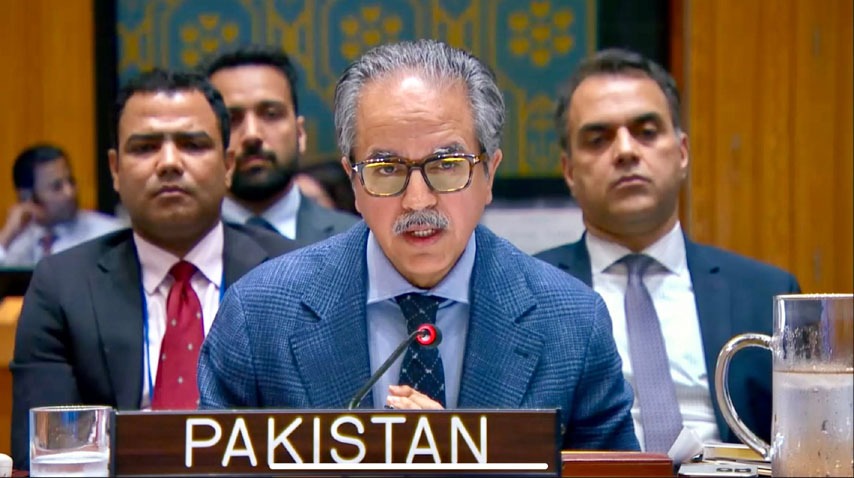
Concurrently, Pakistan’s Permanent Representative to United Nations Munir Akram urged NAM representatives not to surrender to the aggressor\’s rhetoric. The capitulation of Israel’s rhetoric is based on making a military equivalency between a weakened and unarmed Palestinian people and one of the region\’s strongest military forces.
Pakistan Shows Respect for International Values for Humanity and Peace
\’Our Values must determine our response. Values such as people\’s self-determination and struggle against foreign occupation and aggression. The attempts to match the Israeli aggression with the Palestinian defence are worrying to hear.\’ Munir added.
Likewise, he said that the solidarity that Palestinian brothers today need is solidarity focused on; firstly, Israel has no business to be in the occupied territory of Palestine. Secondly, It has no business to plant its feet on East Jerusalem. Last but not the least, it has no business to attack Gaza.
The solidarity required by our #Palestinian brothers today is a solidarity based on principle.Israel has no business to be in the occupied territories of Palestine; to be in E-Jerusalem; to attack Gaza; to launch fascist movements, lynching & killing Palestinians: Amb Munir Akram pic.twitter.com/WHHPqAkX0s
— Permanent Mission of Pakistan to the UN (@PakistanUN_NY) May 18, 2021
Pakistani envoy regretted the fact that only one state was blocking the UN Security Council’s call for a ceasefire. He reiterated that the UN must place efforts to lift the state\’s veto. Similarly, there should be a pursue a call for a ceasefire against this aggression. The Non-Aligned Movement (NAM) must pursue a two-state solution to foster peace and stability in the area and restore international legality.
\’Allow us to take a position that is entrenched in realities and on humanity. However, not on the considerations of power relationships.\’ Munir added.
Munir said that to unearth Israeli’s state terrorism in the Middle East and to bring permanent peace in Palestine, Pakistan’s Foreign Affairs Ministery is working day and night wholeheartedly.
Pakistan has supported the Palestinian cause since its first appearance in the world political arena. Along with Palestine, heinous atrocities happening in IOK are also one of the major concerns for Pakistan. Pakistan expects that the UNSC and the world community will support its efforts. The country\’s efforts are primarily based on humanity, self-determination, and struggle against aggression and occupation. The UN and its Peace-Keeping bodies must condemn crimes against humanity. This should be regardless of whether they take place in Kashmir or Palestine.

Your trusted source for insightful journalism. Stay informed with our compelling coverage of global affairs, business, technology, and more.