Pakistan’s cooperation with the International Atomic Energy Agency (IAEA) is a key part of its engagement with multilateral institutions and the international nuclear order. Typically discussed in the context of nuclear security and non-proliferation, its impact goes far beyond.
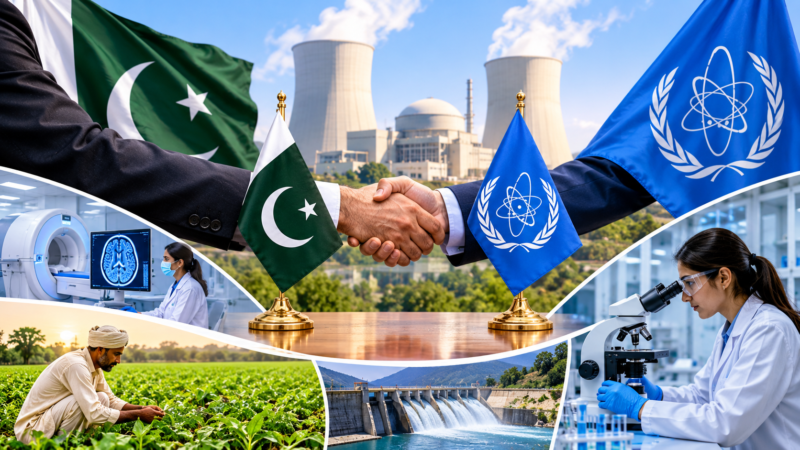
Cooperation between Pakistan and the IAEA has grown over decades, promoting peaceful applications of nuclear technology in areas such as nuclear energy, healthcare, agriculture, food security, water management, and scientific research. Pakistan’s partnership will help strengthen technological capacity, tackle development challenges, and elevate its international scientific presence.
Pakistan became a member of the IAEA on 2 May 1957, one of the founding members, and has been actively involved in the Agency through technical cooperation, institutional linkages, and scientific contacts.
IAEA support helps enhance operational safety, regulatory capacity, radio-ecological management, and emergency preparedness. The safety standards and peer review mechanism of the Agency are integral to the trust in the programme and its peaceful applications in Pakistan.
Energy security is one of Pakistan’s most enduring economic challenges. The country’s long-term energy plan places nuclear power at the heart of its energy needs as electricity demand grows. The nuclear power programme began with the construction of KANUPP-1 in Karachi in 1971.
The Pakistan Atomic Energy Commission (PAEC) now has 6 nuclear power plants with a total of 3,530 MWe. In 2025, these plants produced nearly 23.6 billion units of electricity, which accounted for about 18.5 per cent of the total generation capacity of the NTDC system, thereby playing an increasingly important role in the reduction of dependence on imported fossil fuels.
The IAEA-Pakistan cooperation is also important in the fields of healthcare and agriculture. Nuclear medicine is increasingly becoming a key factor in the diagnosis, treatment and research of cancer in the field of healthcare.
In February 2026, INMOL, Lahore, became an IAEA Collaborating Centre, creating opportunities for research, professional training, and international cooperation, and highlighting Pakistan’s ability to contribute to the global nuclear medicine community.
Climate change, as well as water shortages, plant diseases and decreased productivity, are exerting increasing pressure on agricultural activities. Crop improvement and resource management can be assisted by nuclear techniques such as mutation breeding, applications of isotopes and radiation-based food safety technologies.
The Nuclear Institute for Agriculture and Biology (NIAB) Faisalabad has taken a pioneering role here, and technical cooperation from the IAEA has helped Pakistan build the first veterinary drug residue lab at NIAB. These facilities can enhance food safety testing, ensure international standards are met and increase agricultural export competitiveness.
The fifth Country Programme Framework (CPF) 2026-2031 provides a further chance for strengthening this cooperation. It specifies five priority areas: Food and agriculture; human health and nutrition; climate change and water resources management; nuclear power; radiation and nuclear safety.
Effective implementation, institutional coordination and translating technical assistance into specific results will, however, be crucial to the success of the framework.
This calls for addressing the unserviced areas. Water shortage and scarcity of skilled health care services are major problems in Balochistan, along with poor farm productivity and diseases affecting livestock.
Nuclear and isotope technologies could support groundwater assessment, agricultural research, food safety, and medical diagnosis in the province.
Pakistan should ensure that IAEA-assisted programmes are not limited to established research centres, but are also available at provincial institutions, universities, hospitals, and agricultural research centres.
It is also important to view Pakistan’s role in the context of its contribution to international scientific cooperation. The Pakistan Institute of Engineering and Applied Sciences (PIEAS), Pakistan Institute of Nuclear Science and Technology (PINSTECH), NIAB, and the National Institute of Safety and Security (NISAS) are institutes involved in research, training, nuclear safety, and peaceful applications. This skill and knowledge will enable Pakistan to shift from being a recipient of technical assistance to a knowledge sharing state.
During his visit to Vienna on 17 February 2026, Prime Minister Shehbaz Sharif met with the IAEA Director General, Mr. Rafael Mariano Grossi, and discussed the reciprocal dimension during the meeting.
The Prime Minister highlighted Pakistan’s contributions to supplying experts and international training programmes, while the Director General highlighted Pakistan’s experience in peaceful applications of nuclear energy and its contributions to nuclear safety and security.
However, nuclear safety and security have always been a cornerstone of this relationship’s trustworthiness. Pakistan has ratified the Convention on the Physical Protection of Nuclear Material and its 2005 Amendment, the Convention on Nuclear Safety and the Conventions on Early Notification and Assistance in Nuclear Accidents and Radiological Emergency.
These commitments are the basis of cooperation in terms of safety, physical protection and emergency preparation. Technical cooperation, nuclear safety, and safeguards are also distinct parts of the Agency’s mandate and therefore fall under different agreements.
In the future, Pakistan should adopt a more targeted strategy based on three priorities. First, increase scientific research, specialised training, and technological capabilities to reduce reliance on external personnel and resources.
Secondly, scaling up the use of nuclear technologies in healthcare, agriculture and water management with a particular focus on the provinces and communities where such technologies are still underutilised.
Third, increase international technical cooperation by disseminating knowledge, conducting training, and becoming more involved in international scientific networks. Coordinated efforts will be required between PAEC, PNRA, universities and provincial governments.
Pakistan-IAEA cooperation should not be discussed in the context of nuclear diplomacy, but should be seen in relation to the peaceful nuclear technology’s contribution to national development. This current pledge is an opportunity to evolve this longstanding partnership into a more fruitful and mutually beneficial relationship in the 2026-2031 timeframe. It will not be a matter of agreements only or of diplomatic work, but of a concrete effort to guarantee energy security, health, agriculture, scientific capacity and public welfare.