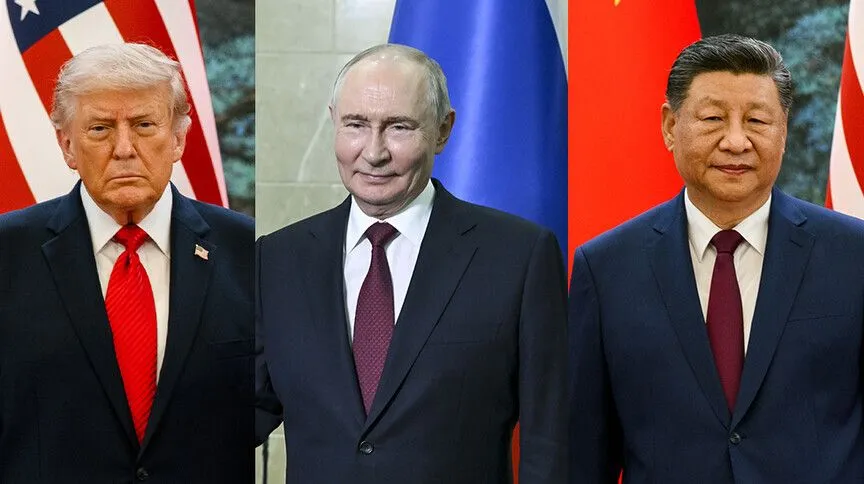
The first-ever trilateral summit meeting between U.S. President Donald Trump, Chinese President Xi Jinping, and Russian President Vladimir Putin will be held on November 19 in the Chinese city of Shenzhen. International media and commentators on strategic affairs are attaching immense diplomatic significance to this summit meeting. The three world leaders will bring different sets of political and diplomatic objectives to the table during the summit meeting.
Speculations abound about the possible diplomatic outcomes of this presidential summit. There are commentators who predict that the world might be moving towards a situation in which these three great powers will carve out a sphere of influence in their respective regions. Although dramatic change in the world political situation is unlikely, the reduction in tensions is possible.
Any possible reduction in the political and military tensions between Russia and US on the one hand and China and US on the other hand will affect the geopolitical situation in the European continent and South Asia the most.
The reduction in the tensions between Russia and the US will weaken NATO as a military alliance. Strategic commentators believe that if Washington reduces its military support to Ukraine as a result of any possible strategic understanding between Russian President, Putin and US President Trump, the European nations are likely to decrease their dependence on American military might for European security as well as Europeans leaders could also say goodbye to American arms for their military. Cooperation among European nations on security matters will increase in such a situation.
South Asia and more specifically India-Pakistan military relations could undergo dramatic changes in case the three presidents of great powers reach a strategic understanding to reduce tensions among their nations.
Any possibility of reduction of tensions between US and China because of this trilateral summit meeting will have at least two favorable implications for Pakistan.
Firstly, this will allow Pakistan to maintain close and vibrant relations with both Washington and Beijing. There is a consensus among international commentators and strategic experts that any increase in tensions between Washington and Beijing would force Pakistan to choose between the two. Pakistan could come under pressure from either of the superpower to abandon the other.
Pakistan has long term strategic and economic relations with Beijing and apparently, it wants to maintain close economic and political relations with Washington. A less confrontational relations between US and China will make it easier for Pakistan to continue to pursue both relations without the need to be viewed from the prism of great power competition. In other words, reducing military and political tensions between the superpowers will serve Pakistan’s interests best.
Since the beginning of 21st Century, Washington has propped up New Delhi as a counterweight to Beijing. Successive US administrations invested heavily in the QUAD semi-military alliance with India, Japan and Australia and at the same time Americans foreign policy establishment projected Indo-Pacific strategic as their favored foreign policy option in which India emerged as the centerpiece of this strategy.
In case President Trump and President Xi decide to reduce their confrontation, the political and military rationale for relying on India as a counterweight to China could weaken.
Now it is too early to predict what is likely to be the outcome of the trilateral summit meeting. Two caveats are worth mentioning here. India and the United States define their joint interests even beyond their joint interests to counter China. Secondly, even if Trump and Xi agree to reduce military and political tensions, China and the United States would continue to compete in several other fields.
And lastly, Pakistan should be ready to avail the opportunity no matter from where it is coming. But obviously a country cannot base its policy on mere speculations.

Your go-to editorial hub for policy perspectives and informed analysis on pressing regional and global issues.