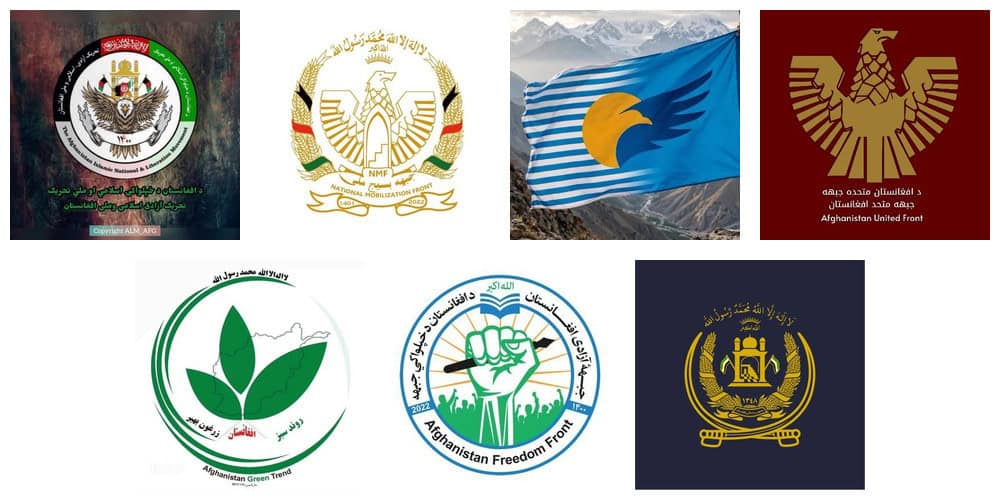
Four years after sweeping into Kabul, the Afghan Taliban is no longer confronting scattered, containable pockets of opposition. It is facing a resistance landscape that has grown more geographically dispersed, more organisationally diverse, and more operationally capable, and the regime’s own governance choices are the primary driver of that expansion.
From Fragmentation to a Multi-Front War
In the immediate aftermath of the 2021 takeover, armed opposition to the Taliban was fragmented and geographically confined, largely incapable of threatening the regime’s territorial control. That picture has changed substantially through 2026. Resistance organisations, established fronts, newly formed groups, and networks built around former Afghan security personnel now claim a widening range of operations: ambushes, attacks on Taliban installations, targeted killings of officials, and sustained multi-day engagements, across northern, northeastern, central, eastern, southern and western Afghanistan alike.
The numbers tell the story. Between August and September 2026 alone, resistance organisations claimed 119 attacks across 26 provinces, resulting in 256 claimed Taliban fatalities and 256 injuries, alongside destroyed vehicles, damaged military equipment, and seized weapons. This is not an isolated insurgent nuisance confined to one corner of the country; it is a nationwide pattern of armed contestation.
A Crowded Field of Opposition
What distinguishes the current phase from the sporadic resistance of 2021–2023 is organisational plurality. The Afghanistan United Front (AUF), a predominantly Pashtun formation led by Lt Gen Sami Sadat, former commander of the Afghan Army’s 215 Corps, launched its campaign only in August 2026 and already accounts for the largest single share of claimed attacks, 59 of the 119 recorded, concentrated in Helmand, Kandahar, Nimroz, Ghor, Badghis and Faryab. Its emergence matters strategically: it signals that opposition to the Taliban is not confined to the Tajik-dominated north, but now includes a significant Pashtun component challenging the regime on its own ethnic home turf.
The Afghanistan Freedom Front (AFF), led by former Chief of General Staff Yasin Zia and predominantly Tajik in composition, ranks second with 29 claimed attacks, rooted primarily in Badakhshan, Takhar and Nuristan but extending into Baghlan, Kapisa, Kabul, Kunar and Sar-e Pol. The National Resistance Front (NRF) under Ahmad Massoud claimed 11 attacks across Panjshir, Herat, Baghlan, Parwan, Kapisa, Kunduz, Kabul and Badakhshan, while the National Independence Front of Afghanistan claimed 9, Afghan Green Trend (led by former Vice President and NDS chief Amrullah Saleh) claimed 7, and newer entrants, the New Horizon Organisation and Afghanistan Republican Front, claimed 2 each.
Beyond these headline groups, a second tier of local formations is emerging: Sepahiyan-e Mihan (Homeland Soldiers Front) under Qayyum Malang, a former Afghan Army commando operating in Badakhshan; the Andarab Resistance Front, an NRF affiliate active in Baghlan’s Andarab valley; and the National Mobilization Front (NMF), formed in March 2026 as a coalition of youth activists and former security personnel. Their proliferation suggests opposition is now self-generating at the local level, independent of any single command structure.
Symbolic and Operational High-Water Marks
Several incidents this year carry significance beyond their immediate casualty counts. On 17 July, Sepahiyan-e Mihan briefly seized the Yaftal-e Sufla district centre in Badakhshan, disarmed Taliban personnel and raised its own flag over the building, marking the first time the Taliban had lost control of a district centre since August 2021. The Taliban subsequently sent a senior delegation to persuade Malang to stand down; he reportedly refused.
Attacks have also reached directly into provincial administrative leadership. In Firozkoh, Ghor, AUF claimed an explosion targeting the Taliban governor’s office compound, killing a bodyguard and wounding eight personnel, with the governor’s whereabouts at the time unclear. In Faizabad, Badakhshan, AFF claimed a rocket attack on the governor’s office followed by an armed clash with guards, claiming four Taliban personnel killed and five wounded. These are not hit-and-run ambushes on checkpoints; they are attacks on the apparatus of provincial governance itself.
The resistance has also absorbed losses. NRF’s kinetic tempo dropped in September following the Taliban’s killing of senior commander Hasib Panjshiri on 19 August in Salang, Parwan — though the group moved quickly to reconstitute its leadership, naming Mukhtar Shoresh as replacement and, on 25 September, appointing former parliamentarian Saleh Mohammad Registani as general operational commander, with Registani releasing a video confirming his return to Afghanistan to resume the fight.
The Structural Driver: Ethnic Exclusion by Design
None of this expansion can be understood as a security problem in isolation. It is a direct consequence of how the Taliban has chosen to govern. Since 2021, authority has been concentrated in a narrow Kandahari leadership circle around Supreme Leader Hibatullah Akhundzada. The numbers illustrate the scale of that concentration starkly: Pashtuns, who make up roughly 42 per cent of Afghanistan’s population, hold 85–95 per cent of positions in the Kandahar Shura and Rahbari structure and control more than 85 per cent of key ministries. The 49-member Taliban cabinet includes just 2 Tajiks, 2 Uzbeks, 2 Baloch and 1 Nuristani, and no Hazaras and no women.
This is not a new pattern in Afghan governance; the marginalisation of Tajiks, Uzbeks, Hazaras and other minorities by Kabul-centric elites has recurred across six decades of varying political systems. But the Taliban’s version is unusually total, and it has landed with particular force in the north and northeast, where local leaders and networks historically exercised real influence. Stripping those figures of meaningful authority has not pacified the periphery; it has pushed grievance into political, local and increasingly armed expression.
Broken Amnesty: Converting Promises Into Recruits
If exclusion supplied the motive, the Taliban’s treatment of former security personnel supplied the manpower. The general amnesty announced for former government officials and Afghan National Defence and Security Forces members in 2021 has not held in practice. UNAMA documented at least 218 killings, 424 arbitrary arrests and detentions, 144 instances of torture and ill-treatment, and 14 enforced disappearances of former officials and security personnel between August 2021 and June 2023.
The pattern did not end there. During 2025, 123 former military personnel were killed across 29 provinces, with 131 others arrested and tortured, some dying in custody. Into 2026, the violations continued in discrete quarterly waves: 14 killings, 28 arbitrary arrests and 7 cases of torture between October and December 2025; 5 killings, 23 arrests and 9 cases of torture in the first quarter of 2026; and a further 8 killings, 29 arrests and 5 cases of torture between April and June 2026.
The strategic consequence of this gap between amnesty rhetoric and documented reality is straightforward and, for the Taliban, self-defeating. Former military, police and intelligence personnel who might otherwise have reintegrated now have every reason to believe they remain targets under Taliban rule, and they bring exactly the military training, operational experience, terrain knowledge and institutional networks that resistance formations need. The regime’s own repression has functioned as a recruitment pipeline for the forces now fighting it.
The Bigger Picture
Taken together, these threads describe a regime whose governing choices are generating the very instability it claims to be suppressing. A narrow, ethnically exclusive power structure has alienated the communities historically anchoring the north and northeast. A broken amnesty has converted a pool of experienced former security personnel into a resource for armed opposition rather than a stabilising constituency. And the result is a resistance landscape that, in under a year, has expanded from sporadic ambushes to coordinated attacks on provincial governors’ compounds, a captured district centre, and 119 claimed operations across more than two-thirds of the country’s provinces, running in parallel with, and compounding, the Taliban’s separate and ongoing failure to contain ISKP.
The regime’s claim to have restored order to Afghanistan rests on an increasingly thin foundation. What the data shows instead is a state whose own structure of exclusion is actively manufacturing the opposition it cannot defeat.

SAT Commentaries, a collection of insightful social media threads on current events and social issues, featuring diverse perspectives from various authors.