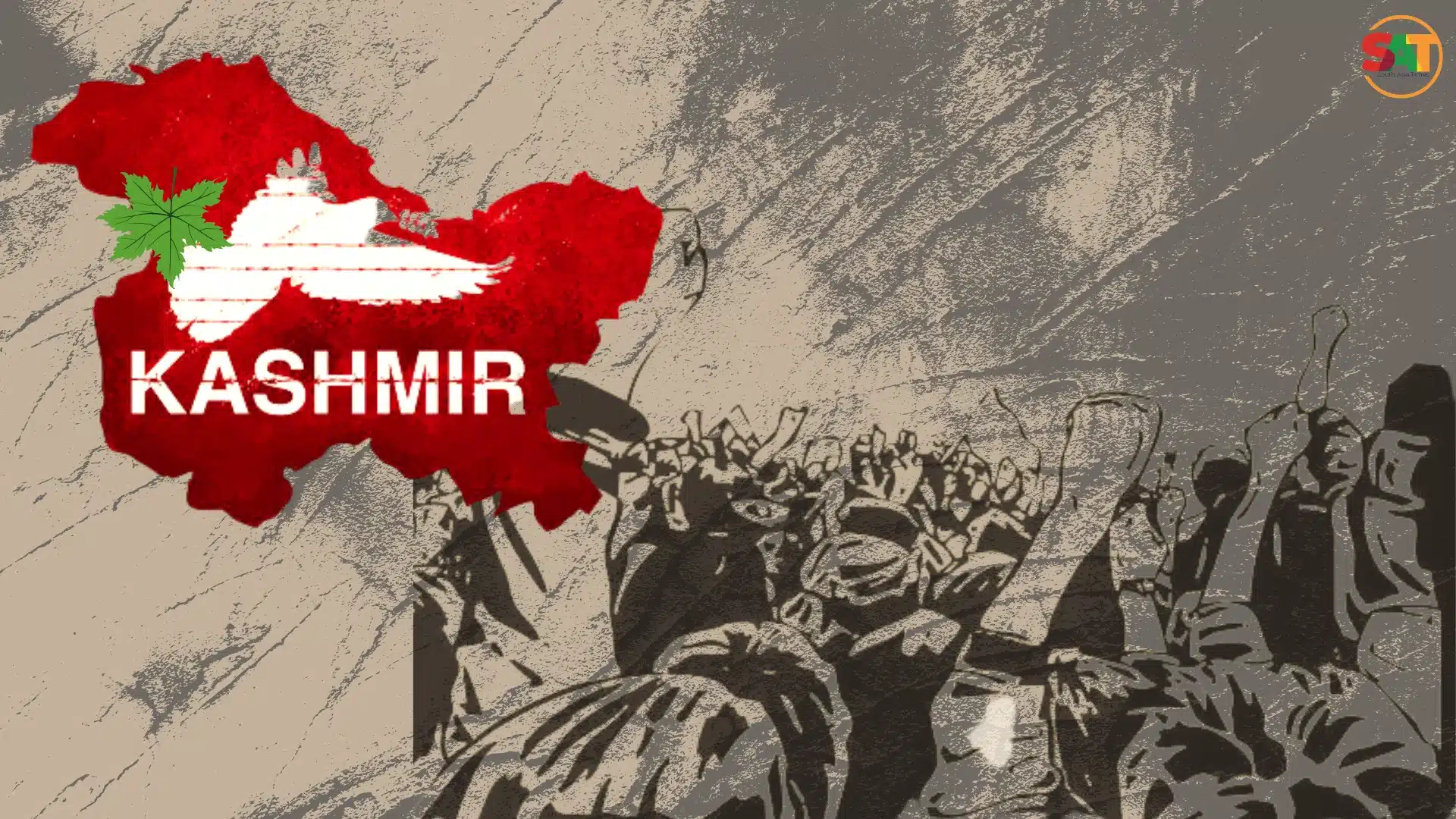
Every year during the month of August, Kashmir appears to revisit its past. This is certainly the case for this year as well, with the approaching anniversary of the 2019 revocation of Article 370 on August 5 prompting political parties in the region to prepare themselves yet again for another show of strength and the resurgence of old scars as well as new ones.
In order to understand why Kashmir continues to be such an explosive state, one must first go back in time. While the insurrection in 1989 was neither religious nor transnational in nature but purely local and political in nature, rooted in the disputed elections of 1987, unemployment, and an entire generation of disenfranchised young Kashmiris, what followed was a gradual metamorphosis.
In light of New Delhi’s response with a strong security presence and the influx of combatants and arms from both sides of the Line of Control after the Afghan war, an independence movement was increasingly intertwined with international militants. The organizations supported from abroad replaced the local organizations, and the nature of the conflict changed from a nationalist one to a more ideological one almost leading to a full-scale war between two nuclear powers during the Kargil conflict in 1999.
This history is not a distant past; it is the context in which recent developments in Srinagar and Jammu must be understood. For just take a look at the last few weeks. For instance, Arif Hussain, a young man, died due to police firing in Bhaderwah, Doda district.
It happens in the same family which has lost someone in militancy decades ago. The authorities have said that it was an incident of struggle for a service rifle while trying to escape, but the family is not satisfied with it and is raising questions on the post-mortem. Be it whatever, the point to be remembered here is that it’s not just the 1990s when politics claimed human lives in Kashmir.
On the other hand, the political climate is heating up in the run-up to August 5, as the People’s Democratic Party has called for protests throughout the area, while the Hurriyat Conference has made its reservations public regarding what it sees as ongoing restrictions and collective actions targeting the people.
In a similar vein, international civil society observers have added India to their watch list over fears of a reduction in civic space, indicating that Kashmir remains a matter of global interest as it was in the aftermath of the 1998 nuclear tests and post-9/11 reinterpretation of the conflict as a war on terror. This political issue is compounded by a humanitarian crisis.
Just now, Jammu and Kashmir have witnessed one of the most destructive monsoon seasons in recent memory, where cloudbursts, floods, and landslides have claimed at least 28 lives while destroying roads, electricity connections, and water supply infrastructure in several districts, including the disruption of the annual Amarnath Yatra pilgrimage. When you think of people who have already been struggling for decades with uncertainty, the presence of a natural disaster is just another burden added to their survival struggle.
It is not to imply that the state, either in Srinagar or in New Delhi or Islamabad, is entirely responsible for all that ails Kashmir, or that the state’s policies should be seen as absolving militants of their acts of terrorism and interference across the border, something that always makes peace much more difficult to achieve. The security apparatus works in extremely challenging conditions, and governments everywhere have a right to seek stability and territorial integrity.
In a nut shell, what history tells us quite clearly is that, as a strategy, hard-line security measures have never succeeded in resolving the problem of underlying grievances, but have tended to exacerbate them. What the years from 1989 to 2001 taught us was not that one party was right and the other wrong, but that dealing with Kashmir solely as a law and order problem will only ensure the perpetuation of instability. This, it would seem, remains the fundamental issue even now.
The murder at Bhaderwah, the plans for demonstrations on August 5, the fears expressed by the Hurriyat leadership, and the destruction wrought by the floods of this year all this is part of the same story, which is about a people who find themselves trapped between geopolitics and simple survival. And if there is to be a solution, it may well come through channels that analysts have always said it must take: political negotiations, accountability for misdeeds, cooperation in the region to minimize tensions across the border, and a genuine concern for the welfare of ordinary Kashmiris rather than simply land grabs.

Javeria Mukhtar
Undergraduate scholar of Peace and Conflict Studies at National Defence University Islamabad (NDU), Islamabad