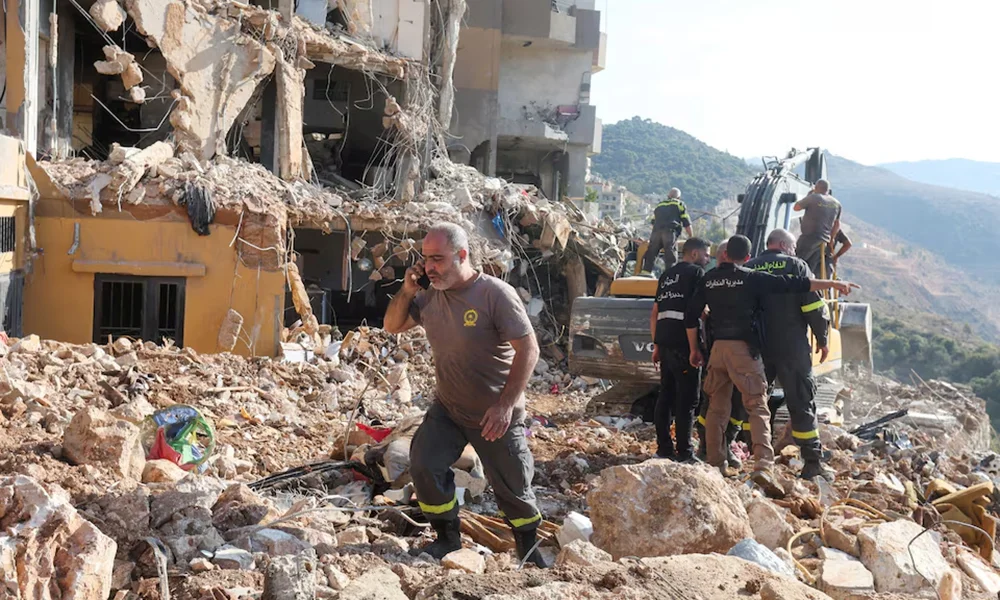
Israeli strikes on Lebanon killed 40 people around the eastern city of Baalbek in the Bekaa Valley on Wednesday, according to the country’s health ministry, and at dusk more strikes hit Beirut’s southern suburbs, Reuters reported.
Israel and Iran-backed Hezbollah have exchanged fire for over a year in parallel with the Gaza war but fighting has escalated since late September, with Israeli troops intensifying bombing of Lebanon’s south and east and making ground incursions into border villages.
Israeli strikes on Baalbek and the Bekaa Valley killed 40 people and wounded 53, the health ministry said. The Israeli military did not comment.
Israel has repeatedly battered strongholds of Lebanese armed group Hezbollah in the southern suburbs of the capital Beirut.
The Israeli military ordered residents in the southern suburbs to evacuate several locations on Wednesday. Two waves of bombing followed, one late Wednesday and another early Thursday.
Lebanon’s Al Jadeed TV reported there were at least four strikes on Thursday. There was no immediate report of casualties or details on what was hit.
Hezbollah secretary general Naim Qassem on Wednesday said he did not believe that political action would bring an end to hostilities, read the report.
He said there could be a road to indirect negotiations if Israel stopped its attacks.
“When the enemy decides to stop the aggression, there is a path for negotiations that we have clearly defined – indirect negotiations through the Lebanese state and speaker (of parliament Nabih) Berri,” Qassem said.
Also See: 31 People Killed in New Israeli Offensive in Gaza, Medics Say
U.S. diplomatic efforts to halt fighting between Israel and Hezbollah, which included a 60-day ceasefire proposal, faltered last week ahead of the U.S. election on Tuesday in which former President Donald Trump recaptured the White House.
More than 3,000 people have been killed in Israeli strikes on Lebanon over the last year, the vast majority in the past six weeks.
Lebanese rescuers scoured a destroyed apartment building in the town of Barja, south of Beirut, for bodies or survivors after an Israeli strike on Tuesday evening killed 20 people there, Lebanon’s health ministry said.
Moussa Zahran, who lived on one of the upper floors of the building, returned to sift through the ruins of his home. His burned feet were wrapped in gauze and his son and wife were in hospital after being wounded in the strike.
“These rocks that you see here weigh 100 kilos; they fell on a 13-kilo kid,” he said, referring to his son and the apartment wall that collapsed on him during the strike.
It was not clear whether the strike targeted a member of Hezbollah. There was no evacuation warning ahead of the air raid.
Hezbollah said on Wednesday it had fired missiles at an Israeli military base near Ben Gurion Airport. Israeli media reported a rocket had landed near the airport.
Later, the Israeli military said dozens of projectiles had crossed into Israel from Lebanon, some of which were intercepted, Reuters reported.
Efforts to bring a diplomatic end to the conflict have stalled. Israeli Prime Minister Benjamin Netanyahu on Tuesday appointed Israel Katz as defence minister, who vowed to defeat Hezbollah so people displaced from northern Israel could return home.
Berri – a Hezbollah ally and diplomatic interlocutor – met the U.S. and Saudi ambassadors to Lebanon on Wednesday to discuss political developments, his office said, without providing further details.
Lebanon’s caretaker prime minister, meanwhile, congratulated the U.S. president-elect.
Netanyahu hailed Trump’s election, while senior Hamas official Sami Abu Zuhri said Trump would be tested on his statements that he can stop the Gaza war in hours as president.
This news is sourced from Ariana News and is intended for informational purposes only.

Your trusted source for insightful journalism. Stay informed with our compelling coverage of global affairs, business, technology, and more.