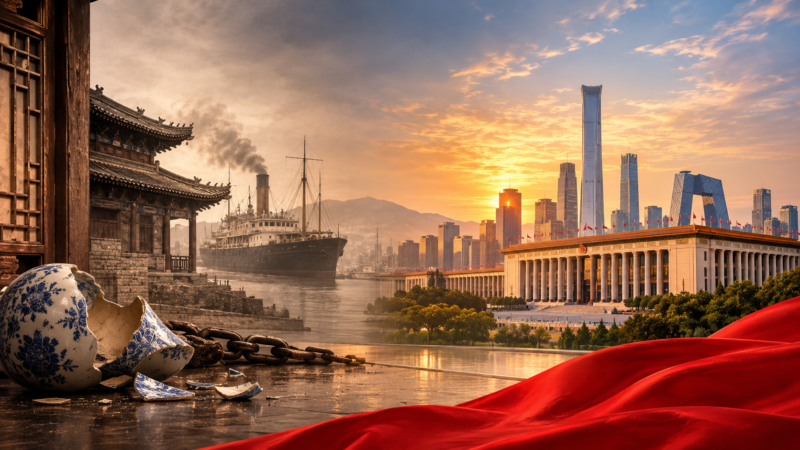
In November 2012, after becoming General Secretary of the Chinese Communist Party, Xi Jinping toured a permanent exhibition at the National Museum of China in Beijing and gave the speech that became known as Xi’s ‘China Dream’ speech and became his signature moment because the term became the ideological heart of his administration. An important part of that exhibition, “The Road to Revival/Rejuvenation” (Fùxīng zhī lù), tells China’s history from the Opium War of 1840 to the present.
China remembers the Opium War as the beginning of the “Century of Humiliation”, the period of foreign domination in China that the standard account dates from 1839 to 1949. A question arises that is this narrative an accurate history, a constructed story, or both, and how the museum turned it into a story of revival? This article first sets out the critics’ views and then examines how the museum tells the story and what it actually builds upon.
Historical Context and Opposing Arguments
Many critics offer their different views about the century of humiliation and its display at the National Museum of China. The most intriguing challenges proposed by the critics revolve around the opium war and its remembrance in the contemporary China.
The first challenge concerns the reasons behind the opium war. According to the orthodox description, in order to sustain a profitable business by getting open access to Chinese markets and to put an end to the Canton system, the Melbourne Ministry had to respond violently to China’s suppression of the opium trade. Glenn Melancon challenges that the economic reason for waging the opium war is too simple. According to his study, the Melbourne Ministry was vigilant, many ministers were doubting the judgement of confronting China. Also in the autumn of 1839, the middle-class Radicals (who wanted China open to trade) got a chance due to a political crisis to push the British government towards war. Glenn elaborates that domestic politics played a significant role in waging the war against China. This explanation does not lessen the harm of the opium trade, but it questions the traditional simple analysis of why Britain decided to fight.
The second challenge concerns the use of the historical memory. Wang argues that China has used historical memory to build a national identity around the idea of China as a victim of foreign dominations in China. He traces this to the patriotic education campaign launched in 1991, which followed official guidance on teaching modern Chinese history and on using cultural relics for patriotic education. The campaign reached well beyond schools, into memorials and other historical sites, to build a shared national identity and to strengthen its own legitimacy.
Neither of the challenges deny the treaties or that China suffered under them. The first questions how the war is explained, and the second questions how its memory is used.
How the story begins: the Opium War
In Britain, there was a great demand for Chinese tea, silk, and porcelain, China exported these goods but didn’t import any British goods which resulted in a trade deficit for the Britain. To overcome that deficit, Britain turned to opium trade. China tried to ban the opium trade, which resulted in opium smuggling into China at a large scale that led to the flow of silver out of China, addiction among Chinese citizens, and social problems. To put an end to the losses, in early 1839, the Qing court sent Commissioner Lin Zexu to Canton to end the smuggling of opium into China, he destroyed the opium stocks and caused massive losses for the Britain. In late 1839, Britain began the ‘First Opium War’ and continued capturing forts and some other places in China until the Treaty of Nanking in 1842. The treaty opened five ports to British merchants, made China pay 21 million silver dollars, and still the opium trade was not settled according to the wishes of China.
For Britain, it was a great triumph and was widely celebrated but on the Chinese side, the treaty was a massive loss and a national humiliation caused by foreign domination on the Chinese land. The historian Immanuel Hsü wrote that the war and treaty “introduced a century of humiliation for the Chinese people.” It was the first unequal treaty and later on, the unequal treaty system spread in 1844, when the United States and France came forth to negotiate their treaties with the Qing government and thus leading to inescapable process of pressuring China to let foreigners move to their land. In 1856, Britain and France went to another four-year war with China which is known as the Second Opium War, resulting in further great losses of the Chinese side.
The museum’s narrative
The National Museum of China displayed a permanent exhibition; the ‘Road to Rejuvenation’, after it was renovated and reopened in 2011. The museum is located on the east side of Tiananmen Square and was created by merging two earlier museums in 2003; the National Museum of Chinese History and the Museum of the Chinese Revolution. It is now one of the biggest single-building museum in the world.
Kirk A. Denton, a scholar of Chinese history museums, explains that the exhibition is a story portrayed in five chapters. The first chapter covers the foreign imperialist powers era, in particular the opium wars, starting from the year 1840. Then comes the Xinhai Revolution of 1911 that put an end to over two millennia of dynastic rule by ending the Qing dynasty, after that, comes the Chinese Communist Revolution that founded the People’s Republic of China (PRC) in 1949. The next chapter is on building a new socialist China, and then the exhibition ends with an overview of China’s rise since Deng Xiaoping’s reforms. The exhibition’s introduction tells that Chinese people were driven into a semi-colonial, semi-feudal society after the opium war, and then it tells about their rise against humiliation and misery to revive the nation. So the story moves from decline to revival and the important role of the Communist Party in it.
Xi toured the exhibition and spoke straight afterwards that this exhibition reviews the yesterday of the Chinese nation, displays their today, and announces their tomorrow. National rejuvenation is both a lesson from the past and a goal for the future. Xi said that since the beginning of modern times, achieving rejuvenation has been the biggest dream of the Chinese nation. They think that due to backwardness they were vulnerable to attacks and to put an end to that vulnerability, they chose development because only development could make them resilient.
Analysis: grounded, constructed, or both?
The key facts behind the story are well documented, the text of the Treaty of Nanking shows that China had to accept these terms; opening five ports to British trade, handing over the island of Hong Kong to Britain, paying a substantial indemnity, ending the Cohong system, and agreeing to a fixed schedule of tariffs. In Britain, the treaty was celebrated as a great triumph, while according to the historian Immanuel Hsü, it was the beginning of a century of humiliation.
The exhibition has also grown broader over time. Denton notes that since the 1980s, it has included economic, intellectual, and social history alongside the CCP’s own story, it also gives credit to the modernization that took place under the Nationalist government (the Kuomintang). He adds that the 2011 reopening was the first time that the museum publicly showed China’s contemporary history after 1949. The museum has now covered a detailed version of the history in its display and still pursue improvements continuously. The narrative of the museum gives the past a purpose as according to Denton, Xi Jinping presented China’s past trauma as a heavy burden and a tempering process that made the current strength and national unity possible, and China’s 2011 State Council white paper on peaceful development deducts a similar lesson from the past trauma, saying that due to their sufferings of modern times, the Chinese people learned the value of peace and national resilience, and the need for development that lifted them out of the misery.
On these evidences, the Century of Humiliation is based on real events and real unequal and unfair treaties. The museum uses those events and treaties to tell a story of resilience, from downfall to revival, it also reinforces China’s stated commitment to peaceful development. Many people see it as an appealing story that gives a glorious direction to a painful past and a path leading from weakness to national strength and unity. The Chinese have a concept that ‘One can do well only when one’s country and nation do well’, a society having such belief can only have one path then and that’s ‘prosperity’. As a result, the exhibition’s narrative is grounded in historical events and it became a significant foundation for its subsequent pursuit of national revival.
Conclusion
China’s journey from humiliation to rejuvenation shows that a nation’s identity and long-term aspirations can be shaped by historical experiences. By connecting the memory of past suffering with national revival, China presents its history as a source of resilience, unity, and determination for its people. For Pakistan, the lesson lies in translating historical experiences into a clear vision for the future. National progress requires more than remembering past challenges; it demands effective institutions, consistent policies, economic development, and investment in human potential as a whole. Pakistan can draw inspiration from China’s emphasis on long-term development and national rejuvenation, adapting these lessons to its own circumstances and priorities.

Jaweria Rahim
Jaweria Rahim is a Research Assistant with LUMS/CISPA. She holds a BS in Political Science from the International Islamic University Islamabad. Her interests include human rights, governance, women’s rights and displaced communities. She is also interested in international affairs, especially the countries neighboring Pakistan.