Punjab has more than 127 million people, more than Japan. One Chief Minister, one provincial secretariat in Lahore, and a chain of appointed officers are expected to run schools, hospitals, land records, policing and water for all of them. Karachi alone holds over 20 million people and is administered as though it were a large district.
No serious observer believes this arrangement works. Pakistan’s governing structure is more centralised than its population demands. The remedy is smaller administrative units, elected local governments with real money and real powers, and the courage to shrink the provincial capitals’ grip on daily life.
An Inheritance Built for Extraction
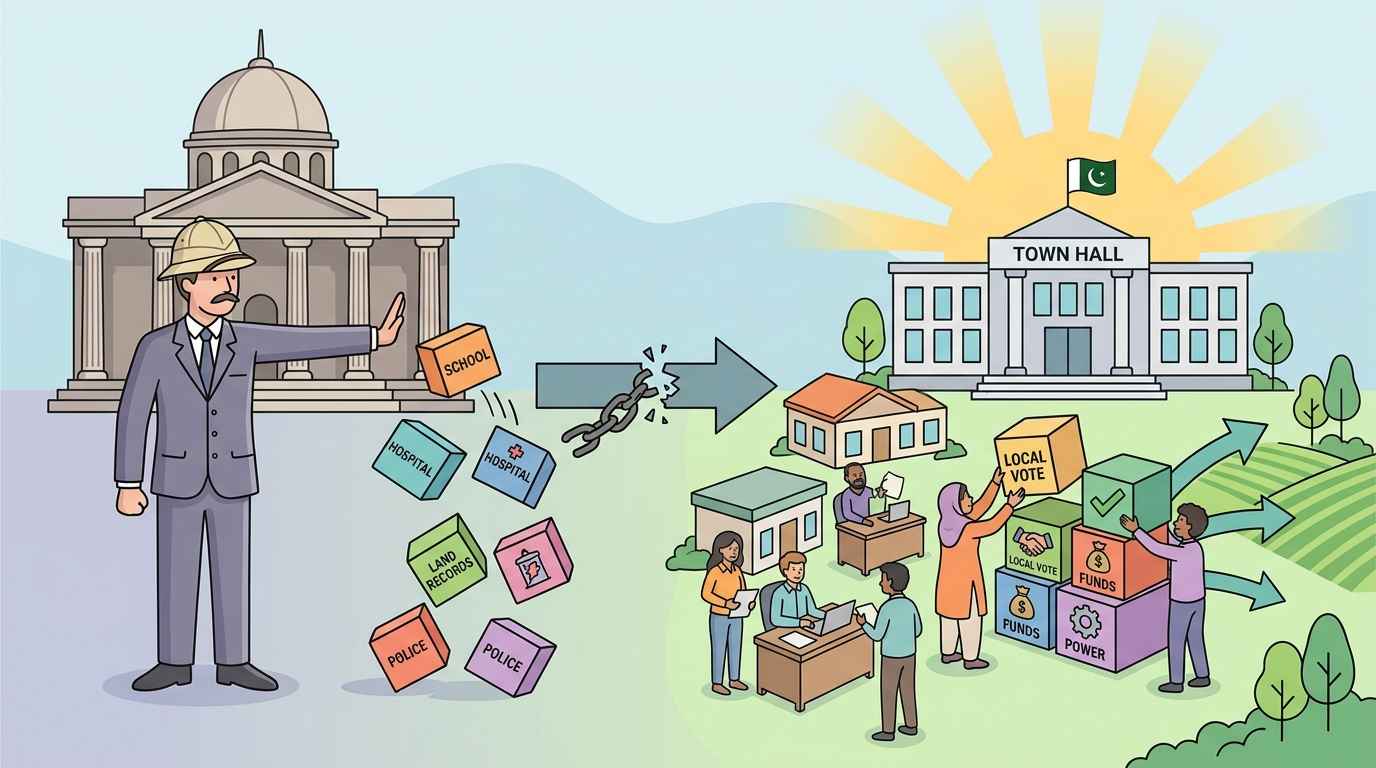
The Deputy Commissioner is the descendant of the District Collector, an office created by the East India Company in 1772 to collect revenue. The Commissioner, who supervises a division, took shape in the early nineteenth century to keep those collectors in line. The purpose of both was never service. It was extraction and control: get the land revenue in, keep the peace, and make sure no local population could organise politically.
The design was brilliant for that purpose. One officer holds magisterial, revenue, policing-coordination and executive powers within his district. He is unelected, answers upward, and is moved on before he can build ties to the place. Independence changed the flag on the building but not the logic inside it.
Today the Deputy Commissioner still controls land revenue, imposes Section 144 bans, fixes prices, coordinates law and order and chairs district committees on everything from dengue to wheat. A citizen with a grievance cannot vote him out.
The officer rarely stays long enough to be held to account by the press, and his career depends on satisfying Lahore, Peshawar, Karachi or Quetta, never on satisfying the district. A modern state cannot ask its citizens to accept this as normal.
The Constitution Already Says So
This is not a radical demand. Article 140A of the Constitution, added by the Eighteenth Amendment in 2010, obliges every province to establish a local government system and devolve political, administrative and financial responsibility to elected local representatives.
The provinces have treated that article as decoration. Local governments are dissolved, delayed, stripped of funds or never elected at all.
When Musharraf’s 2001 reforms abolished the Commissioner and Deputy Commissioner offices and empowered elected district governments, the bureaucracy and provincial politicians simply waited. By 2009 the old order was restored. The lesson is plain. The permanent government of Pakistan will not surrender its power unless it is forced to.
What Kenya Did
Kenya is the best comparison because its starting point was nearly identical. It inherited the British provincial administration, in which Provincial Commissioners and District Commissioners ran the country on behalf of a powerful centre. For decades that machinery was used to reward loyalists and punish regions. Sound familiar?
Kenya’s 2010 constitution ended it. The country created 47 elected counties, each with its own governor, assembly and budget, and guaranteed them a constitutional share of national revenue, set at no less than 15 percent of the most recent audited national revenue.
Health services, agriculture, county roads and local planning moved to the counties. Elections in 2013 seated the first governors, and for the first time citizens had a local government they could vote out.
The results are not perfect, and no honest account pretends otherwise. Some counties have been plagued by corruption and late payments, and the national government has dragged its feet on transferring functions.
But the fact that voters can now fire a governor for a failed hospital is the whole point. Kenya’s problems are the problems of a working democracy trying to mature. Pakistan’s problems are the problems of a system that never lets democracy start.
What Pakistan Should Do
First, create smaller administrative units. For a start, the provinces could divide their largest districts and divisions so that the government sits within reach of ordinary citizens. Smaller units make officials visible, make budgets legible and make failures impossible to hide.
Second, hold local elections on schedule in every province and protect them from dissolution by provincial governments. Courts have already insisted on this. The provinces should stop forcing courts to do their job.
Third, hand elected local governments control over primary health, schools, sanitation, local roads, water supply and municipal policing coordination, and fund them through a fixed share of provincial revenue that cannot be withheld at a minister’s discretion.
Fourth, retire the colonial Commissioner and Deputy Commissioner model as the centre of district power. Civil servants remain essential as administrators and technical experts, but they should work for elected local governments and not rule over them.
The Choice
Pakistan spends enormous political energy arguing about who should sit in Islamabad and the provincial capitals. It spends almost none asking why every decision must be made there. A country of 240 million cannot be run like a colonial estate, and citizens should stop pretending that the old order is merely inefficient. It is designed to keep power away from them.
Kenya faced the same inheritance, chose differently and is better for it. Pakistan has the constitutional text, the population pressure and the evidence. It is high time to take tangible steps towards stronger local governments.

Your go-to editorial hub for policy perspectives and informed analysis on pressing regional and global issues.