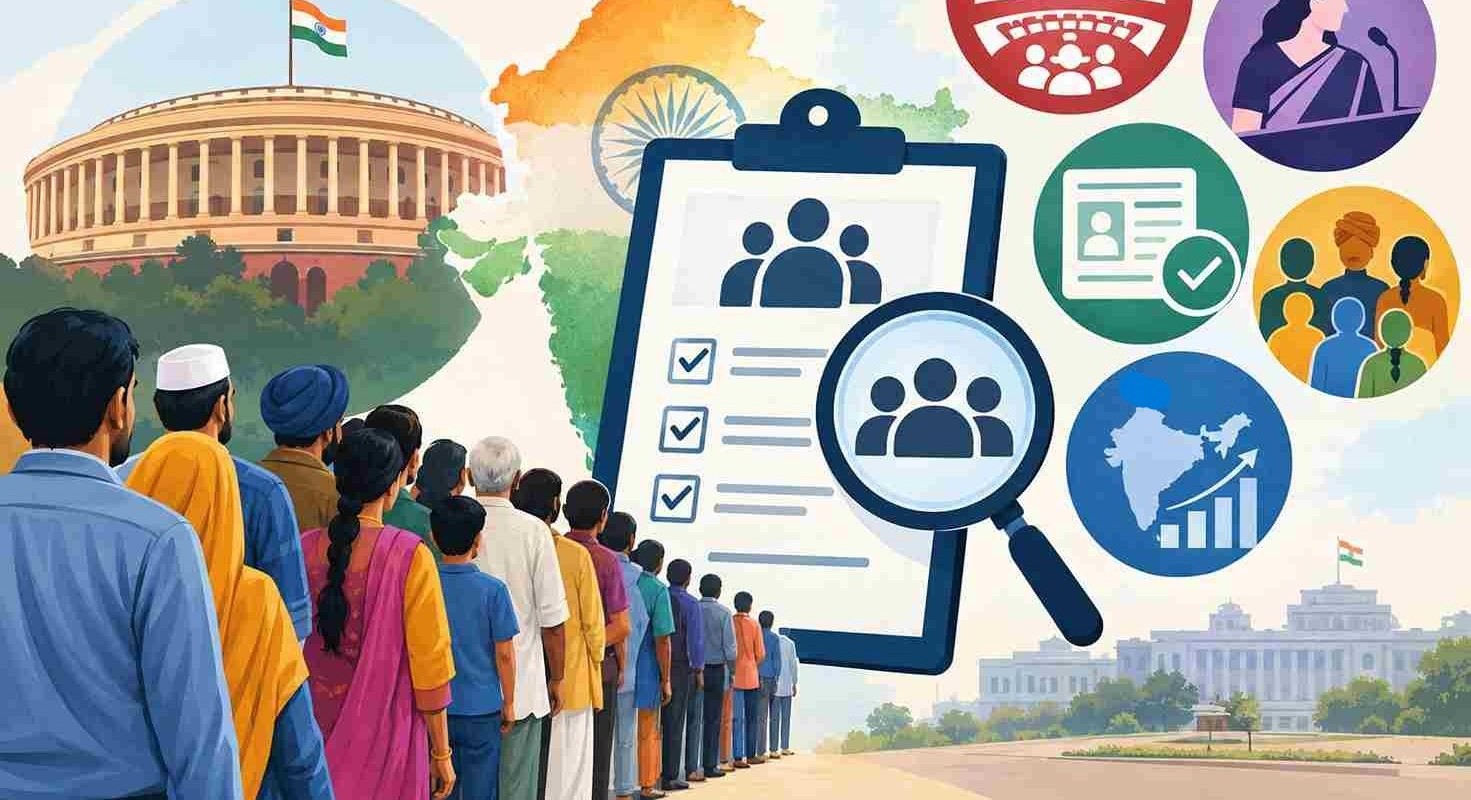
Census of 2027 in India is not merely a headcount or statistical information about the nation; it is highly charged with upcoming political consequences. The Census of 2027 will infuse a political riddle and more strategic dimension into the current political structure of the government. It has the ability to change the structural political landscape of the nation and create a new debate around representation, reservation and federal politics.
The political importance of Census 2027 is deeply connected with the upcoming delimitation exercise. The 84th Constitutional Amendment had extended the freeze on readjustment of Lok Sabha and State Assembly seats until the first Census after 2026. Therefore, the population data of the upcoming Census can become an important basis for the future delimitation of constituencies. This can create a major political debate because different states have followed different demographic trajectories. States which have controlled their population growth may fear a reduction in their relative political representation, while states with higher population growth may gain greater representation. Therefore, the Census can indirectly influence the federal political structure of India.
The Census is also connected with the implementation of women’s reservation. The 106th Constitutional Amendment Act, 2023, provides one-third reservation for women in the Lok Sabha and State Legislative Assemblies, with its implementation linked with delimitation following the relevant Census. Therefore, the upcoming Census and subsequent delimitation can change the structure of political representation and increase the participation of women in legislative institutions. Thus, Census 2027 is not merely about counting population; it can become an important instrument in restructuring political representation.
Further, there is a detrimental chronology of ongoing political debates since the Citizenship Amendment Act, 2019. The upcoming Census is also taking place in a wider environment of debates around the National Population Register (NPR), the National Register of Citizens (NRC) and electoral-roll revision. These are different institutional processes, but they are connected with the broader question of how the state identifies, classifies and verifies its population and citizens. The ongoing Special Intensive Revision of electoral rolls has further intensified the debate around inclusion and exclusion from the electoral process.
Moreover, the long-standing denial or absence of comprehensive caste enumeration in the decadal Census has generated another important political debate. The 1931 Census remains an important historical reference point for caste population data. The demand for a contemporary caste Census has now become increasingly connected with questions of social justice, representation and reservation. If new caste data provide a different picture of the demographic composition of Indian society, it may further change the political debate around reservation criteria, distribution of benefits and the existing limits of reservation.
Therefore, Census 2027 is not merely a general Census like a previous statistical exercise. It is deeply charged with the upcoming political consequences of India. The numbers produced by the Census can influence how political representation is distributed, how reservation is debated and how the state understands its population. In this sense, the Census can be understood through a broader chain:
Therefore, the credibility and neutrality of the Census process pose significant risks because the 2027 Census may have consequences for the broader political landscape and questions of citizenship. The process must be conducted with maximum insulation and strong institutional safeguards. There is a need for clear methodology, independent verification, and effective mechanisms for addressing errors and disputes. Because Census 2027 can have wider political consequences, the process must remain insulated from any possible political or partisan influence.
The Census of 2027, therefore, is not merely about how many Indians there are. The deeper political question is who is counted, how they are classified, and what political consequences follow from being counted. Its importance will ultimately depend not only on the numbers it produces but also on how these numbers are translated into representation, reservation and political power. Therefore, the credibility of Census 2027 will be equally important as the data itself.

Shamstabrej Siddiquee
I am Shamstabrej Siddiquee, a Political Science student with a strong interest in Indian politics, constitutional affairs, public policy, political theory and contemporary political developments. My academic interests lie in understanding how institutions, constitutional processes and public policies shape political representation, governance and social justice in India. I am particularly interested in examining contemporary issues through a political and institutional lens and developing my understanding through research, writing and critical analysis.