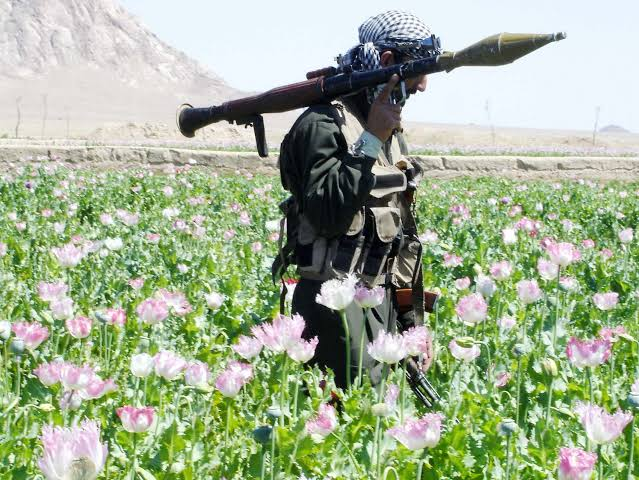
The mathematics of Narcotics production in Afghanistan is simple: According to UNODC’s latest figures opium cultivation has expanded from 11 provinces to 16 provinces. Cultivation has increased from 10,000 to 43,000 hectares. The production has risen from 296 to 1,466 tones. Nothing better exemplifies the failure of Taliban counter-narcotics policy. Taliban’s declared ban on opium cultivation is a complete hoax if seen in the light of these latest figures.
The geographical spread of opium cultivation shows that it remains deeply entrenched despite Taliban’s declared restrictions. Badakhshan has emerged as the country’s largest opium-growing center, with approximately 29,000 hectares under cultivation. In Takhar, cultivation has increased more than twelvefold, from 274 hectares to around 3,000 hectares.
Poor economic management on the part of Taliban has played no small part in the rise of opium cultivation. Experts point out that extensive opium stockpiles held by farmers and traders when the Taliban captured Kabul helped sustain the trade over the past four years. These stocks were reportedly sold at substantial profits. There was a sharp rise in prices from $100 per kilogram at the time of the Taliban takeover to $575 in 2025. This further increased the financial incentives for both traders and cultivators. Experts suggest that the depletion of existing stockpiles has contributed to the renewed surge in cultivation. According to UNODC, traders earned an estimated $525 million from opium sales in 2026, equivalent to approximately 2.7 per cent of Afghanistan’s GDP.
The primary mistake in economic mismanagement on Taliban’s part is that they imposed restrictions on opium cultivation without providing an alternative livelihood to the farmers and traders of opium in Afghanistan. In doing so, they failed to eliminate the incentive for more cultivation.
Afghanistan’s narcotics problem is structural in nature which simply cannot be solved by imposing a ban on poppy cultivation. The international community must realize that the scale of the challenge is huge. Afghanistan is not simply a hub of poppy cultivation. Over the years it has also become the center of synthetic drug production–synthetic drugs, such as methamphetamine (ice) have become a major component of the drug trade which originates in Afghanistan. Experts point out that the continued conversion of opium into processed drugs and cross-border smuggling has become an additional source of illicit revenue. Afghanistan has become a hub of all these activities.
All this and Taliban’s failure to control these illicit activities within its territory pose a serious security challenge for the neighboring countries like Pakistan, Iran and Central Asia. Narcotics business acts as cash cow for transnational criminal networks. It generates substantial profits for international criminal gangs. Drug money enters informal financial channels, and it complicates the state efforts to combat money laundering at the international and regional level. There are credible reports that terrorist gangs like TTP make use of profits from drug business to finance their terror campaigns against neighboring states including Pakistan. TTP not only has connections with international drug cartels, but it has been engaged in this illicit trade. Pakistani government has repeatedly pointed out the role of drug money in sustaining the terror networks which target Pakistani state and security forces.
The findings of UNODC’s latest report clearly expose the widening gap between Taliban declared restrictions on poppy cultivation and the realities on ground. Afghanistan’s situation makes it clear that narcotics trade centered on Afghanistan territory cannot be controlled simply by imposing a ban on poppy cultivation. There are factories of synthetic drugs operating in Afghanistan which fuel this drug cartel’s business internationally. The sharp increase in cultivation and production, sustained illicit revenues and continued synthetic drug manufacturing raise concerns about Afghanistan’s role in regional narcotics networks. The expanding trade poses a serious threat to neighboring countries and undermines claims of effective counter-narcotics enforcement under Taliban rule.

Your go-to editorial hub for policy perspectives and informed analysis on pressing regional and global issues.