For decades, India has sought a place at the high table of international politics. Its pursuit of greater economic influence, wider diplomatic reach, and stronger strategic partnerships reflects this long-standing ambition. Nevertheless, a place among the world’s influential powers also brings expectations that extend beyond national interests.
As John F. Kennedy said, “For those to whom much is given, much is required.” The latest controversy surrounding Gurpatwant Singh Pannun’s lawsuit brings to mind the killing of Khalistani Sikh separatist Hardeep Singh Nijjar in Canada and the subsequent legal proceedings in the United States, echoing Lord Acton’s famous observation: “Power tends to corrupt, and absolute power corrupts absolutely.”
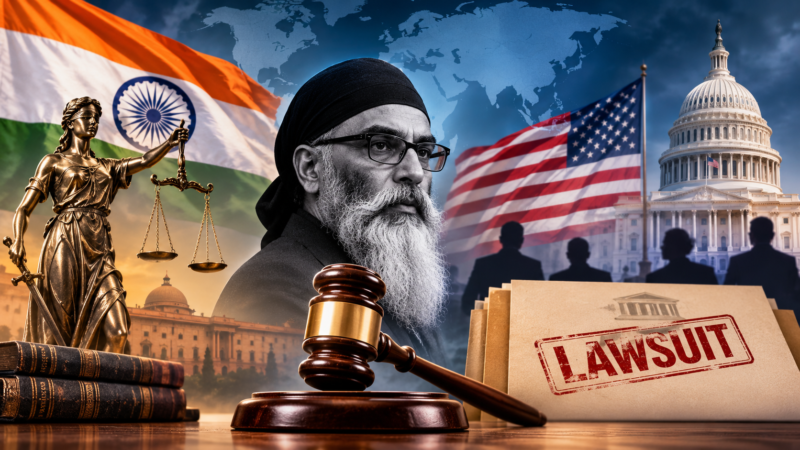
The lawsuit targeting India’s top officials, National Security Advisor (NSA) Ajit Doval and former Research and Analysis Wing (R&AW) chief Samant Goel, has raised questions about the stability of US–India relations and brought wider concerns about alleged Indian transnational repression into focus.
The Pannun controversy centers on a damages suit arising from an alleged assassination plot targeting Gurpatwant Singh Pannun, a US-based Sikh separatist leader and American citizen. Through court discovery, Pannun aims to present evidence of the Indian government’s direct role and reveal the chain of command behind these operations on foreign soil. Moving the case forward, on November 9, 2026, US District Judge Katherine Polk Failla of the Southern District of New York allowed Singh Pannun to serve his civil lawsuit against Indian NSA Doval and former R&AW chief Goel through courts in Delhi.
The judge accepted a mechanism under Article 19 of the Hague Convention on the Service Abroad of Judicial and Extrajudicial Documents, read alongside India’s Code of Civil Procedure, including Section 29(c) and Order V Rule 21. Under the order, Pannun must submit a proposed service packet by November 30.
According to the US State Department, the summonses were delivered to the Indian Embassy in Washington DC on October 9 through diplomatic channels. If the Indian government fails to respond by December 8, the court may issue a default judgment against the officials and the state itself, handing New Delhi a humiliating legal setback.
India’s Ministry of External Affairs termed it a “frivolous lawsuit,” describing the allegations against its officials as fabricated and malicious. New Delhi asserted that judicial documents for service in India can only be routed through the country’s designated central authority, the Ministry of Law and Justice.
However, Pannun had previously attempted to serve the individuals through India’s Ministry of Law and Justice in 2024, alongside three failed attempts to serve Doval personally during visits to the US. India’s objections to the lawsuit also reflect its longstanding position on Pannun, whom it regards as a national security threat. Pannun leads Sikhs for Justice (SFJ), an organization banned in India, and is wanted by Indian investigative agencies in connection with several terrorism-related cases.
The Pannun lawsuit is not an isolated case. It mirrors a wider pattern of Indian transnational repression, involving direct coercion and assassination plots beyond its borders to target critics and political opponents abroad. Filed in September 2024, the lawsuit alleges an Indian-backed conspiracy to assassinate Pannun in New York in 2023.
In November 2023, US federal prosecutors charged Indian national Nikhil Gupta with conspiring with Vikash Yadav, an Indian government employee in the Cabinet Secretariat, which houses the intelligence agency RAW, to orchestrate the assassination. According to US prosecutors, Yadav agreed to pay $100,000 for the killing. Gupta pleaded guilty to all three charges in February 2026.
The allegations also raise questions about the 18 June 2023 assassination of Hardeep Singh Nijjar, a Sikh separatist leader and associate of Pannun in Canada. The following day, Gupta reportedly told an undercover officer that Nijjar had also been a target and that “we have so many targets.” Taken together, these cases have intensified concerns that India’s alleged pursuit of separatist figures extends beyond its borders, raising serious questions about the safety of political dissidents and the sovereignty of the countries in which they reside. Perhaps, this case rips open the Indian state’s carefully guarded secrecy and forces its top security officials into the glare of a foreign courtroom.
Moreover, the lawsuit has once again exposed the fragility of US–India relations. It has also placed the US government’s responsibility to protect its citizens from such activities at the center of a sensitive legal and diplomatic dispute.
The controversy predates Donald Trump’s return to the White House. In November 2023, the Biden administration publicly raised concerns over the alleged plot to assassinate Gurpatwant Singh Pannun, a US citizen, on American soil. The 2023 killing of Hardeep Singh Nijjar in Canada, which Ottawa linked to alleged Indian government involvement, further strained New Delhi’s relations with both Washington and Ottawa.
The continuation of these tensions under Trump demonstrates that Indo-US strategic convergence, particularly over containing China, has not insulated New Delhi from serious disagreements with its Western partners. Rather, it highlights the limits of India’s expectation of privileged treatment as a strategic partner without the responsibilities that accompany such a role.
Trump’s pressure over India’s purchases of Russian oil, H-1B visa restrictions, and engagement with Pakistan’s military and political leadership have further exposed the transactional nature of Washington’s approach. Against this backdrop, the Pannun lawsuit could also be interpreted as a pressure tactic aimed at influencing India’s foreign-policy choices, particularly its efforts to normalize diplomatic relations with China following the 2025 tariff confrontation with the Trump administration.
All that said, the case has caused considerable international embarrassment for New Delhi, bringing its top security establishment and official spokespersons under renewed scrutiny. The Indian government can no longer hide behind denials as the allegations of state-sponsored assassination now threaten its international standing and credibility.
The Democrats’ victory in both chambers of Congress in the November 2026 midterm elections is likely to add another dimension to this friction. Their return to congressional control could bring renewed scrutiny of the Pannun case and increase pressure on the Trump administration over its approach to New Delhi.
All in all, a seat at the high table brings prestige, but it also brings scrutiny. India cannot expect the privileges of great-power status while treating the responsibilities that accompany it as optional. The challenge for New Delhi is to recognize that international stature is earned not simply through the projection of power, but also by rules, reciprocity, and credibility. Hence, the real cost of the Pannun controversy lies not merely in the strain it has placed on US–India relations, but in exposing how fragile a partnership can become when strategic interests align but mutual trust remains conditional.

Sibra Waseem
Sibra Waseem is an International Relations researcher and writer, currently pursuing a Master’s in International Relations at NUST, Islamabad. Her work focuses on regional security, strategic affairs, nuclear deterrence and South Asian geopolitics. She has contributed to national and international publications, including *Taylor & Francis*, *The News International*, *Middle East Monitor*, *Geopolitical Monitor*, and *The Nation*, writing on nuclear security, regional conflicts, military technologies and contemporary geopolitical developments.