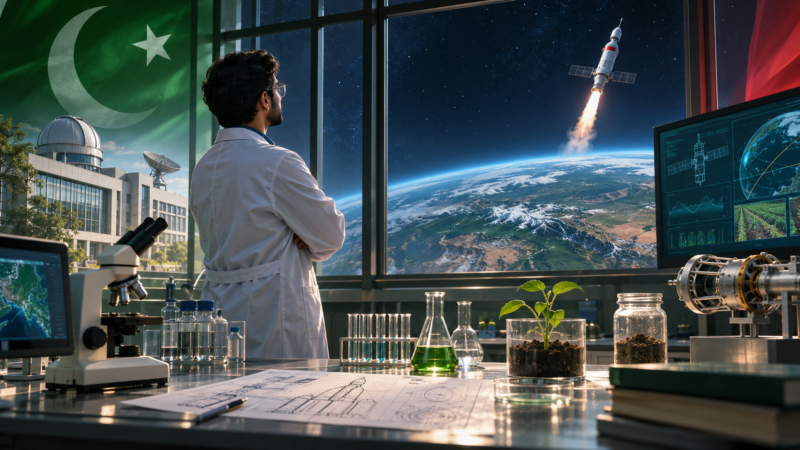
It is an immensely proud moment for Pakistan that one of its scientists, Zeeshan Ali, has been named a crew member of China’s Shenzhou-24 space mission which is scheduled to launch tomorrow (Wednesday). Ali is all set to become the first Pakistani to undertake an orbital space mission.
This event should also become a moment to ask an uncomfortable question: Why do we always find ourselves in a situation where we have to celebrate achievements of individual scientists without building institutional capacity which should allow scientific inquiry to become a normal way of life in society?
While it is true that Pakistani society has produced immensely successful and eminent individual scientists, we have failed to create a scientific culture in Pakistan.
In the modern world, science and technology are not simply luxuries. We must realize that modern state and governance are not possible without scientific knowledge and technological capabilities.
We are primarily an agricultural economy. Modern agriculture is not possible without scientific research, soil analysis, climate forecasting and modern irrigation. Even a half literate society cannot lead a normal life without public health arrangements readily in place. And public health depends on medical research and technological infrastructure. Our military capabilities are increasingly dependent on Artificial Intelligence, cyber capabilities, space technology and state of the art surveillance systems. We are living in a world which is increasingly becoming economically competitive—and this depends on automation, engineering innovations and technological productivity.
Therefore, we can safely conclude that Pakistan’s development problems are not simply financial and administrative. Our problems are a product of insufficient technological and scientific capacity.
Pakistan has suffered because of ignoring and neglecting scientific approach towards life in several areas.
We have experienced recurring floods and have suffered immensely because of insufficient investments in scientific water management. We have suffered air pollution and environmental degradation as we don’t possess adequate technological facilities for monitoring and enforcement.
Our cities have suffered because of urban congestion and unplanned urban expansion because we have not sufficiently equipped ourselves to manage our urban planning. Our public health crisis is worsening because of inadequate scientific research and institutions. We should realize that these are not isolated failures. Rather these cases reflect our inability to do research, evidence-based decision-making and scientific reasoning central to our planning.
Consider some of the structural flaws in our system: Our Education system rather frequently rewards memorization instead of making questioning, experimentation and independent thinking, the central activities in our education system.
Universities operate without adequate funding for research and laboratories within the universities don’t have an organic link with the industrial sector. Political decision-making is driven by short-term consideration.
Cooperation with China in science and technology could open new avenues for Pakistani society. China is producing cutting edge technology. It is bypassing the west in research and development. In the 1980s China started its journey by borrowing and importing technology from Western European and American societies, even though China didn’t have smooth and normal political relations with these societies.
We have strong political and strategic relations with Chinese society and state. We can learn immensely from China’s advancements in science and technology.

Your go-to editorial hub for policy perspectives and informed analysis on pressing regional and global issues.