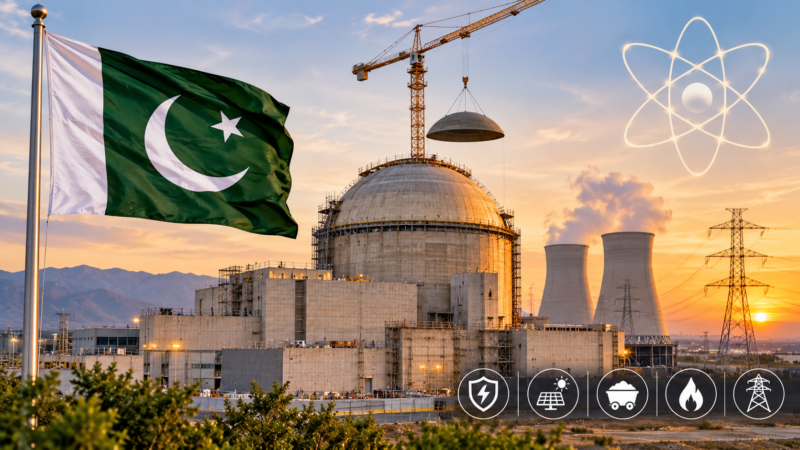
The installation of the dome on the Chashma-5 reactor building on November 10 marks a major milestone in Pakistan’s nuclear energy programme. Prime Minister Shehbaz Sharif chaired the event and said the 1,200 MW project will contribute significantly to the country’s energy security, with power generation expected from September 2030. This was important against the backdrop of the closure of the Strait of Hormuz, which brought Pakistan’s energy vulnerabilities into the limelight.
Estimates suggest that roughly 80 per cent of the country’s crude imports transit the strait, and the war also put LNG from Qatar at risk, which fuels about a tenth of electricity generation. In March, the power minister told Reuters that 74 per cent of electricity now comes from domestic sources (Solar, Wind, Coal, hydropower, and nuclear), with a target of 96 per cent. Nuclear energy is a key part of that work. The installed capacity of six units, at 3,530 MW, is slightly more than 7 per cent, and their electricity generation is around 17 per cent.
Dome, however, is a milestone and not an outcome. But the ultimate test of Chashma-5 is not whether the reactor is built, but the system to which it is to be hooked up and the strategic options involved. Four imperatives remain:
The first is delivery discipline. Pakistan’s Energy Security Plan (2005-2030) planned 8,800 MW of nuclear power generation by the end of this decade. With Chashma-5, the total will be about 4,730 MW, just over half of the target. The project was approved at Rs1.048 trillion ($3.7 billion), while the contract was awarded at $4.8 billion, and published estimates differ. Nuclear power projects are rarely delayed because of the technology. They are weak, lose time and increase expenses. The Pakistan Nuclear Regulatory Authority (PNRA) should therefore be properly resourced and supported by a pipeline of trained engineers and operators. At the same time, costs and timelines are reported transparently. It’s good that construction is ahead of schedule, but it should not be a point of bragging.
The second imperative is to fix the power sector conundrums. Installed capacity reached 49,651 MW by March, far exceeding grid consumption as demand growth has slowed and rooftop solar has reduced daytime consumption. This year, consumers will be asked to pay Rs2,163 billion in capacity payments; circular debt has reached more than Rs2.6 trillion till mid-2025; and 13 independent power producers with a total capacity of 5,105MW are idle. Adding 1200 MW of capital-intensive baseload to such a system will offer limited relief unless contracts are renegotiated and distribution losses and theft are reduced.
The third is to make energy mix planning a whole-system approach. Since 2017, Pakistan has imported over 58 GW of solar panels, with 40 GW of Chinese solar panels imported since 2024. An estimated 36.3 TWh of solar generation has surpassed nuclear’s record output of 22.5 TWh. Planners haven’t driven this shift; households and businesses have reacted to high tariffs. Diversification hasn’t gone far enough in the meantime. In September, the share of generation using imported coal rose to 16.3 per cent from 8.1 per cent in the year-ago period, and the average fuel cost inched up 32 per cent to Rs9.4 per unit. Import dependence has fallen, but not been eliminated. Nuclear can provide night-time base load, if designed that way: Transmission, storage, and market rules must be designed concurrently. All this must be part of the country’s long-term generation planning and not treated as a standalone project.
The fourth is not to be too dependent. The Chinese are providing the majority of financing, approximately 85 per cent of the contract value, according to the World Nuclear Association, and Pakistan is not a signatory to the Non-Proliferation Treaty, which limits its access to the broader nuclear technology market and financing. It’s a quarter-century of success, from the first Chashma units to the Hualong One reactors near Karachi, and the IAEA safeguards agreement inked for Chashma-5 is a positive development. However, the one-supplier, one-lender approach has its limits. Islamabad needs to increase its capacity and local content, and broaden its array of financing and technical assistance.
Nuclear power also needs to be put in perspective. It is used to guarantee the electrical side of the Hormuz exposure. It does not affect the oil that gets Pakistan’s trucks and tankers moving, nor does it help the sea lanes that the oil passes through. Together with strategic reserves, shipping and port resilience – not just a single flagship project – energy security is the sum of these parts.
Hence, we can conclude that once Chashma-5 comes into operation in 2030, it will be evaluated on three criteria: cost, its ability to fit into the grid, and its effectiveness in reducing Pakistan’s vulnerability to shocks outside its control.

Musavir Hameed
Musavir Hameed Barech is a Research Officer at the Balochistan Think Tank Network (BTTN)