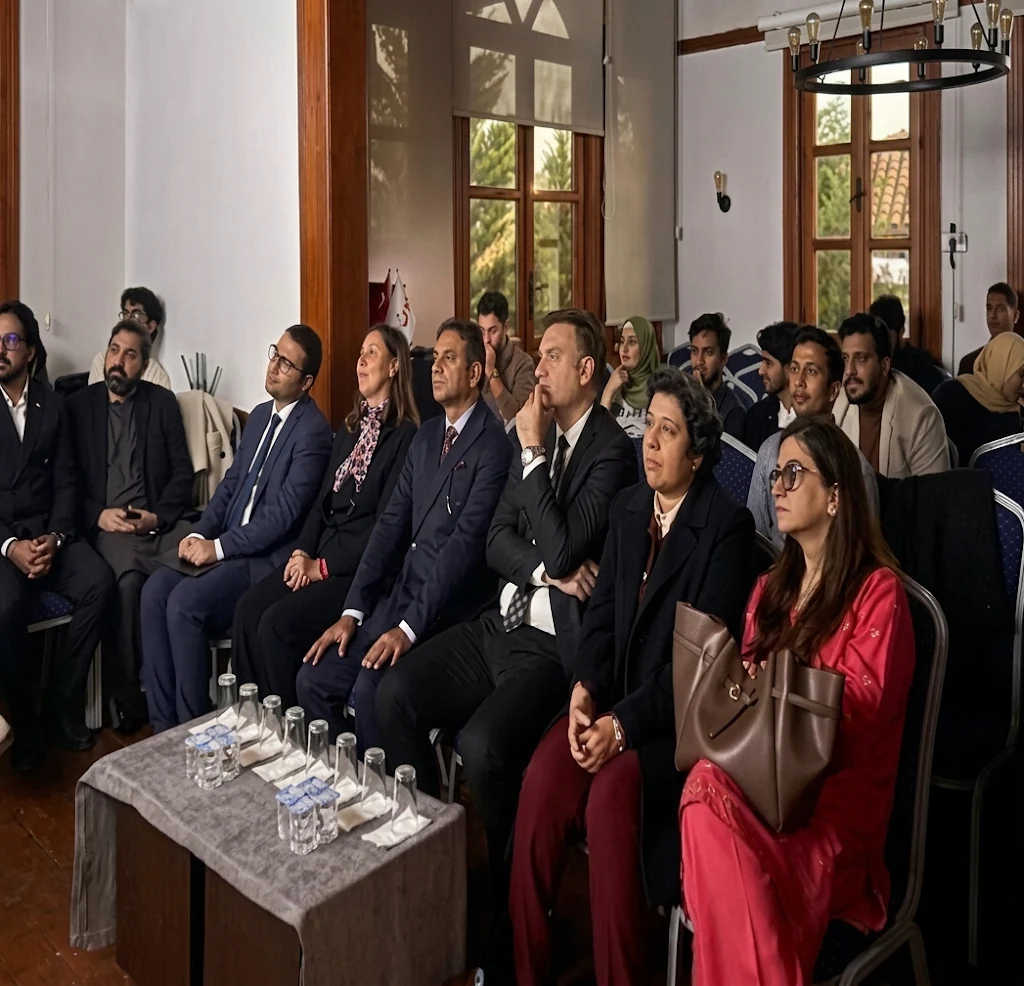
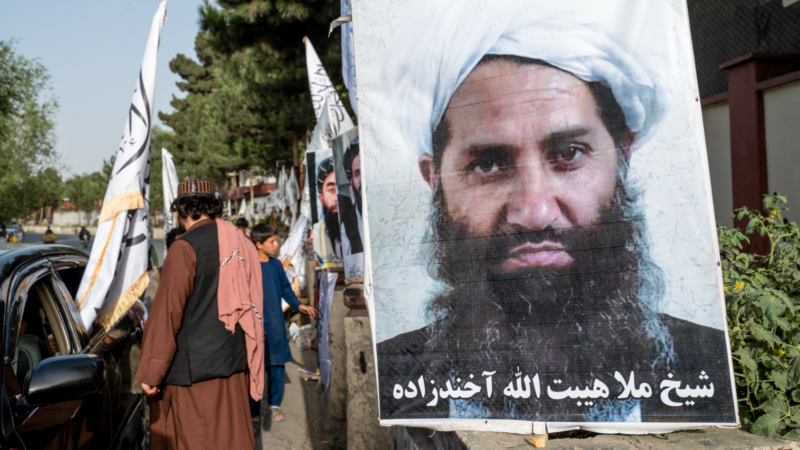
Taliban media has claimed that a gathering of scholars held at Kabul University on 16 and 17 November declared Mullah Hibatullah as Sheikh al-Islam. This step by Mullah Hibatullah is a sign of his lust for power and personality cult. In the 1448-year history of Islam, no person has ever presented himself for this title.
Always, the people of knowledge in the Muslim world, impressed by someone’s scholarly status, have acknowledged that status with this title. From Sheikh al-Islam Mufti Taqi Usmani onwards, whenever any personality was given this title, he acted with humility, described himself as a student of religion, and said that he was not worthy of the title. Mullah Hibatullah is the only oddity in Islamic history that, using state power, gathered his preferred people under official arrangement and forced them to accept him as Sheikh al-Islam.
Even more ridiculous is that this proposal presented under government arrangement was not even formally approved by this official gathering. Sources present in the gathering reveal that the head of the Haqqani Network, Sirajuddin Haqqani, reacted strongly to it and said in his speech: “In Islam, no single individual has the right to establish dominance.
He also admitted that many people disagree with Hibatullah. And by name he forbade praising Hibatullah, saying work, without the support of the people this system will fail.” Not only this, but information is that after Sirajuddin Haqqani’s speech, scholars belonging to the Haqqani group got up and left the meeting. Seeing this, the opinion of the scholars was not even taken on this resolution. It was simply announced in their controlled media that “the scholars have declared Hibatullah as Sheikh al-Islam.”
THE REALITY AND STATUS OF THE TITLE OF SHEIKH AL-ISLAM:
The title of Sheikh al-Islam has been used since the early centuries of Islam as recognition of knowledge for such masters of knowledge and wisdom who were the most prominent scholars of their era and were considered imams of Islamic teachings. Imam Ibn Taymiyyah (may Allah have mercy on him), Imam Ibn Hajar al-Asqalani (may Allah have mercy on him), Imam Ibn Kathir, Imam Zakariya al-Ansari and such scholars are examples of this. It was purely recognition by the people of knowledge of the scholarly status and rank of a person of knowledge.
The Ottoman Caliphate formally gave this title legal status. Here the Sheikh al-Islam used to be the highest religious official appointed by the Sultan. The legal status of the Ottoman Sheikh al-Islam was somewhat more than that of the Chief Justice.
He used to guide the entire caliphate including the Caliph in Sharia matters, and he could also review the Caliph’s actions and decide whether they were correct or wrong. There are many examples in history where the Caliph made a decision and took it back when the fatwa of the Sheikh al-Islam came. It was a kind of religious check on the Caliph and the state. (Here, while being the ruler himself, Hibatullah is demanding this authority; where did the check go?) The powers of the Ottoman Sheikh al-Islam included issuing fatwas, supervision of Sharia and legal matters, supervision of judges and religious institutions, and guidance and accountability of the state.
After the end of the Ottoman Caliphate, this post also ended. Since then, it has been a title used by contemporary scholars as recognition of the knowledge and insight of someone, but no one has tried to declare himself Sheikh al-Islam like Hibatullah.
Why Does Hibatullah Want to Become Sheikh al-Islam?
It is an important question why Hibatullah was so eager to declare himself Sheikh al-Islam that he himself gave himself this honor through official arrangement. One fact is that psychologists claim that when the feeling of inferiority exceeds limits, a person becomes afflicted with the disorder of declaring himself honorable.
In the past, declaring himself Sheikh al-Hadith and then Sheikh al-Hadith al-Quran are such signs in whose presence this claim can be accepted. But the second and even more important purpose is Mullah Hibatullah’s lust for power and his pathological method of keeping powers concentrated in his own hands. In the recent past, he has already taken from the Prime Minister the authority to call cabinet meetings.
He has snatched the power of decisions from ministers. From appointments and transfers of the armed forces to the appointment of the lowest level state officials and technical issues like the budget, the gentleman has taken them under his grip.
Now through this title, he has also seized the decision-making power of ordinary judges, and has tried to deceive the public that as Sheikh al-Islam he has the right to enforce whatever Sharia interpretation he wants. Under the cover of this title, he has tried to obtain the authority to behead his opponents, and the authority to force the entire country onto the jurisprudence of his choice. This was his purpose.
The gathering held under the Taliban’s higher education authorities brought the scholars together to endorse his decrees. Giving a historic scholarly title to a person who already holds the rank of Amir al-Momineen sends an unambiguous message that religious authority and political power are concentrated in one person. Akhundzada’s presence in the capital and his address to the crowd leaves no room for doubt that obedience to his leadership is unconditional.
Hibatullah’s Address as Sheikh al-Islam:
Mullah Hibatullah said in his address at Kabul University that “the multiplicity of schools of thought in Afghanistan has ended, now he has chosen the path, and everyone will follow the Hanafi school, no one will be allowed to act on Shafi’i jurisprudence.” He further said that all decisions of the Taliban courts have now become uniform, and this is the result of his order and decision.
The Taliban Supreme Leader also demanded from the mullahs affiliated with the group that they firmly support the Taliban rule and strive by every possible means to sustain it. Akhundzada expressed concern in part of his speech about the emergence of internal disputes among Taliban members, and appealed to the mullahs and members of the group to preserve their unity and stand firm in support of the Taliban regime. He ordered the judges that “all decisions of death and harsh punishments should first come to him for approval.”
At this occasion, every single word of Hibatullah’s one-hour-ten-minute long address is enough to prove that Hibatullah is not even worthy of being called a legitimate Muslim ruler, let alone Sheikh al-Islam. Every single word of this address of his is announcing that this person can at most be a sectarian extremist, but is absolutely not worthy of a high and lofty position like Sheikh al-Islam.
A person who does not even accept any other jurisprudential meaning of Islam other than his own interpretations, rather declares it a crime, he is not even Sheikh al-Islam. On the one hand, he does not have the right to become even a mufti of Hanafi jurisprudence, because Hanafi jurisprudence is the most moderate and practical interpretation, in which the negation of coercion is present at every step.
If a cursory review of the gentleman’s address is taken, then in his address he wrongly used Quranic verses and blessed hadiths for his power and announced that “the status of the nation is that of a flock of sheep, whose shepherd is the Amir.”
Here the term shepherd has been used in the sense of servant and protector, that just as a shepherd is responsible for every need of his sheep and does not let any harm come to them, the same is the responsibility of the Amir.
That is, the jurists used the words of shepherd to make the Amir realize his responsibility. But Mullah Hibatullah took it in the meaning of “owner” and declared the public as his property, that is, slaves, and openly announced that “no one has the right to choose a school of thought and jurisprudence without Hibatullah’s will.” This is his one hundred percent action against Islam, rather open rebellion against the teachings of Islam.
His second announcement was that the judiciary, which was already bound and compelled by his orders, whatever minor authority it had to make decisions, he also snatched that and announced that every judge will issue his decision after Hibatullah’s approval. This announcement is also one hundred percent rebellion against the teachings of Islam, rather against the orders and decisions of the Master, our Prophet Muhammad (peace be upon him).
The Prophet (peace be upon him) made agreements with the Jews of Medina, and even gave them freedom of worship. When the delegation of the Christians of Najran came, he gave them permission to worship even in the Prophet’s Mosque. And this Hibatullah is saying that he will not let anyone pray under the jurisprudence of any other imam except Hanafi jurisprudence. Where is the Islam in this? This is rebellion against the teachings of Imam Abu Hanifa himself. Whatever Hibatullah is saying and doing is absolutely not Islam or Hanafi jurisprudence. This can at most be some new self-made Kandahari jurisprudence; it is not an interpretation of Islam under Islam or Hanafi jurisprudence.
Taking the authority of decisions from judges and limiting it to his own person is against the spirit of justice in Islam, rather it is its massacre. In the Islamic system of justice, from Sayyiduna Abu Bakr (may Allah be pleased with him) to Sayyiduna Ali al-Murtaza (may Allah be pleased with him), every Caliph remained answerable to the judge, that is, the judiciary. Rather, personalities of high status like Sayyiduna Umar (may Allah be pleased with him) and Sayyiduna Ali (may Allah be pleased with him) appeared in courts, became part of the proceedings, and decisions also came against them and they accepted those decisions.
If the authority of decision is given to the ruler, then what remains of the justification for the ruler being subject to the judiciary or of accountability. Both announcements of his speech prove that Sheikh al-Islam is a very big post; Mullah Hibatullah is not even qualified to become an ordinary ruler.
EFFECTS OF MAKING HANAFI JURISPRUDENCE MANDATORY AND BANNING OTHERS
Mullah Hibatullah Akhundzada has clearly announced in the recent gathering that in Afghanistan following only Hanafi jurisprudence is mandatory, while acting on Shafi’i jurisprudence is improper and against the law. This decision is not merely a claim of religious uniformity but part of a political and religious strategy whose purpose is to completely end religious diversity in Afghanistan and establish a rigid, centralized religious system under the Taliban.
The apparent purpose of this decision is to end differences in the judicial system, worship, and educational institutions and drive everyone on one coercion. Akhundzada himself said that the Amir chooses one from among the opinions of the jurists and enforces it. Behind it the bigger purpose is to further strengthen his absolute status and declare any kind of religious or jurisprudential opposition illegal.
This announcement is in fact an open declaration of war against Salafis, Shia, and Hazara Muslims. Now no additional justification or pretext is needed for action against them. Only this order of Hibatullah is enough to declare the followers of these schools as “against Sharia” and close their mosques, madrasas, educational institutions, and other centers.
The biggest and immediate result will be that action against these minorities will intensify ruthlessly. Their mosques can be seized, the right to worship in them can be taken away, and restrictions can be imposed on their scholars and students.
This policy will not only end religious freedom but will further increase sectarian tension in Afghanistan. The Hazara, Salafi, and Shia communities who are already facing restrictions can now also become targets legally. Thus this decision provides the Taliban government with formal justification for seizing the institutions of these minorities and limiting their religious activities.
If Hibatullah’s this announcement is seen in the light of the collection of laws issued in January 2026, then an extremely frightening picture emerges, because in clause 13 of that law, those people who have been given the authority to kill for expediency, that is, without crime, among them under sub-clause 1 is included the one who continuously spreads corruption, while yesterday he has declared everyone except Hanafi jurisprudence as corruption.
Under sub-clause 2 the one who attempts corruption, under sub-clause 4 the one who defends a false belief, under sub-clause 5 the one who gives education and invitation of a false belief is also deserving that he be given the death penalty only for expediency. Now that he has declared only his preferred version even of Hanafi jurisprudence as truth, the rest have all been declared false and corruption. Therefore now every Salafi, every Shia, and every Hazara will be liable to be killed.
HIBATULLAH’S NEW FACE AND AL-QAEDA
Mullah Hibatullah is declaring himself Sheikh al-Islam and announcing that acting on Shafi’i jurisprudence will be a crime. The question is, will he also enforce these laws and orders of his on Al-Qaeda, ETIM, and other Arab and global terrorists? Because Al-Qaeda’s official school is Salafi, that is, these people are also Shafi’i, Maliki, and Hanbali.
- Will Hibatullah take action against Osama bin Laden’s Shafi’i son Hamza bin Laden?
- Will the same law be enforced against Saif al-Adl who holds the Shafi’i school?
- Will action be taken against the head of ETIM present in Kabul, Abdul Haq Turkistani, who is Maliki?
- Will action be taken against the governor of Panjshir, Gul Agha, who is Shafi’i?
- The fact is that the foreign terrorists on whose basis Hibatullah has established his dominance over Afghanistan are all Shafi’i, Hanbali, or Maliki. What will happen in their case?
It can be said with certainty that Mullah Hibatullah will use the same old hypocrisy here that the Afghans whose massacre he is carrying out on these grounds, Al-Qaeda will be exempted from it. Exactly in the same way that in his book Aqeedah Ahl al-Sunnah he has declared raising weapons against Muslims a crime, and has kept the killer of Muslims TTP in his lap.
Saifullah Khalid
A senior journalist, editor, security analyst, and columnist with 35 years of experience. Since 2001, he has extensively covered political and strategic developments in Afghanistan and Central Asia since 1991. He has authored 4 books , 2 on Afghanistan. In 1994, he authored a book on Afghanistan titled Main Ne Kabul Jaltay Dekha (I Saw Kabul Burning), and in July 2026, he published his book Taliban Ka Asli Chehra (The Real Face of the Taliban) in Urdu.