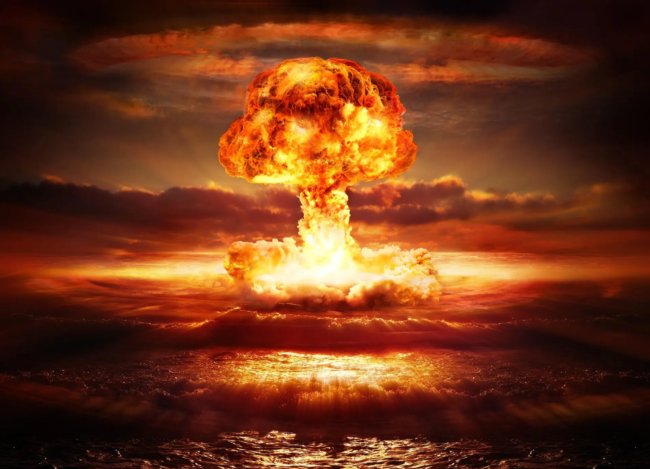
“The unleashed power of the atom has changed everything save our modes of thinking, and we thus drift toward unparalleled catastrophe.” Albert Einstein never worked on the atomic bomb, yet his equation E=mc² and a 1939 warning letter played a key indirect role in launching the American nuclear effort.
On 2 August 1939, Einstein wrote to US President Franklin D. Roosevelt that recent work in nuclear physics made it probable that uranium could become a new and important source of energy, one that could be used for “the construction of extremely powerful bombs.” Alarmed by Germany’s decision to halt uranium sales from occupied Czechoslovakia, the letter set off the $2 billion, top-secret Manhattan Project, a race to beat Germany to the bomb. Led by physicist Robert Oppenheimer, it propelled the US into the nuclear age.
The destruction of Hiroshima and Nagasaki introduced the idea of deterrence to the world and, above all, to the US itself. John Mearsheimer, the American international relations scholar, argued in a 1998 New York Times op-ed that nuclear weapons are an excellent deterrent for states that feel threatened by rivals.
Soon the Soviet Union was racing to catch up. On 29 August 1949 it detonated RDS-1 (“First Lightning” to the Soviets, “Joe-1” to the West) at the Semipalatinsk Test Site in present-day Kazakhstan. Others followed: the UK on 3 October 1952, France on 13 February 1960, China on 16 October 1964, India on 18 May 1974, Pakistan on 28 May 1998, and North Korea on 9 October 2006, after withdrawing from the Treaty on the Non-Proliferation of Nuclear Weapons (NPT).
The NPT entered into force on 5 March 1970 and was extended indefinitely on 11 May 1995. Under it, non-nuclear-weapon states promise not to acquire nuclear weapons, nuclear-weapon states promise not to help them, and International Atomic Energy Agency (IAEA) safeguards verify compliance.
So if treaty members cannot build the bomb, and North Korea did so only after leaving, how do they deter their adversaries? The answer was the extended nuclear umbrella. The strongest example is the North Atlantic Treaty Organisation (NATO), founded by 12 countries and now 32 strong. Its three nuclear-armed members, primarily the US, alongside the UK and France, commit their nuclear capabilities to defend every member state.
Yet the umbrella has always carried doubt. In May 1961, in Paris, French President Charles de Gaulle famously asked US President John F. Kennedy: “Would you trade New York for Paris?” As RAND analyst Paul van Hooft reads it, the question was whether the Russians would be convinced if de Gaulle himself was not. Credibility, in other words, depends not on warhead counts alone but on the whole defensive posture. That is the argument of this piece: credibility rests less on whether someone would press the button than on whether the command structures, planning and doctrine behind that decision exist.
Those doubts long predate the current US administration. Russia’s 2022 invasion of Ukraine, and its growing nuclear coercion, put nuclear weapons back at the centre of European security for the first time since the Cold War, while Washington kept its focus on the Indo-Pacific and asked whether its own arsenal could cope with a growing China. Europe is now exploring alternatives. French President Emmanuel Macron says the French deterrent has a “European dimension,” and German Chancellor Friedrich Merz has spoken of engaging with the French and British forces.
Could they be enough? The numbers look lopsided. SIPRI’s 2026 Yearbook puts Russia’s arsenal at about 5,400 warheads, nearly 1,800 of them deployed, against roughly 280 deployed French and 120 deployed British warheads. Even so, van Hooft argues, that is enough to inflict unacceptable damage on Moscow and St Petersburg, and their submarines, patrolling far out at sea, are likely to survive a first strike. That makes them credible against existential threats to France or the UK themselves. Unlike the US, which needed a large, flexible arsenal and a major conventional presence in Europe to persuade its allies, France and the UK are in Europe and cannot separate their security from the continent’s.
Another accord, dubbed a “Muslim NATO” by some analysts, raises the same question. The Makkah Joint Defence Agreement, signed in Makkah on 7 August 2026 by Saudi Arabia, Türkiye and Pakistan, follows a NATO Article 5-style framework: an armed attack against any one of the three states is to be regarded as an attack against all. It builds on the Pakistan-Saudi Strategic Mutual Defence Agreement of September 2025, and with Pakistan as the only nuclear-armed signatory, ambiguity about a nuclear umbrella has hung over it from the start.
That ambiguity surfaced almost immediately. Asked on Geo TV whether the deterrence Pakistan gets from nuclear weapons would be available to Saudi Arabia, Defence Minister Khawaja Asif said, “What we have, and the capabilities we possess, will be made available to (Saudi Arabia) according to this agreement.” In a separate interview with Reuters, he denied that nuclear weapons were part of the accord, saying they were “not on the radar.”
Analyst Dr Zahir Kazmi, writing in CISS StratView, reminds us t
hat deterrence was never a guarantee against attack, harassment or provocation. Its real effect is to make aggression and escalation carry unacceptable risks. Pakistan’s Full Spectrum Deterrence aims to do exactly that across the whole range of aggression.
So “Would anyone really press the button?” is less about a single act than about response and timing. Deterrence does not mean pressing a button and watching the adversary vanish. True nuclear guarantees, like NATO’s Nuclear Planning Group, in which non-nuclear states such as Türkiye take part, require integrated command-and-control structures, joint planning and explicit operational doctrine. Pakistan has announced none of these for the Makkah pact. Its doctrine has historically been built around a South Asian framework centred on India, so formally extending it to the Middle East looks unlikely. It would also be legally and politically complex, since Saudi Arabia and Türkiye are NPT parties that have committed not to acquire nuclear weapons.