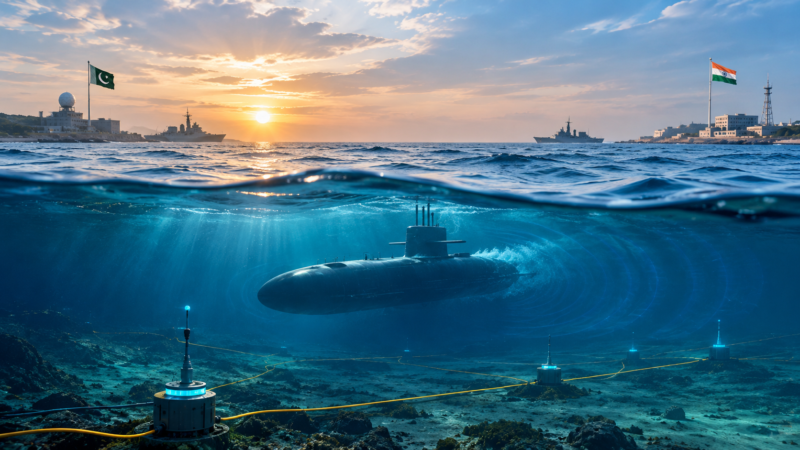
On 30 April 2026, Pakistan ordered its first Hangor class submarine, PNS/M Hangor from Sanya, China. On September 26, 2026, it fired its first missiles live off the coast of the North Arabian Sea, in the same submarine.
The two developments are the first steps towards the deployment of Pakistan’s sea-based nuclear deterrent in increasingly surveilled waters.
The Defence Research and Development Organisation (DRDO) is working on the creation of an Underwater Fibre Optic Sensing System (UFOSS), a network of sensors that will be deployed on the ocean floor to monitor submarines in the Indian Ocean, according to Indian media reports in July 2026.
On October 31, 2025, India and the United States also inked a 10-year defence partnership, with one of the key areas of cooperation being Underwater Domain Awareness (UDA). This is also backed by India’s National Quantum Mission (NQM) that has an estimated budget of about US$740 million.
The primary focus for strategic stability is not what quantum-enhanced sensing can do today; it is still in a fairly immature stage of development. It is also a worry what military planners in Islamabad and New Delhi think it is going to attain.
If there are no maritime confidence building measures between two countries, even the knowledge of the other country’s capability can affect military decisions.
There are three significant knowledge gaps in detection, analysis, and perception that can lead to an unproven technology to become a source of instability. This needs to be guarded against in both countries.
Possibilities of Quantum Sensing
New methods for object detection are achieved with quantum sensing which go beyond the limits of traditional acoustic methods. Changes in the Earth’s magnetic field due to the metal hull of a submarine can be measured with an optically-pumped magnetometer. Laboratory experiments have produced a very high sensitivity, in the femtotesla range.
Practical detection is still several hundred meters (not kilometers) away, however. Quantum gravimeters and gradiometer are able to measure small gravity changes due to the presence of a mass underwater, but are not widely incorporated into operational platforms.
Cold-atom navigation systems can also be used to assist submarines in keeping track of their location for extended periods without external navigation signals. This might be useful to both submarines trying to evade detection and submarines that are trying to track them.
But this quantum communication is not capable of detection of sub-marines. It is used to secure communication between sensors from being rogues. India’s Physical Research Laboratory (PRL) has shown this by sending an entanglement-based encryption key over 300 meters of open space.
Three Asymmetries
The first is in detection. The four hubs of the National Quantum Mission in India form the part of a larger system comprising twelve P-8I aircraft, upcoming UFOSS network and working with Washington through the UDA framework. Single sensors are still predominantly used for research. But if they are linked together in a larger network, their values increase given that one sensor’s information could aid in a second sensor’s work.
The second one is not in detection but in analysis; and it could be of greater significance than detection itself. If the magnetic activity changes, it’s just information until analysts have determined what it is. They need to differentiate submarine operations from changes in the sea bed, shipping activities, and marine life.
This needs comprehensive information on various underwater signals, which have been developed over many years, and centers where data from various sources can be integrated. In the Cold War era the American Sound Surveillance System (SOSUS) was more than effective at detecting Soviet submarines; the data base of the American navy on submarine signals was much too large for others to duplicate.
Pakistan does not have a database and resources to build one in a short period of time. So, the biggest problem with it is not that there aren’t enough sensors on it, but rather, there isn’t enough information and analytical power to interpret what the sensors are detecting.
The third gap has to do with perception. Currently, and likely over the lifetime of a submarine commissioned in 2026, no one can be sure of what such a quantum-enhanced monitoring network, assisted by international partnerships, will be able to detect.
Military planners could not possibly know what their opponents have or haven’t demonstrated, and may not be able to rely on information systems which share information and verify claims.
In fact, the 2025 survey by the British American Security Information Council (BASIC) revealed that the more advanced and mature the technology, the more disruptive it is seen as being during crisis situations. The approach to thinking might have an impact on the way military planners perceive quantum sensing.
How Belief Breaks Down Force Posture
When a relatively small and still developing submarine force is concerned, the fears of vulnerability may lead it to change its military posture in a number of ways. First, it may raise its patroling frequency to keep the deterrent effect visible but at the same time, higher patroling can lead to greater exposure to the monitoring.
Secondly, it might be more aware of the need to operate in protected areas that are close to its own territory, acknowledging that security is worth less in terms of freedom of movement.
Third, the proliferation of sea-based cruise missiles would make it more difficult to tell the difference between conventional and nuclear military exercises in a crisis. Fourth, if communication with senior command is lost, the concern of new detection technologies may impact the decision-making process of who will assume command.
Limits also exist due to the number of submarines available. The eight Hangor class submarines that Pakistan has ordered for around US$4-5 billion in 2015 have to be trained and maintained and routinely patrolled. This means that only one or two submarines are at sea at any time.
During the period of tension, increased submarine activity can be seen as an indication of military intent by India. There is no formal agreement between the two countries that has been established to control naval incidents, and no maritime crisis hotline has been established, nor are there any procedures for avoiding misunderstandings between submarines.
Unlike the 1972 U.S.-Soviet Union pact, and the 2014 Code for Unplanned Encounters at Sea (CUES) that involves India and not Pakistan. The naval front was relatively quiet during the crisis that occurred after the operation Sindoor in May 2025. But in the event of another crisis, they can assume that they can keep a check on their fellow submarines, which may limit the amount of room for maneuver.
Cheaper Answers Than Counter-Sensors
The gap is between the information and its understanding and assessment in Pakistan’s undersea domain. Thus, its answer should be based on research and analysis and not on identifying and repeating India’s technology. One doesn’t need to have the same capabilities as the other.
It involves a decision maker getting a grasp of the difference between proven technological performance and research-based claims. It will be far less expensive to train engineers to understand the quantum technology and evaluate naval developments than to develop the entire system of new sensors.
Pakistan should refrain from investing in a costly program that it might not be able to sustain. Rather than that, it should work on strengthening its capacity to evaluate new technologies, fine-tune the existing naval procedures, keep the roles of conventional and nuclear submarine apart and form a research team to keep an eye on the technology developments in India and America.
There are five simple steps that could help defuse misunderstandings between the two nations without needing to make large financial investments. India and Pakistan should first agree on the management of naval incidents and have a direct maritime crisis hotline similar to the one in 1972 between the US and USSR.
Secondly, the two countries should think about giving advance warning of submarine movements and sea missile tests. Third, they should not follow one another’s strategic submarines in a manner that could lead to confrontation. Fourth, India needs to be more transparent on the extent of limitations of its monitoring systems, such as what it is unable to monitor.
Be transparent about what technology can and cannot do may be more reassuring than just making announcements about technological achievements. Fifth, the U.S. needs to marry the transfer of Underwater Domain Awareness to India with a clear message on Indian usage.
If not, Pakistan might see this co-operation as a project to build facilities that are targeted at monitoring Pakistan’s strategic submarines. Pakistan’s top priority should be to form a permanent maritime assessment team and differentiate its conventional and nuclear naval policies.
The quantum layer in the Indian Ocean is not yet a reality of technology but is definitely shaping strategic thinking.
The maritime stability of the region may be impacted even before the quantum sensors are deployed underwater given the differences in investment, limited submarine stocks and both countries’ calls for the worst scenarios. But there’s still a chance to implement low-cost protective measures and enhance communication between the two nations. But in the next big crisis, that may not be as available.

Marusha Kamran Hashmi
Marusha Kamran Hashmi is a researcher at the Centre for International Strategic Studies AJK (CISS AJK), where she works on international security, strategic affairs, and the impact of emerging technologies. She holds a bachelor’s degree in international relations and has published analysis in several outlets.