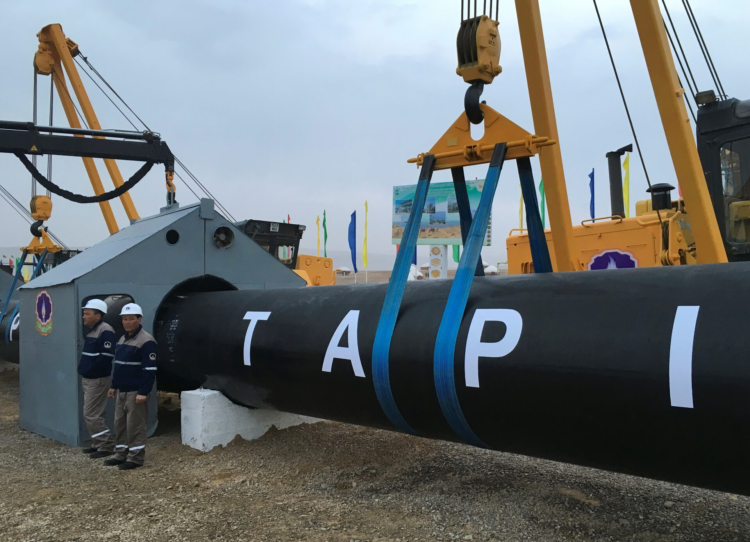
A new Turkmen offer has brought to light Islamabad’s attempts to keep the TAPI option alive as it looks for ways to avoid conflict and gas losses with Afghanistan.
On November 6, the Turkmen ambassador briefed journalists. According to the embassy, the goal is to supply gas via TAPI and electricity via TAP. On September 21, 2026, Pakistan launched airstrikes in Afghanistan that killed three civilians, according to a UN mission.
The offer is good value for money. Ashgabat has been pushing for the pipeline but lacks the money and know-how to build it on its own. Securing support from international institutions has been difficult because the Taliban government is not internationally recognized.
The offer also comes at a higher cost. The estimated cost of the TAPI line has been revised slightly upward, to some $10 billion, for a distance of 1,814 km. The pipeline will draw on the Galkynysh gas field, which holds 27 trillion cubic meters of gas. Turkmenistan can also supply up to 3,000 MW of electricity.
The biggest challenge is the conflict. Between October 2025 and June 2026, the UN mission recorded 499 civilian deaths and 1,216 civilian injuries resulting from hostilities across the border. Human Rights Watch reports that at least 28 civilians were killed in Pakistani airstrikes on June 29. Pakistan’s main land crossings are also closed.
Even a flawless Afghan section would not solve all the problems. Because of theft and leakage, a significant portion of the gas is lost from Pakistan’s gas network, and the upgrade of domestic pipelines, estimated to cost billions of dollars, has yet to be approved.
Meanwhile, Turkmenistan’s other offer is moving forward. At the start of 2026, Turkmenistan had already put forward plans to export electricity to Afghanistan, and talks on exports to Pakistan were under way. In September, talks on power transmission were held.
Both tracks remain active in Ashgabat. In June, President Serdar Berdimuhamedov announced that Turkmenistan was actively working on TAPI and on the electricity program with Afghanistan and Pakistan.
I read this as Turkmenistan playing it safe rather than gambling on the Afghan route. It is signing memoranda while continuing to study the Afghan line.
For Pakistan, the lesson is an unwelcome one. It must keep a peaceful frontier with Afghanistan if it is to remain a gateway to Central Asia. With every airstrike and border closure, Central Asian countries will be more inclined to look for other routes.
Pakistan’s fears are not baseless, and Pakistan is right to hold them. They are not excuses; they are facts. The first fear is Afghanistan. TAPI must pass through it. Any rational government would have to ask how it can spend $10 billion on a pipeline running through a war zone. No investor would put money into a pipeline that the next border clash could blow up, block, or shut down.
The second worry is internal. Even if TAPI gas reached Quetta tomorrow, Pakistan’s gas network could not handle it properly, and the system has not yet been fixed.
However, a fact becomes an excuse when it is used to prevent action rather than to enable it. Pakistan has grown complacent, making its fears a reason for inaction. Turkmenistan’s fears, by contrast, have spurred it to act.
Turkmenistan is frightened too. It fears depending solely on China and Russia for gas sales, and it does not want to be stuck in one place forever. It fears that without new buyers, its huge Galkynysh field will remain an underground fortune that is never extracted.
Pakistan, however, is hoping for perfect peace, a perfect gas system, and a perfect financing plan. In international politics, nothing is ever perfect. Policy means acting in spite of your fears.
If Pakistan was worried about Afghanistan’s instability, the right course would have been to establish a joint security mechanism for TAPI. The three countries should agree that the pipeline will be protected even during political tension. Afghanistan would also receive approximately $5 billion in transit fees over the 30-year period.
The policy should be to repair the gas system while TAPI is being built, not after it is completed. Pakistan does not have to wait for TAPI to solve its theft problem; it must solve the theft problem to be worthy of TAPI.
Central Asia is not waiting for Pakistan. In Uzbekistan, a railway is under construction. Kazakhstan is keeping an eye out for alternative routes. Turkmenistan is seeking other buyers. If Pakistan keeps its borders shut, the whole region will route around it. A nation that should be a link could become a bypass within a few short years.
What should Pakistan do now? It must act in spite of its fears. First, it should keep trade and politics apart by negotiating and signing a written TAPI/TAP agreement that commits all parties to continue even in tense times. Second, it should put its own house in order by implementing a concrete strategy to prevent gas theft and repair leaks. Third, it should immediately begin work on every section of the Quetta–Multan route. Investors respond to the substance of a commitment, not to rhetoric. They invest in action.
The glass is in Turkmenistan’s hands, and Pakistan is thirsty. The gas is there, and so is the power. Only one question remains: will we drink, or will we keep arguing?
Afifa Nawaz
The author is a researcher and scholar of International Relations at the International Islamic University Islamabad. Her areas of interest include South Asian and Central Asian affairs, energy security, regional cooperation, foreign policy, and international diplomacy.