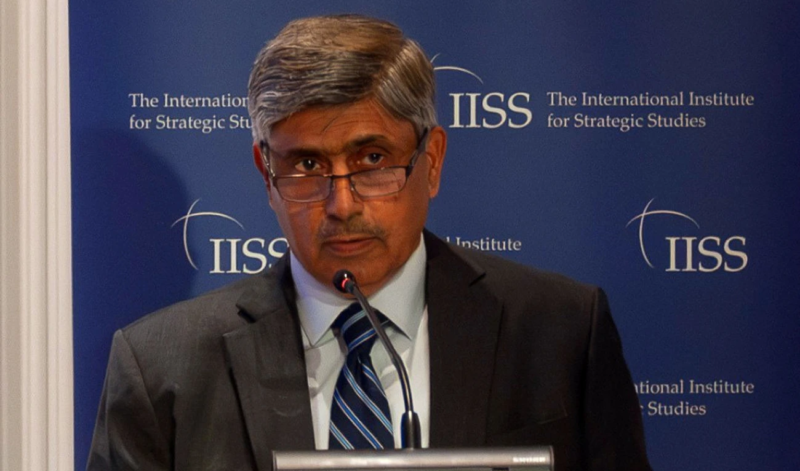
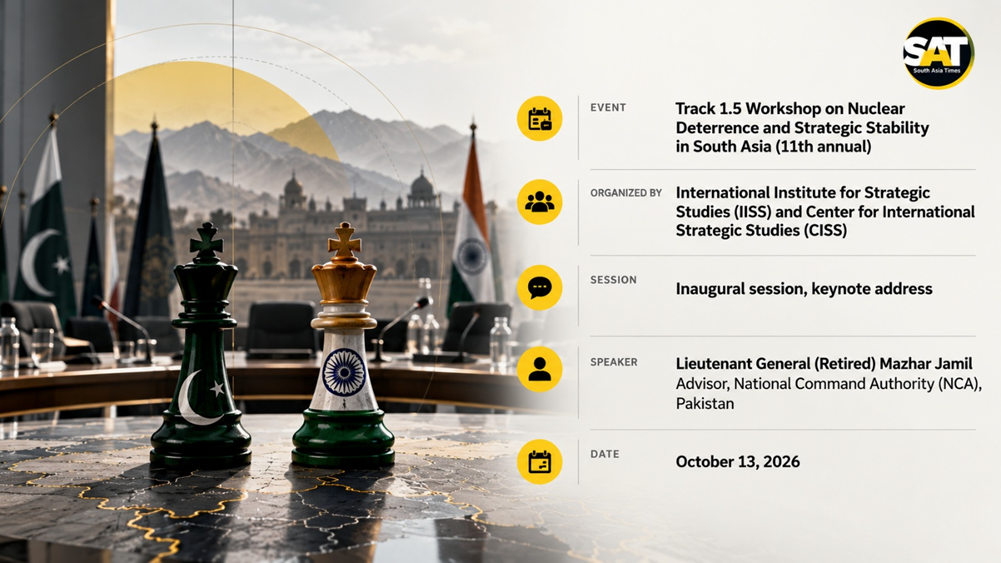
Lieutenant General (Retired) Mazhar Jamil, Advisor to Pakistan’s National Command Authority, delivered the inaugural keynote at the 11th annual workshop on nuclear deterrence and strategic stability in South Asia. The workshop was organized by the International Institute for Strategic Studies (IISS) and the Center for International Strategic Studies (CISS). He said the May 2025 crisis had narrowed the space between Indian posturing and Pakistani restraint, and he offered India political dialogue and a crisis management mechanism.
About this dialogue
Key points
- Stability starts at the political level. Strategic stability in South Asia cannot be read through a Cold War lens. It depends on resolving the Kashmir dispute under United Nations Security Council resolutions.
- May 2025 showed calibrated deterrence. Pakistan’s response, under its Quid Pro Quo Plus policy backed by Full Spectrum Deterrence, denied India the space to normalize coercion under the nuclear shadow.
- Indian moves are raising risk. He cited the Indus Waters Treaty being held in abeyance, a fast-growing Indian missile programme and reported nuclear deterrence patrols by Indian submarines, which he said dilute India’s No-First-Use claim.
- Terrorism as policy. He urged the international community to scrutinize alleged Indian support to the Tehreek-e-Taliban Pakistan (TTP) and the Balochistan Liberation Army (BLA).
- An offer of engagement. Pakistan is ready for political dialogue on all disputes, including Kashmir, and offers a robust crisis management mechanism as a first step, with impartial international mediation.
Full text of the keynote address
Distinguished audience, friends, good morning and as-salamu alaykum. I am indeed very thankful to [the] IISS and CISS for inviting me to deliver the keynote address on the 11th annual workshop. And I also extend very sincere appreciation for holding this workshop on a subject that has assumed far greater importance in the wake of the recent crisis in South Asia. I hope today’s discussions will be very productive and useful. So, with that short premise, let me begin by saying that I intend for today, first of all, to set the broader framework under which the strategic stability in South Asia should be discussed to make it meaningful. Why I am saying that is because sometimes we see that [the] Western and international scholarly communities evaluate the strategic dynamics of South Asia purely from the Cold War lens, which I sense is a different case study in many ways, particularly in the context of the political aspirations, the national strategic cultures, and also, the security perceptions of the states in South Asia.
So, before getting down to the deterrence stability and crisis management aspects, a strategic stability model for a region must take into consideration the political beliefs and strategic thinking of states, which form the basis of policies. And that shapes the strategic and security environment in the region.
So, when we talk of the stability, I believe the stability at the higher political plane is the key. So, therefore, the regional leadership have to rise to the highest standard of statesmanship to face the realities courageously with our opinion for peace and conducive political environment for resolution of all conflicts. This will actually ensure the stability in the higher political plane. The political and strategic thinking of states, therefore, should prefer [a] political approach because military adventurism, hegemonic ambitions are highly risky and unaffordable in the South Asian nuclearised environment.
Unlike the Cold War, the two South Asian rivals have outstanding disputes. Kashmir being the core dispute with the history of having fought three wars. And we have seen some recent crises in South Asia. So, it needs to be resolved as per the United Nations Security Council resolutions. But, ladies and gentlemen, what we are seeing, on the contrary, is [an] Indian political approach of avoiding the resolution of conflict, because perhaps Bharatiya [Indian] leadership believes it has no locus standi on Kashmir when it is presented on the multilateral forums. And, therefore, India tries to manage [the] Kashmir conflict with military violence within occupied Kashmir and through military aggression against Pakistan. This has not worked, and therefore Kashmir remains a nuclear flashpoint, seriously impacting the South Asian strategic and security environment.
The security perceptions in South Asia have not evolved in a vacuum. Indian revisionist and hegemonic political aspirations have [a] long history of Indian coercion and militant violence against all [of] its neighbours. Indian political ideology is based on its mythological concept of violence and revisionism, according to which South Asia, they believe, this traditional belief, that it belongs to [the] Hindu civilisation. And, not surprisingly, the country was given a dual name in the constitution, India, that is Bharat, clearly defining the strategic direction of the state to be Bharat. And while keeping the dual name of India, to conceal the revisionist concept of Bharat from the world. Bharat essentially is a revisionist concept that is rooted in reclaiming [the] vast landmass of South Asia and its domination by Hindu civilisation. Indian political forces, interestingly, do not shy away anymore in projecting what previous governments pursued covertly. Very surprisingly, the map of Mahabharat, the greater Bharat, as they call it, covering [the] entire landmass of South Asia, is on the display in the Lok Sabha. That’s the parliament of India, clearly giving the political direction to the state and the state organisations. So, no wonder, beyond [the] core nuclear [dyad] of India–Pakistan, India’s conflict with all other countries serves as a perpetual driver of [the] evolving security dynamics in South Asia.
And more recently, we see a political transformation, led by the extremist Hindutva doctrine, that seeks to marginalize and delegitimize [the] non-Hindu population of the state, especially the Muslims. This has introduced an additional layer of complexity to the regional security environment. This marks a significant shift towards a nationalism, which is prejudiced by extreme theological principles. So, what we see is that we have a nuclear-armed neighbour whose political and strategic thinking is subordinated to a revisionist, mythological outlook with an overconfidence to subdue its neighbours.
This dangerous political philosophy has trickled into the Indian political, strategic, organisational and even societal culture. This mindset has also, unfortunately, penetrated deeply into Indian military thinking. As a result, what we are seeing is that Indian military thinking is being shaped by a dangerous ideology, which conflates mythology with national power. [The] outcome is very risky and delusional Indian military doctrines with [a] poor strategic sense of nuclear realities [are] endangering South Asia and beyond.
It seems [that the] Indian leadership is frozen in time and is unable to break the shackles of history. Indian political- and mythological-laced stubbornness is not allowing India to realise three very fundamental but significant conclusions and lessons. Those are vital for the strategic stability in South Asia.
And if I may state these lessons, one lesson we learned from history. Conflicts outlast military adventurism and wars, unless [they are] resolved politically. [The] resolution of the Kashmir conflict, therefore, needs a political approach and dialogue to achieve stability at [the] higher political planes.
[The] second conclusion is that any military misadventurism between two nuclear powers can only escalate the crisis to undesirable consequences and cannot serve any purpose to the policy. [The] last two crises between Pakistan and India amply highlight[s] this aspect. Essentially, it needs to be understood by the leadership of India that it cannot dictate its unjustified and illegal policy objectives through military aggression to another nuclear power.
And if I may state the third lesson, which is very pivotal to [the] crisis dynamics of South Asia, and that is to be learned from the study of warfare. And let me quote here, Carl von Clausewitz, who warned, that ‘war is the realm of uncertainty and escalation is really a control ladder’.¹ War is the realm of uncertainty and the lesson from the history of warfare and theory alike is clear. Wars that begin with confidence and control often end with the realisation that control was illusory. In a nuclearised environment of South Asia, that realisation may come too late to manage safely, if [the] Indian policy of provocation with [a] false sense of achieving escalation domination continues.
So, resultantly, ladies and gentlemen, what we are seeing in South Asia are two diametrically opposing strategic approaches, directed by the political ideology of India and Pakistan, are at play, which define the strategic and security environment of South Asia. [The] Indian strategic approach seeks political and military dominance to be a regional hegemon with a revisionist political thinking. Whereas Pakistan’s strategic approach is directed to [the] resolution of conflicts through [a] political process with shared prosperity and to defend the sovereignty with strength against a regional bully. Pakistan’s initiative of political dialogue and offer of [a] long list of Confidence Building Measures [CBMs] did not make any headway with Indian hegemonic thinking.
Now let me share my views on how the global geopolitical environment and emerging destructive technologies are impacting the strategic stability of South Asia. To me, there are three major outcomes of [the] contemporary global strategic environment that have influenced [the] Indian leadership’s strategic thinking and behaviour.
The first major outcome is that in [the] Asia-Pacific balance-of-power struggle, India presented itself as a net security provider, to exploit this geopolitical competition for its own global power-projection ambitions. The US and Western powers did not dig deep into the actual political motives and capacity of India, [and] rather were too quick to grant this status to India. This, however, gave India a false sense of hegemon[y] in the region.
[The] second outcome relates to the support by Indian technology partners and, very strangely, also allowing India to get [a] Nuclear Suppliers Group [NSG] waiver, in spite of its irresponsible nuclear behaviour. Resultantly, India, now, is running one of the fastest-growing nuclear and missile programmes. This has been done with no regard and concern to arms control, a key factor in the strategic stability for the region. So, what we see, we now see India developing intercontinental ballistic missiles [ICBMs] and submarine-launched ballistic missiles [SLBMs] to reach the entire globe, with eight reactors outside International Atomic Energy Agency [IAEA] safeguards. That is very amazing. [As a] non-NPT [Treaty on the Non-Proliferation of Nuclear Weapons] state, [India has] eight reactors outside IAEA safeguards [which] are operating as a potential source of fissile material for nuclear weapons. So, from the nuclearisation of South Asia in 1974 [to] the nuclearisation of the Indian Ocean, Bharat speaks of its global power ambitions. I think what [we] should now worry about [is] this ambitious and revisionist state, reaching to most of their capitals with no restraints and transparency, even to its own technology partners.
[The] third outcome is about the policy of appeasement by certain powers that [has] made India think that its exceptionalism will always be acceptable to the world. Indian propaganda and [its] disinformation campaign was accepted without scrutiny and responsibility. No questions [were] asked to India about its human-rights violations in Kashmir and against minorities, where state institutions and Hindu extremists [are] conducting heinous crimes as a state policy. Kashmir [has been] under lockdown since 2019, where fear and torture of [the] Indian military rules in occupied Indian Kashmir, with no outside access. This is a very, very troubling example of state terrorism in this era. The UN Human Rights Commission reports aptly highlight Indian law [enforcement] forces’ atrocities and heinous crimes, we just need to read those. It is only a matter of time before internal uprising in Indian-occupied Kashmir boils over. That will have [a] serious impact on [the] security and stability of our region.
In parallel, India’s access to advanced technologies, space-based capabilities, dual-use weapons systems are also impacting the strategic stability. Dual-use platforms with precision-guided systems have blurred the lines between conventional and nuclear technologies, making it more dangerous for South Asia, due to its geographical proximities and also the sensitivities. This also has to be seen in the backdrop of [the] irresponsible behaviour of India. The case in point is the intentional BrahMos [missile] attack on Pakistan on 9 March 2022. Strangely, it took India 48 hours to tell its nuclear neighbour about this incident. 48 hours. While India claimed this to be an accident, it speaks volumes about the dysfunctionality of Indian command-and-control systems, and maybe the presence of some rogue elements in their organisation, because India never shared the findings of [its] investigations for [the] sake of transparency and building some trust. Likewise, the launch of dual-capable BrahMos missiles during [the] May 2025 crisis was a deliberate act of provocation that could have caused catastrophic miscalculation. So, ladies and gentlemen, it complicates the regional security dynamics, which already lacks institutionalised confidence-building measures and an arms-control mechanism aligned with the emerging technologies.
So, now let me mention here also, because this is a very important aspect of stability, during crises, how was the crisis behaviour of the two nuclear states of South Asia during the two recent crises, 2019 and May 2025? That explains the dynamics of crisis management in our region. The crisis-management mechanism, though [it] is very vital for crisis stability, but, I believe, the spirit and the key to success of such [a] mechanism essentially remains a responsible behaviour of the leadership during the crisis.
During [the] 2019 crisis, Prime Minister Modi bragged at an election rally that India was not storing nuclear weapons for Diwali, openly threatening to use nuclear weapons. That exposes the Indian No-First-Use [NFU] policy, which Pakistan never believed anyway. Later, Prime Minister Modi outrageously called the night of 27 February 2019, right in the middle of [the] confrontation, ‘Qatal Ki Raat’, which means ‘Night of Slaughter’. Basically, boasting that India could have struck Pakistan with missiles to inflict huge human casualties. Such rhetoric and nuclear saber-rattling is inconceivable during the crisis, and that too from the highest leadership of [a] nuclear state. One really wonders whether there is any concept of institutionalized command and control of nuclear weapons in Bharat. That’s a bigger question. We need to really look at it.
Likewise, during the May 2025 crisis, Indian leaders immediately, within [the] first hour, blamed Pakistan for [the] 22 April attack in Pahalgam, without presenting any evidence or waiting for any investigations. In spite of Pakistan’s offer of investigation, India launched [a] military offensive, breaching Pakistani sovereignty in an unprovoked fashion.
India’s reformatted Dynamic Response Strategy [DRS], aimed for escalation domination, whereby India planned to intimidate Pakistan by sheer force and [the] tempo of the operation and conflict. This delusional military strategy was predicated on the assumption that India owns the escalation ladder. And, as if Pakistan has no right to respond. However, this overconfidence and such reckless military doctrine of escalation proved seriously flawed. As Indian planners [grossly] underestimated Pakistan’s resolve and capability, [the] Indian political and military leadership was completely surprised by the quality and strength of Pakistan’s response. [The] crisis of India’s making could have taken South Asia to the brink of nuclear catastrophe, saved only by the strategic restraint of Pakistan. The Indian military losses and failed military strategy is now known to the world. I need not go into those details.
During the crisis, [the] Indian leadership openly dismissed Pakistan’s nuclear deterrent as mere nuclear bluff, and even boasted about the ability to break Pakistan apart. And Defence Minister Rajnath Singh went so far as to claim that fully deploying India’s navy could have fragmented Pakistan further. Such irresponsible statements signaled an abnormal strategic behaviour and a dangerous disregard to the nuclear realities. A serious concern that should worry the world now is that when rhetorics and overconfidence becomes a policy, then you are bound to make blunders and may get into a commitment trap.
On the other side, Pakistan responded to the crisis with strong resolve and cost to the aggressor. But it was not an impulsive retaliation, rather a response with a clear political direction and strategic restraint. When India violated Pakistan’s sovereignty with missiles and strikes on May 6, 7, and 8 [2025], Pakistan exercised its right to self-defence under the UN Charter. Pakistan’s response was calibrated, precisely targeted at Indian military assets, and with strategic clarity [on] how to respond if it escalated. India was effectively deterred, and Pakistan’s operational response achieved its intended effect. It denied India the space to normalize coercive conventional aggression under the nuclear shadow, and established the new normal of punishing the aggressor with strength.
This reflects the effectiveness of Pakistan’s professed operational policy of Quid Pro Quo Plus [QPQ+], a strong, integrated, conventional response to aggression, while Full Spectrum Deterrence [FSD] remains a central pillar, with robust strategic capability.
Pakistan’s response illustrated that deterrence need not rest on rhetorics, but [is] ensured through disciplined and strategically coherent military operations [that] the message to [the] aggressor was strategically clear. Aggression will have a heavy cost, and military thinking of escalation domination is strategically untenable.
Having incurred a heavy loss on the aggressor, Pakistan did not escalate by a responsible choice and agreed to [the] Indian request for [a] ceasefire. I think in all fairness, India owes a thanks to President Trump. Pakistan, however, once again established itself as a regional stabiliser and a responsible nuclear state.
But unfortunately, ladies and gentlemen, Pakistan’s responsible behaviour is being deliberately misrepresented, by Bharat leadership, as [a] nuclear bluff. And surprisingly, some Western academics also deliberately end up [downplaying] the nuclear deterrent, calling South Asia’s nuclear flashpoint a cliché. Such false perceptions and flawed strategic thinking only draw South Asia closer to [the] catastrophic consequences in any future military crisis.
Now let me define quickly the strategic landscape of South Asia post-May 2025 conflict. And if I may say, the new normal of South Asia. We see Prime Minister Modi following his revisionist agenda [that] has dangerously enhanced the conflict profile of South Asia by holding in abeyance the Indus Waters Treaty [IWT] unilaterally, threatening Pakistan’s water lifeline, adding another very serious conflict to [the] already nuclear flashpoint of Kashmir in South Asia. So, this is the conflict profile, as of today. While saner voices and some political forces in India are questioning Prime Minister Modi’s reckless policy of aggression that resulted in huge Indian military losses, Prime Minister Modi continues on his strategic discourse of threats and compellence to another nuclear power. True to Bharat’s strategic culture of violence and deceit after it got beaten in [the] conventional domain, there has been support to terrorist organisations like [the] Tehrik-e-Taliban Pakistan [TTP] and Balochistan Liberation Army [BLA], exporting terrorism as an instrument of policy and manifesting [the] publicly professed Doval Doctrine to create instability in Pakistan.
Ladies and gentlemen, the changed dynamics of South Asia after [the] May 2025 conflict needs to be understood. I have given you the conflict profile. I have given you what India is doing in the subconventional domain now. [The situation] post-May 2025 conflict has increased the risk of escalation. [The] space is shrinking between Indian aggressive posturing and Pakistan’s restraint. If the Bharatiya strategic thinking of violence and aggression is not taking the saner course, the resolve of Pakistan is even stronger to punish the aggressor, with credible and potent capabilities across the spectrum of conflict. Historically, it has been seen that [the] righteousness of the cause enhances the resilience of the nation to defend [itself] at all costs against aggression from an existential threat.
This means [that] enhanced conventional deterrence with credible combat capabilities as part of [a] policy of Quid Pro Quo Plus [QPQ+] applied cohesively in the strategic environment of effective nuclear deterrence. The potent conventional capabilities will impose a heavy cost on the aggressor in any future military conflict by a synergised application of operational capabilities, and will not allow India to achieve any political-military aims.
The concept essentially ensures strong response options to decision makers, and the aggressors will not be allowed to apply military power, with escalation domination and military victory in any form.
Now, before I conclude, let me also comment on one of the think tanks’, SIPRI’s, assessment that India has now mated some of its nuclear warheads with the SLBMs [submarine-launched ballistic missiles] and has conducted sea-based deterrence patrols.
India’s capability of maintaining ‘continuous-at-sea-deterrence’ further dilutes the credibility of India’s claimed policy of NFU and points towards India adopting an offensive first-strike posture.
The absence of [the] pre-notification of sea-launched ballistic missile [SLBM] tests by India, when there are operationalized nuclear weapons on board Indian SSBNs [nuclear-powered ballistic missile submarines] during peacetime, increases the risk of misperception and miscalculations.
While Pakistan remains committed to peace, strategic stability and responsible nuclear stewardship, it cannot ignore these dangerous escalatory steps. Pakistan reserves the right to undertake all appropriate measures to safeguard its national security and preserve [the] strategic balance in the region, under all circumstances.
Now, let me conclude by saying that the perpetual instability in South Asia can only be addressed when [the] strategic and political discourse of India takes a direction of political engagement and [the] resolution of conflicts, instead of political and military dominance.
For peace and stability of South Asia, India should also shun the policy of supporting terrorism and the terrorist organizations like TTP (Tehrik-e-Taliban Pakistan) and BLA (Balochistan Liberation Army). Unlike Indian false-flag operations, disinformation campaigns, and rhetorics without any evidence, Pakistan has presented irrefutable evidence of Indian state support to [these] terrorist organisations, to the international community, and also to United Nations Security Council [UNSC] members. I think it is time that [the] international community should scrutinize [the] Indian state’s involvement in supporting terrorism and hold India accountable now.
It should be realised that the restraint and strategic patience of Pakistan has its own thresholds, and is not being valued by Bharatiya leadership. [The] resilience of Pakistan to defend its sovereignty has no limits, and the message to India is very clear: [in] any future military aggression, the aggressor will have to bear a heavy cost.
However, Pakistan as a responsible nuclear state is ready to move forward towards [a] political dialogue to resolve all conflicts, including Kashmir, and offers to establish a robust crisis management mechanism, as a first step in that direction.
Pakistan also believes that objective international mediation without any prejudice and biases has assumed greater importance for conflict resolution first, and crisis management in South Asia. Bharatiya leadership should not be allowed to hold hostage the welfare of two billion people of South Asia, in favour of their hegemonic and delusional revisionist aspirations. I thank you all, ladies and gentlemen.
Note:
This is the text of the keynote as delivered. Words in square brackets were added for clarity or to correct transcription errors. The speaker’s spelling and usage are retained.
¹ The idea that war is the realm of uncertainty comes from Carl von Clausewitz, On War (1832). The image of escalation as a ladder is generally associated with later nuclear strategy writing, notably Herman Kahn, On Escalation (1965).