A shop sign has a small job: tell you what is inside. Yet the signs above pharmacies, mechanics, tailors, tea stalls and bookshops also teach residents how to read a city. Their colour, scale and language reveal what a neighbourhood sells, which customers it expects, and how businesses negotiate attention in a crowded street. The lettering is commercial, but the visual knowledge behind it belongs to public life.
That is why the decline of hand-painted signboards across South Asia deserves a better argument than nostalgia. This is not a plea to restore every old board or condemn digital printing. It is a case for documenting a form of local design knowledge before its makers and methods become harder to find.
In Karachi, the transition has a human record. Arab News reported in January 2024 on Muhammad Irshad, a wall and banner painter in Orangi Town whose work declined as printed political advertising replaced hand-painted banners. Another Arab News report in May 2023 followed Pervez Bhatti, a former cinema billboard painter who began his trade in the early 1970s and later turned to portraits as that market disappeared. Their practices were different, but the underlying change was similar: equipment and formats changed, and paid work for skilled painters contracted.
Those are reported cases, not a comprehensive survey of every street or workshop. They nevertheless show why this issue cannot be reduced to whether a sign looks charming in a photograph. Behind each board there may be a craft economy, a working method and a customer relationship that a digital file cannot document on its own.
A sign painter was not simply copying letters from a fixed menu. The worker had to decide how to fit a business name into the available space, how an Urdu or English word would remain legible, which colour could survive the visual competition nearby, and where an illustration might help someone recognise the service before reading its name. The result might not satisfy a modern designer’s grid. It often solved a commercial problem within constraints the designer had never met.
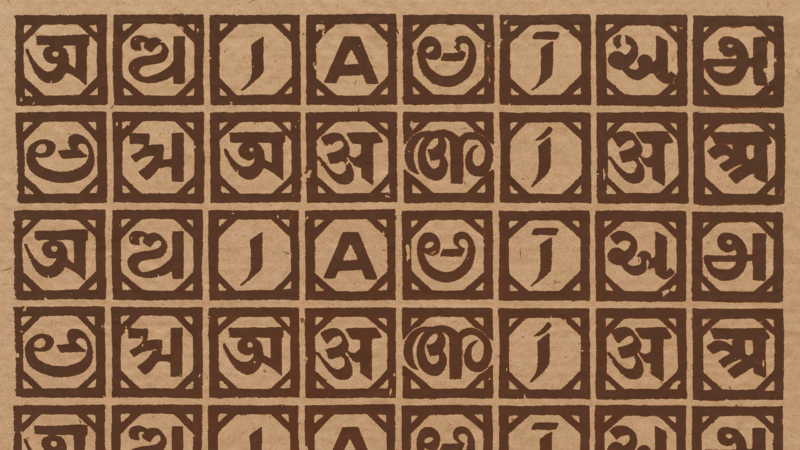
Across the region, different scripts and communities produced their own answers. In a 2016 essay on Bengali sign painting, type designer Jacob Thomas documented sign-making businesses in Rajshahi and considered how hand-lettered forms could inform type design. The value is not that Bengali and Urdu signs should be treated as interchangeable. Quite the opposite: each script carries its own visual decisions, adaptations and working traditions. A region-wide conversation should make those differences visible rather than flattening them into a single picturesque category.
The strongest argument against keeping old techniques is practical. Printed flex, vinyl and computer-prepared layouts can be quicker to produce, easier to reproduce and less expensive to revise. A pharmacy or small retailer has good reasons to want consistent branding and legible information. Digital workflows also employ printers, installers and designers. It would be unfair to ask a cash-strapped shopkeeper to subsidise heritage by purchasing a slower sign.
But this is a false choice if preserving knowledge is taken to mean requiring everyone to buy hand-painted signs. Digital technology and craft documentation can coexist. We can welcome clearer wayfinding while asking what happens to the older skills and who gets to record them.
UNESCO’s 2003 Convention for the Safeguarding of the Intangible Cultural Heritage recognises traditional craftsmanship as a domain of living heritage. Its framework is concerned with the transmission of knowledge and skills, not merely storing attractive objects. Hand-painted commercial lettering is not automatically a UNESCO-listed tradition, and it should not be presented as such. The relevant principle is that a craft can have cultural value because people know how to practise and teach it.
An honest response could begin modestly. Art and design schools could interview sign painters about layout decisions, paint preparation, lettering styles and apprenticeships. Local archives could photograph signs with a location, date, business name and maker’s permission, rather than collecting anonymous street imagery. Municipal heritage projects could distinguish between photographing a finished object and recording the people who made it. These efforts would also need to pay attention to consent and the fact that commercial artwork may carry legal rights or community sensitivities.
There is a second reason to document the work: a young designer studying only software defaults can mistake the available font menu for the limit of typographic possibility. A shopfront designed for a particular street teaches something else. Letterforms change because languages, sightlines, surfaces, budgets and audiences change. That lesson still applies when the final artwork is made on a computer.
This matters for clothing and graphic design as well. Once letters move onto a shirt, a vehicle or a wall, they are encountered at changing distances and from incomplete angles. They have to work as an image before they can be read as a sentence. That relationship between public lettering and personal style is worth studying in its own right, not merely borrowing its surface as decoration.
Cities do not have to choose between efficient new signs and respect for old skills. What they cannot recover easily is a working tradition after its practitioners disappear without leaving an account of how they worked. South Asia’s streets are an evolving public design archive. If we treat them only as advertising space, we will not notice how much knowledge has been erased until there is nobody left to ask.
Hadi Ahmed
Hadi Ahmed is a Karachi-based writer exploring visual culture, typography and how design communicates in everyday life. He is affiliated with Text Tease, a graphic-fashion brand.