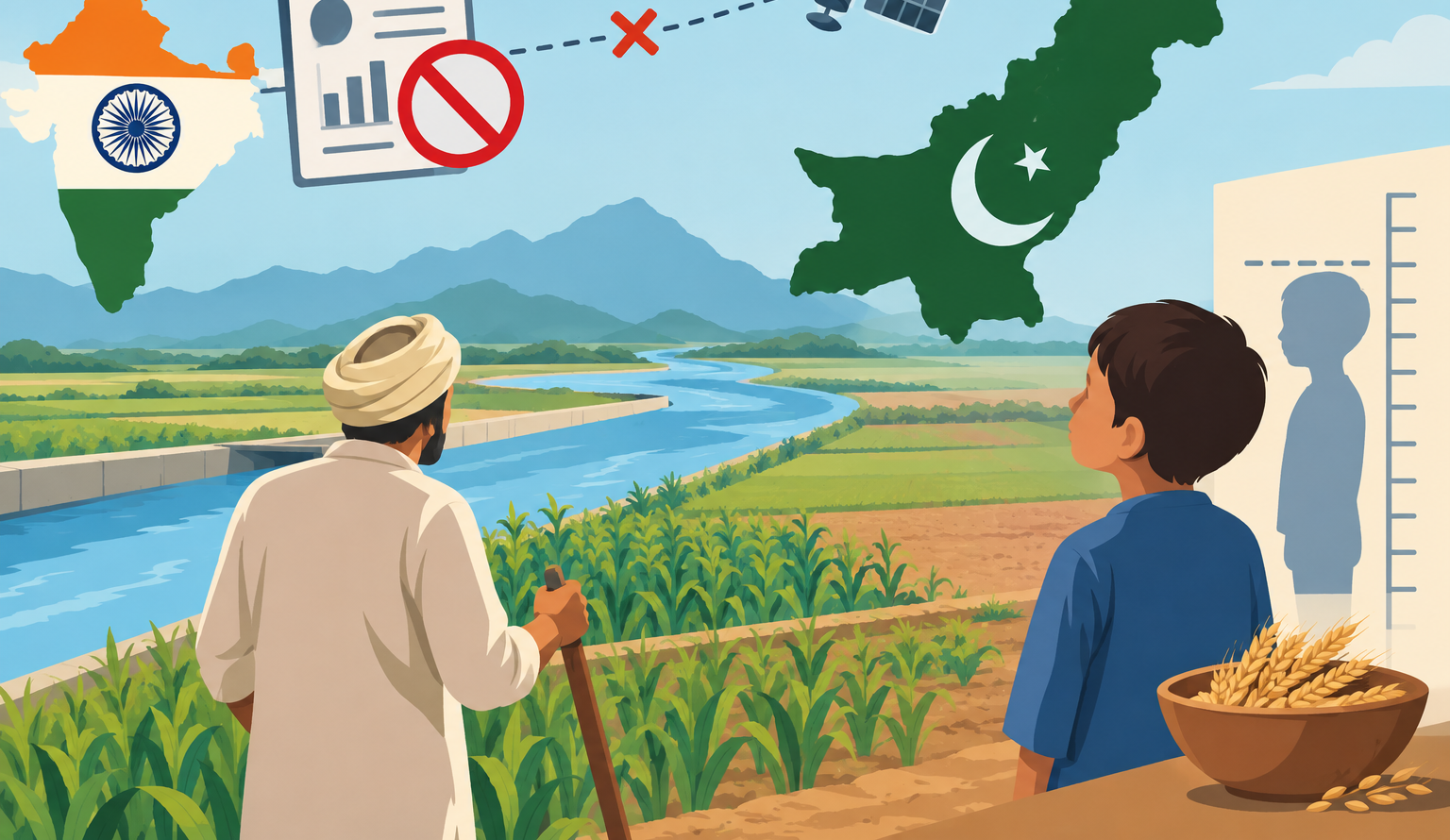
“India Didn’t Cut Pakistan’s Water. It Cut the Forecast”
On August 31, the Permanent Court of Arbitration unanimously ruled that the Indus Waters Treaty “remains fully in force” and that India is bound to observe its obligations. The tribunal rejected every ground India has offered for holding the treaty in abeyance since April 2025, be it material breach, armed conflict and countermeasures, or fundamental change of circumstances. India rejected the ruling within hours, maintaining that the court has no jurisdiction. Much of the discourse since has been about strategic signaling and regional politics. The more consequential effect, however, is registering somewhere far less visible: in the growth charts of Pakistani children.
The abeyance put an end to hydrological data sharing and the meetings of the Permanent Indus Commission. That sounds procedural. Pakistan draws roughly 96 per cent of its renewable water from the Indus system, while agriculture consumes between 80–92 per cent of it, and the country holds about 30 days of carryover capacity. A system that thin cannot absorb surprises. It is run on forecasts, and since April 2025, the data behind them has not been accessible.
India does not have the storage or diversion capacity to cut flows on the western rivers at scale, which is why this damage will never show up in a hydrograph. It shows up at the farm gate. Sowing decisions are made months ahead against expected canal water. Without data related to upstream flow, allocations become estimates, and a farmer who cannot price water risk either plants less, plants conservatively, or does not invest at all.
Pakistan’s agriculture sector was already stalling before the ruling. It is 24 per cent of GDP and 37 per cent of the country’s employment, yet crops grew 1.44 per cent last fiscal year and major crops just 0.65 per cent. Wheat output fell 4.52 per cent to 28.44 million tonnes on 6 per cent less sown area. This September, an agrarian economy went to the market for 750,000 tonnes of imported wheat and found sellers for only 656,000.
Follow that chain one step further, and it stops being an agricultural story. Over the last winter, 7.5 million Pakistanis across 45 rural districts were in crisis-level food security or worse. Pakistan ranks 106th out of 123 countries on the 2025 Global Hunger Index. Its last National Nutrition Survey, conducted in 2018, found that 40.2 per cent of children under five are stunted and 17.7 per cent wasted, a rate the World Health Organization classifies as very high.
Stunting describes not simply reduced height, but arrested neurological and immune development that does not reverse after the first 1,000 days. Nutrition International puts the annual cost at 17 billion dollars, 4.6 per cent of gross national income, and at 21 million lost IQ points and 3.3 million lost school years every year. Pakistan has 252 million people, 56.9 per cent of whom are of working age, and a growth strategy that assumes that cohort will be productive.
This is what pressure on a shared river looks like in practice. Not a gate closing on the Chenab, but a treaty’s predictability withdrawn, uncertainty priced into a fragile farm economy, and the cost settling on children who will enter the labour market in the 2040s. It is slow, deniable, and almost impossible to attribute to any single decision. That should interest anyone watching upstream states elsewhere in Asia.
The next decision point is already scheduled. The tribunal’s interim measures restraining construction at the Ratle hydroelectric project run until 90 days after a Neutral Expert delivers a technical determination, expected in July 2027. If India accepts that determination, the treaty’s machinery will have survived a severe test, and the precedent will matter well beyond South Asia. If India maintains that no tribunal has jurisdiction over it, the treaty becomes an instrument that works only while both parties wish it to, and every downstream state on the Mekong and Brahmaputra will draw the obvious conclusion.
None of this lets Pakistan off. Three things sit within Islamabad’s control and are not being pursued with the urgency required. The lost hydrological data is partially replaceable through satellite hydrology and independent basic monitoring, and that capability should be funded now.
Pakistan’s cropping patterns still tilt towards sugarcane and rice, among the thirstiest options available, at a time when water certainty has become the scarce input. Livestock grew 3.75 per cent last year against 1.44 per cent for crops. Policy should follow that signal.
Additionally, nutrition belongs in the water and agriculture file rather than the welfare one. Pakistan is managing a human capital emergency on numbers collected eight years ago.
For external partners, the useful contribution is not another statement noting the ruling. It is finance for basin monitoring and agricultural water efficiency, which is one part of this problem that money can fix.
Pakistan prevailed on the treaty’s legal status at The Hague. The ruling, however, will not by itself add a centimetre to any child’s growth curve. The UN SDGs bind both countries to end hunger and guarantee clean water, and neither is reachable while a shared river is treated as leverage rather than a shared source. That makes this a collective problem, not a bilateral one.
The treaty held in law. Whether it holds in practice will be legible a decade from now, in a generation of Pakistanis who grew up shorter than they should have.

Irtija Ahmad
Irtija Ahmad is an Assistant Research Officer at the Institute of Regional Studies, Islamabad. She holds an MSc in International Public Policy and Development from Royal Holloway, University of London (Distinction), and an MPA from Quaid-i-Azam University, Islamabad, where she graduated as Gold Medallist of the Class of 2022. Her work combines security analysis with policy-informed research on governance in Pakistan, examining why institutional commitments often fail to survive a change in government or the news cycle. She has also written on global health for The Borgen Project.