Pakistan does not have an instability problem. It is afflicted by an instability-inducing system. The distinction matters, because a problem can be solved while a system has to be understood before it can be dismantled.
For years, the country’s internal crises have been analysed as separate events. Each is treated as its own story, with its own causes, its own actors, its own resolution. What gets missed is the enabling environment and architecture connecting them; a repeating loop in which prevailing socio-economic conditions resulting from a mix of factors like geography, culture, remoteness, ineptness and neglect are reframed, amplified and converted into narratives that serve an agenda the original protesters never signed up for.
This is a doctrine. And Pakistan is one of its primary theatres. The doctrine has a name in strategic literature: controlled chaos. The logic is straightforward. You do not need to defeat a state militarily if you can keep it perpetually occupied managing internal disorder. Use agitation to generate pressure, exploit newfound power of social media to amplify it beyond its organic reach and state’s own failures as evidence base for a narrative of deliberate malice.
The genius of the approach is to make people see their existing conditions as perceived deprivations, turn it into grievance and then link it to their particular identity. Harnessing the destabilising power of information technology, this strategy has been successfully employed in Ukraine, Libya, Tunis, Syria, Egypt, Yemen and Sudan among others. It is a testament to the resilience of Pakistan’s institutions that the country has successfully resisted the onslaught.
In Pakistan, the ‘grievance loop’ has a quite discernible pattern. Certain conditions exist as part of the environment and not because of any malicious intent: a community enjoying electricity and wheat subsidies until the state is unable to afford these anymore, a coastline where infrastructure development is leading to new economic opportunities but at the cost of traditional professions like fishing, a remote, sparsely populated district where infrastructure does not exist comparable to large urban centres. Until a demagogue emerges and turns the withdrawal of subsidies, the development of a port on the coastline, and the low scale of infrastructure into grievances.
Soon outside actors arrive, supplying a specific frame where existing conditions turned grievances are seen as state policy targeting a particular identity. Negligence is seen as oppression. Issues are not seen as problems requiring solutions but evidence of a structural relationship between the state and community that cannot be reformed, only resisted.
Once that frame is in place, social media does the rest. The protest that three hundred people attended in a remote town becomes a global story before the provincial government has convened a meeting. Invisible networks amplify it for national and international audiences. Hashtags trend. Shady political fronts perched in Europe mobilise to demand scrutiny in the name of human rights. International media picks up the framing. And by the time any Pakistani official offers a response, the story has already been told globally, in terms that the hostile actor, not the Pakistani state, chose.
Consider the Joint Awami Action Committee movement in Azad Jammu and Kashmir. The spontaneous protests over the withdrawal of subsidies on electricity and wheat were quickly taken over by populist demagogues to turn it into a movement pursuing a much broader agenda beyond the original demands. Within weeks, through coordinated amplification driven by information networks, a tariff protest had been reframed as an identity issue. Withdrawal of a privilege was turned into a grievance by demagogues, while foreign actors supplied the frame that targeted the very foundation of the relationship between AJK and Pakistan. People on the streets did not make that shift. Information operations made it for them.
The same pattern ran through Gwadar. The community, used to a certain way of life and already uneasy with the sudden spotlight and influx of strangers building infrastructure and manning the security apparatus, was made to see these developments as inimical to their interests and economic survival. Some of the concerns were genuine and easily addressable like illegal fishing by large trawlers and access to certain areas that they had fished for generations. However, the information operations targeting protests converted a local governance story into a geopolitical one. By the time it reached foreign media, Gwadar’s fishermen had become evidence of strategic dangers of Chinese investment.
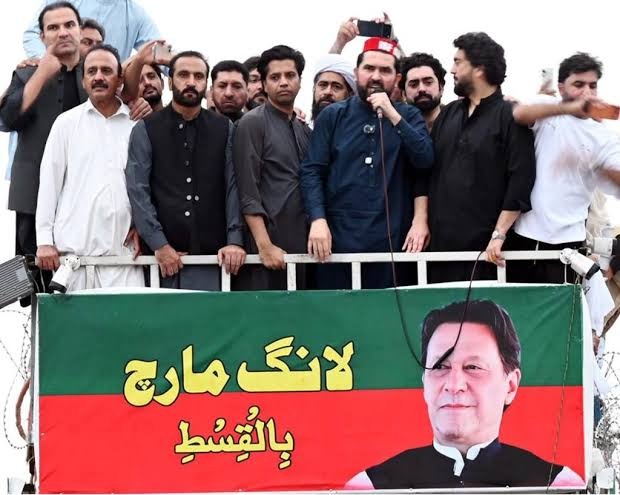
The events of May 9, 2023 demonstrated the speed at which this infrastructure now operates. Within hours of Imran Khan’s arrest, a coordinated information operation had framed attacks on military installations as a popular uprising against a state lacking democratic legitimacy. The framing was global before the Pakistani government had issued a coherent response. Whatever one’s political position on the events of that day, the information operation demonstrated something that should concern every Pakistani, regardless of party: the country’s internal crises are now processed through an external narrative infrastructure that shapes how they are understood, both domestically and internationally, faster than any state institution can respond.
The Baloch Raji Aajoi Sangar, the BLA’s media wing operating primarily out of Afghanistan and parts of Europe, has a response time to security incidents in Balochistan that routinely beats official Pakistani sources. Every development project is framed as exploitation or displacement. Every security operation is framed as collective punishment.
What makes this effective is not sophistication alone but the availability of genuine material. The regions that feature most prominently in the hostile narrative are also in many cases the ones where connection between people and their representatives has been weakest, where the accountability gap is widest, where demagogues have been allowed for generations to pursue identity politics and blackmail the state in the name of rights while they themselves have been the biggest hurdle in development and integration. The information operation capitalises on these failures. It contextualises them, frames them and distributes them to audiences that have no other source of information about the places in question.
Breaking the loop requires understanding which part of it the state can actually influence. It cannot control social media algorithms or foreign networks. It cannot prevent legitimate or perceived grievances from being amplified by actors with hostile intent. It cannot counter a narrative that lands internationally in the first hours by issuing a press release in the second.
What it can do is to directly connect with its citizens. Accessible, responsive and trusted community leaders who people can reach when they are frustrated and who people can hold accountable. Access and accountability give a feeling of empowerment. Direct connection between people and their political leaders will remove space for manipulation both by opportunist populists and hostile foreign players. The political class has to understand another important issue as well. That when out of power, they should not sink the boat by selling cheap narratives of deprivation, marginalisation, exclusion and identity. When repeated over time, people, especially young generations, are likely to buy into it and grow up with a poisonous mindset.
This article was originally published in The News

Amir Jahangir
The writer is a strategic communications expert, media executive, and policy adviser