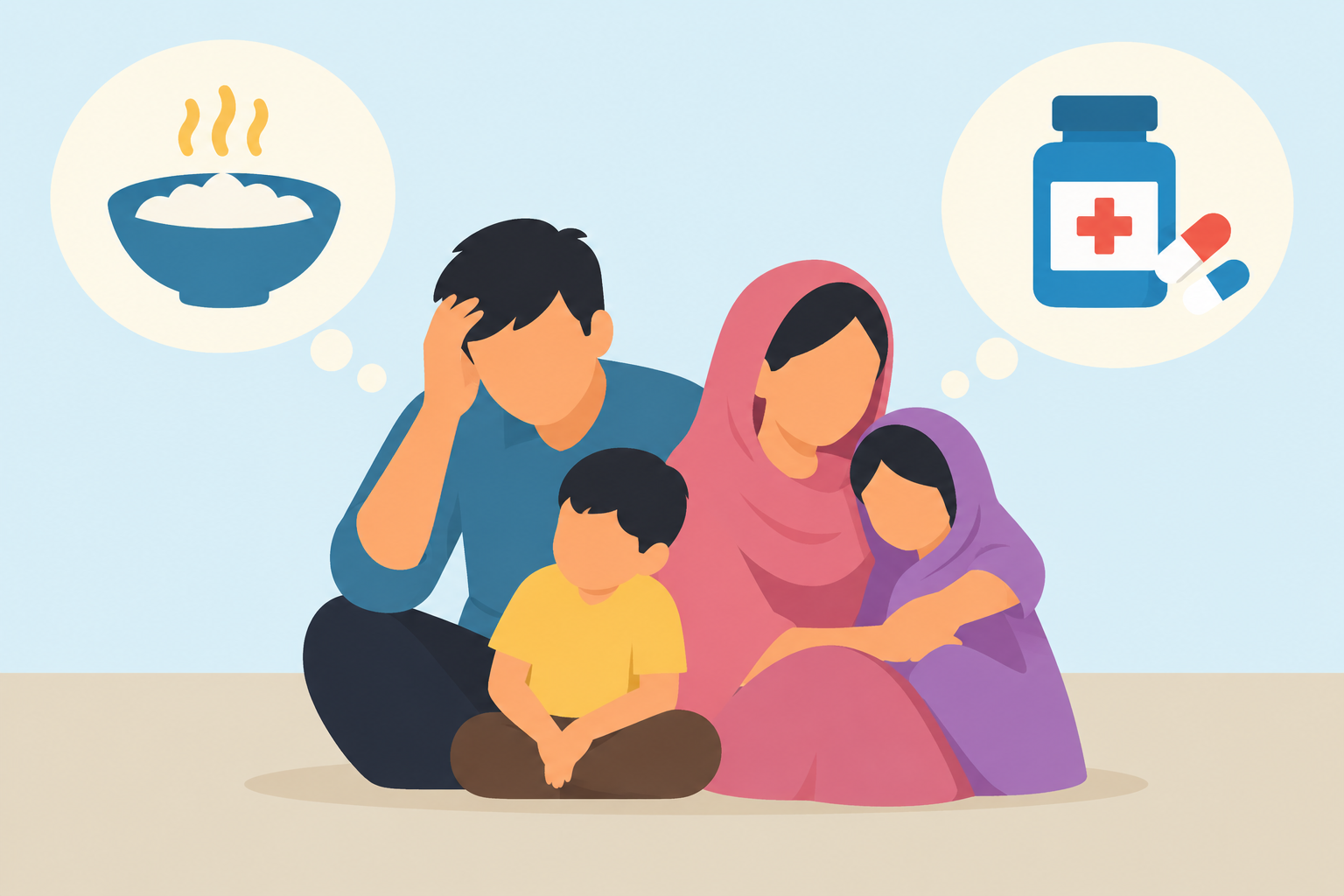
To a poor family, an illness is never just a health issue. It can easily turn into a financial crisis that makes people make decisions no family would have to make: buy the children something to eat or buy a parent a medicine, rent or a hospital bill, keep a child in school or use funds saved on education as an emergency. Millions of families in South Asia are on the verge of this harsh reality.
Poverty can be measured in terms of income and this is often the case, however when people are limited in their resources, the real picture can be better seen in the choices that they are forced to make. An affluent, or even middle-income, family might see illness as a minor inconvenience, but to a low-income household, even a comparatively minor medical issue may eat a big chunk of its monthly income.
Lack of savings and inability to afford health care means that a single health crisis may drive an already struggling family even deeper into debts. This is what makes healthcare and poverty not to be dealt with separately. The financial future of a family can be determined by its health whereas getting healthcare at all can be determined by its financial status.
The situation is even more grave when the necessary medical care needs to be paid with something more valuable than medication. A patient might require a ride to a hospital, lab tests, consultation, medications and follow-up appointment.
To access a hospital, access to a remote village can be costly and time-consuming. Another tough calculation that a daily wage worker makes is that a visit to a doctor can cost him a day of income. When that employee remains at home to take care of a ailing relative then the family can lose even more income. Such expenses are usually not seen through the lens of healthcare that is considered solely in terms of hospital expenses.
A family might be capable of paying a consultation but not the transport, diagnostics or several weeks of treatment that ensues. Consequently, individuals occasionally tend to put off seeking medical care until a complication becomes more complicated and costly to manage. What started as a controllable disease may turn out to be a significant economic liability.
Another aspect of the crisis is food. When the income in the household is low, families tend to have to pay special attention to the basic needs, and food is the first to be considered. But even food can become hard to afford, when prices go up.
The family can react by decreasing the number or quality of their meals, purchasing cheaper and less healthy foods, or skipping some meals. The issue is even more complicated when one of the members of the family gets ill as recovery might need both a healthy diet and medication.
A sick person who takes medicine and is not able to afford proper food may still find it difficult to heal. Children are especially susceptible since inadequate nutrition may impair their growth, education and development in general. This forms a cycle where poor nutrition is caused by poverty, poor health by poor nutrition and ill health further strains the household economically.
The effects may be much further than a single medical incident. Individuals who lack financial security may take loans with relatives, friends or informal lenders to cover medical bills. Others can sell livestock, household property or other properties that sustain their living.
Other people can assume a debt that will require years to pay off. In some extreme cases, parents can pull children out of school to be able to work and help to provide money to the house. This implies that the economic consequences of sickness may be felt a long time after a patient has recuperated. A family might come out of the direct crisis but a part of its future may be lost.
This is among the reasons why poverty is so hard to quit. A family may invest years in the attempt to better its financial status but instead it may lose its savings or assets due to one severe disease.
People in the informal economy are especially hard-pressed by the situation. In South Asia, workers are high in numbers, largely relying on daily wages, and are restricted to fewer employment benefits, paid sick leaves or trustworthy social security.
To such workers, one cannot work due to illness, and this automatically translates to being unable to earn. An injured construction worker, a street salesperson with a disease or a housekeeper with a sick child might lack something important to cushion their finances.
Women may undergo other stressors since they are often responsible of caring the home as well as in family income. Families tend to use unpaid care offered by women and older children, thus limiting their work or educational opportunities when healthcare is unaffordable. Economic pay in this unpaid labour may often be out of sight, but it can have significant impact on the household wellbeing.
To solve this issue, it is not enough to construct hospitals. It is also necessary to make healthcare affordable to those that require it most.
The governments can empower the public hospitals, increase access to affordable primary healthcare, enhance access to basic medicines and create good health insurance or social protection programmes to vulnerable families. Preventive medical care is also necessary as early detection and management of most diseases can lower the cost and severity of diseases.
Health facilities must also be distributed in the areas not just within the big cities but also in rural and other remote areas so that the individuals in these areas do not have to travel a long distance to get basic treatment.
Simultaneously, families may also live through short-term financial crises with the help of more robust social protection without selling their assets or leaving their children to school. This should be aimed at having it so that when one falls sick, there is no automatic descent to poverty.

Muhammad Usman Nawaz
M. Usman Nawaz is a Development Studies researcher and writer with an MPhil in Development Studies. His areas of interest include global affairs, development, human rights, climate change, governance, and social issues. Through research and writing, he aims to promote informed public discourse and contribute to meaningful conversations on contemporary global challenges.