Pakistan has once again learned, at great human and economic cost, that its development plans are only as strong as the weakest embankment.
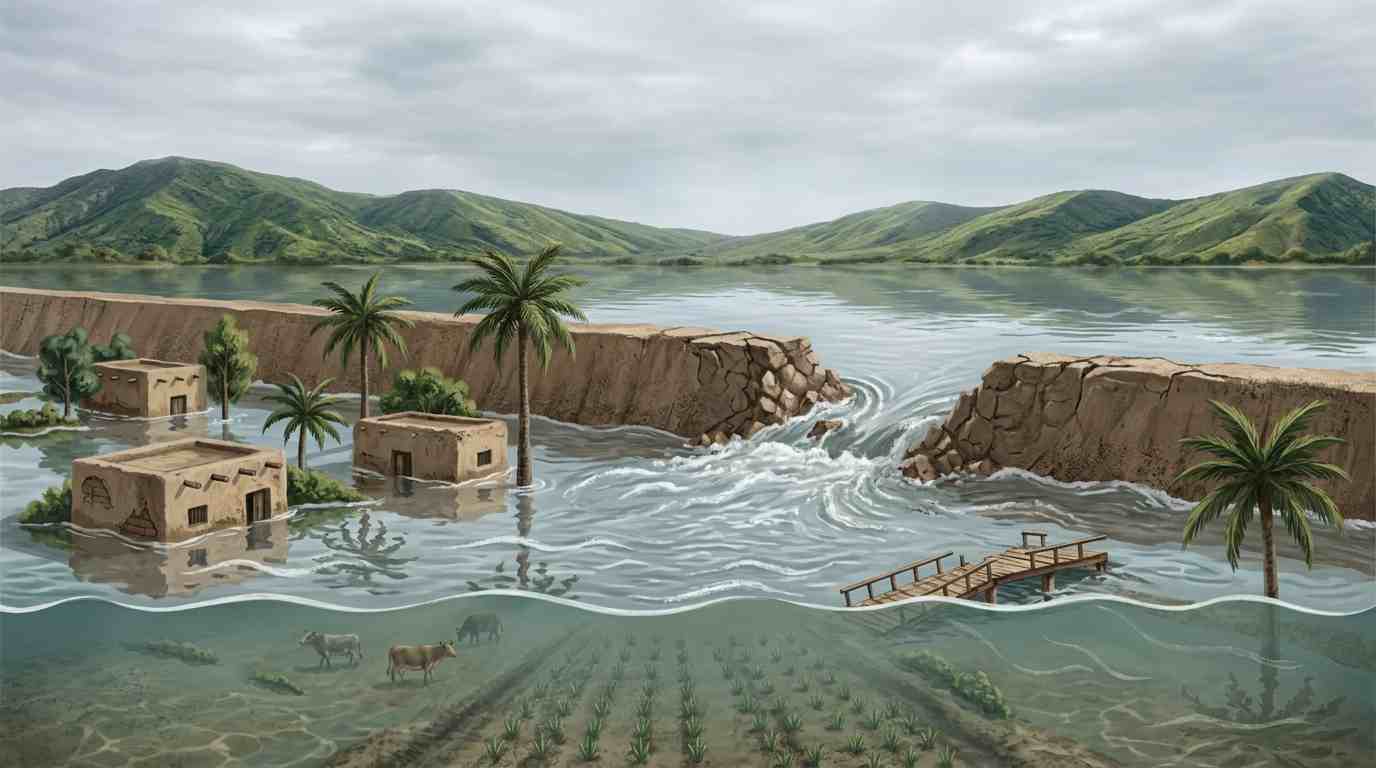
Flash floods that tore through Punjab and are now advancing into Sindh have claimed hundreds of lives, submerged roughly 1.8 million acres of farmland and left crops, livestock and homes in ruin.
The scale of the destruction has forced the government to do something it usually avoids until the last possible moment. It has asked the International Monetary Fund to treat this disaster not as an inconvenience to the fiscal calendar but as a factor that must reshape it.
The Fund’s response has been measured but telling. Its upcoming review of the Extended Fund Facility will examine whether the FY26 budget and its emergency provisions are “sufficiently agile” to meet the needs created by the floods, in the words of its resident representative.
That single phrase captures the central tension in Pakistan’s development story. A country that spent the better part of two years stabilizing its macroeconomic indicators, taming inflation and rebuilding reserves is now being asked whether its hard-won discipline can bend without breaking.
This is not simply a story about weather. It is a story about what kind of development model Pakistan has actually built.
For years, planners in Islamabad have spoken of resilience as though it were a line item that could be inserted into a five-year plan. Roads get widened, dams get funded, industrial parks get inaugurated, and each ribbon cutting is presented as proof of forward motion.
Yet when monsoon rains arrive with unusual intensity, as they now do almost every other year, the same infrastructure that was meant to signal progress is submerged along with the fields around it. Growth built on concrete and announcements has repeatedly proven less durable than growth built on drainage, early warning systems and rural insurance.
It would be unfair, however, to lay this entirely at the government’s door. Pakistan sits at the receiving end of a geography it did not choose and a climate crisis it did little to cause. It contributes a small fraction of global carbon emissions yet consistently ranks among the countries most exposed to climate disaster, a mismatch that officials are right to raise in every international forum they attend.
The Indus basin was never designed to absorb the kind of compressed, glacier-fed monsoon surges now arriving with growing frequency, and no drainage network built on last century’s rainfall data would have coped much better this year.
The government is also boxed in by its own stabilization program. Every rupee redirected toward flood defense competes with debt-servicing obligations and IMF-linked spending ceilings negotiated precisely to keep the economy from sliding back into crisis.
Asking Islamabad to simultaneously hold the line on fiscal discipline and fund a nationwide flood defense overhaul is asking it to do two contradictory things at once, and the criticism it receives for failing at both often ignores that tension.
The government’s own projections make the gap visible.
Before the floods, officials spoke confidently of growth near four percent for the current fiscal year, buoyed by a recovery in agriculture and manufacturing under the IMF program. That figure now looks less like a forecast and more like a wish.
Analysts estimate the damage to standing crops alone could shave meaningful points off annual growth, and reconstruction spending, however necessary, tends to substitute for productive investment rather than add to it. A nation rebuilding a bridge is not the same as a nation building a new one.
A harder question is also buried in the IMF’s language, one Pakistan’s policymakers would rather not confront directly. Every time a natural disaster strikes, the country asks its lenders for flexibility, and every time that flexibility is granted, it comes bundled with fresh conditions, fresh reviews and fresh dependence.
Climate vulnerability and program dependency have become mirror images. The more frequently floods strike, the more frequently Pakistan needs the Fund’s patience, and the less room it has to argue that its economic sovereignty is intact. This is not an argument against seeking help. Immediate relief for displaced families and flood-hit farmers cannot wait for a philosophical debate about sovereignty. But it is an argument for asking why, after the catastrophic floods of recent years, so little of the promised resilience infrastructure has actually been built where it matters most.
The instinct in Islamabad will be to treat this flood season as an exceptional shock, a bad roll of the dice that justifies revised targets and renewed patience from lenders. That instinct should be resisted, even while acknowledging how hard the alternative actually is.
Provincial and federal disaster authorities still operate with overlapping mandates and inconsistent funding, so relief and reconstruction money rarely reaches the same farmers twice in a row. Decades of unregulated construction along riverbanks and floodplains, much of it tolerated by local authorities that benefit from the land revenue, means that even well-designed drainage upgrades run into encroachments the state has been unwilling or unable to clear.
And climate financing on the scale Pakistan actually needs, enough to rebuild embankments, relocate vulnerable settlements and modernize early warning systems across the Indus basin, remains far beyond what any single IMF facility or green bond issuance can supply. These are not excuses so much as the real boundaries within which any government, of any political stripe, would have to operate.
Pakistan’s Global Climate Risk ranking has not moved because of one unlucky year. It reflects a pattern, and patterns require structural responses rather than seasonal ones.
A national development outlay that allocates the bulk of its infrastructure spending to transport and energy while treating water management and flood defense as an afterthought is not planning for the country it actually has. It is planning for a country that no longer exists.
If there is a lesson worth carrying out of this crisis, it is that credibility in development is not measured by how convincingly a growth target is announced but by how well an economy survives contact with reality. The IMF’s review will ask whether Pakistan’s budget is agile enough to absorb this year’s disaster.
The more important question, one that no external reviewer can answer on Pakistan’s behalf, is whether the country is finally willing to build an economy that does not need to ask that question again next year.

Your go-to editorial hub for policy perspectives and informed analysis on pressing regional and global issues.