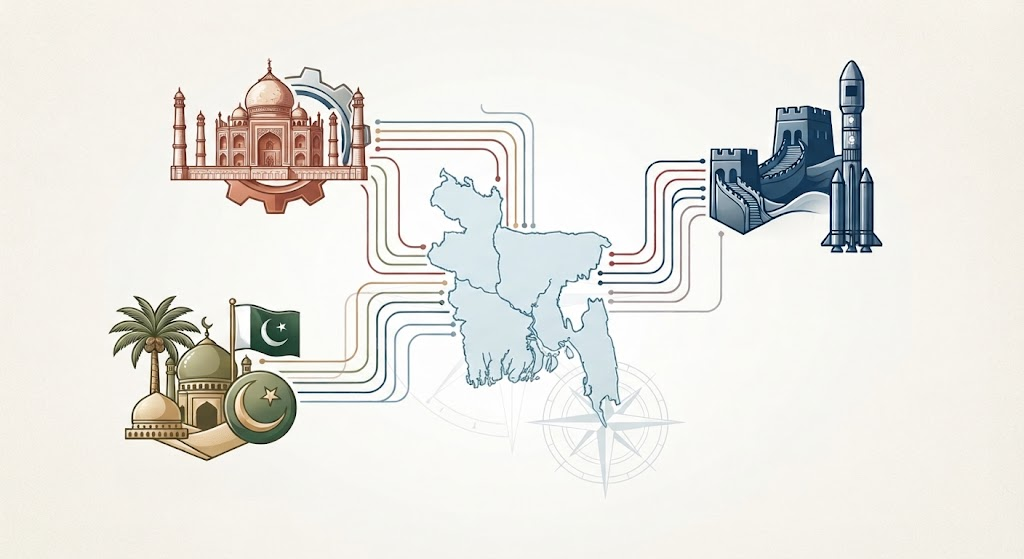
How do smaller South Asian states pursue strategic autonomy? Bangladesh’s foreign-policy choices answer this question well. Rather than balancing primarily between India and China, Dhaka chooses to build overlapping relationships with multiple regional and extra-regional powers.
Its recent defense and diplomatic moves, closer engagement with China, renewed ties with Pakistan and Turkey, and possible participation in the Saudi-Turkey-Pakistan Makkah defense agreement show that strategic autonomy in South Asia is becoming less about choosing between competing blocs and more about accumulating options.
Bangladesh’s New Strategic Calculus
The timing is significant. On August 25, Bangladesh signaled that it could consider joining the Makkah Joint Defense Agreement (MJDA). MJDA was signed on 7 August 2026 by Turkey, Pakistan, and Saudi Arabia. It commits its members to treat an armed attack against one as an attack against all.
Dhaka’s positive reception of the invitation is therefore more consequential than a symbolic diplomatic gesture. It introduces a new security network within South Asia already shaped by India-China competition.
However, the Makkah agreement should not be decoded simply as Bangladesh moving into a Pakistan-led campaign. It’s one more coat to the layered development of Dhaka’s simultaneous external relationships.
Just two days before the Makkah revelation, Reuters reported that Bangladesh is moving toward formal negotiations with China over the possible purchase of J-10CE fighter aircraft and attack helicopters.
The proposed acquisition would result in deepening Dhaka’s already substantial defense relationship with Beijing, the principal source of Dhaka’s major military equipment.
From Balancing to Multi-Vector Security Networking (MVSN)
Now, why does this matter? Because Bangladesh is rebuilding political ties with Pakistan while managing the difficult relationship with India, simultaneously.
Prime Minister Tarique Rahman’s proposed August visit to New Delhi stalled amid disputes over former Prime Minister Sheikh Hasina’s presence in India and Dhaka’s demand for her extradition. Even though both states retain strong economic and geographic interdependence, the political relationship remains unsettled.
Between this cooperation, competition, and unsettlement, taken together, these developments point to a different strategic logic: Multi-Vector Security Networking (MVSN).
For much of the post-Cold War period, discussion of South Asian alignment has centred on whether states are moving closer to India, China, or (at times) the United States. That framework is increasingly inadequate.
Bangladesh’s current trajectory indicates that smaller states can derive leverage precisely by refusing to make their partnerships mutually exclusive. Beijing can provide military hardware and infrastructure, Turkey offers defence-industrial cooperation, Pakistan provides political and military connectivity into the Islamic world, Saudi Arabia offers economic, labour-market and strategic ties, and India remains indispensable because of geography, trade and connectivity. This is not necessarily incoherence. It can be a strategy.
Dhaka’s calculation is especially understandable because its structural dependence on India coexists with incentives to diversify away from excessive dependence on New Delhi. Bangladesh shares a 4,096-kilometre border with India, while bilateral merchandise trade remains above $12 billion annually.
No government in Dhaka can realistically substitute China, Pakistan or Gulf partners for India’s geographic importance. But geography does not require political dependence.
Meanwhile, China gives Bangladesh an alternative source of strategic and defence capacity. During Tarique Rahman’s June visit to Beijing, Dhaka and Beijing expanded cooperation across trade, infrastructure, connectivity, diplomacy and defence. Institute of South Asian Studies (ISAS) at the National University of Singapore has consequently debated whether Bangladesh is pivoting towards China or pursuing a broader strategy of multi-alignment intended to preserve strategic autonomy.
The J-10CE negotiations make this debate more concrete. Defence procurement is not merely an economic transaction. It creates training relationships, maintenance dependencies, technical familiarity and longer-term military interoperability. A substantial Chinese aircraft acquisition would therefore deepen the strategic component of the Bangladesh-China relationship even if Dhaka continues to insist that it is not choosing sides.
It does not stop at India and China. At the same time, possible participation in the Makkah arrangement would widen Bangladesh’s strategic network beyond East Asia. As argued in my analysis for the Centre for Strategic and Contemporary Research, “The Makkah Pact and an Emerging Islamic Security Architecture,” the agreement should be understood not merely as a bilateral or trilateral defense commitment, but as an early institutional expression of a broader Islamic security architecture.
It links South Asia, the Gulf and Turkey through a framework centered on collective defense, strategic coordination and defense cooperation. Saudi Arabia contributes financial and strategic weight, Turkey brings a sophisticated defence-industrial base, and Pakistan provides military expertise and South Asian connectivity.
Therefore, Bangladesh’s participation would connect Dhaka to a security network whose strategic geography extends well beyond the subcontinent.
Why This Matters for India
For India, this should be treated neither as an immediate strategic defeat nor dismissed as diplomatic theatre. The greater concern is cumulative. If Bangladesh acquires more alternatives in defence, infrastructure, diplomacy and political partnerships, New Delhi’s ability to convert geographic centrality into political influence could gradually narrow.
However, it still possesses structural advantages that external partners cannot reproduce. But influence is not the same as indispensability. Bangladesh can remain economically dependent on India while simultaneously increasing its bargaining power by cultivating alternative relationships.
Importance for the Wider Region
This is where the Bangladesh case becomes important for the wider region. Nepal has long practiced balancing between India and China.
Sri Lanka has leveraged competition among India, China, and other external actors. The Maldives demonstrated how rapidly a small state’s strategic orientation can become contested. Bangladesh may now be taking this logic into a more sophisticated domain: diversification across multiple security networks rather than simple bilateral balancing.
The distinction matters because traditional balancing assumes identifiable poles and relatively stable alignments. MVSN assumes that partnerships are modular.
A country can cooperate with China on fighter aircraft, Turkey on defence technology, Pakistan on political and military relations, Saudi Arabia on security and economic interests, India on connectivity and trade, and the United States or Japan on other economic or strategic priorities without formally aligning with any single bloc.
The implication for South Asia is broader. Smaller states are unlikely to passively select between rival camps when major-power competition intensifies.
They are learning to exploit connectivity, defence procurement, geography and diplomatic relationships simultaneously. Their strategic value lies precisely in their ability to connect different regional orders.
The Limits of Strategic Autonomy
However, this strategy (MVSN) has limits: the more interconnected these partnerships become, the harder it becomes to prevent one relationship from affecting another. A Bangladesh that enters a collective defence arrangement involving Pakistan could encounter sharper Indian sensitivities.
A deeper Chinese defence relationship could generate additional concerns in New Delhi and Washington. Conversely, excessive diversification could produce procurement fragmentation, competing military standards and dependencies on multiple external suppliers.
Thus, strategic autonomy is not guaranteed by having more partners. It depends on the ability to manage those relationships without becoming dependent on any one of them.
Bangladesh’s emerging policy is more consequential development not as a pivot away from India, or even as a pivot towards China or Pakistan, but as an effort to increase the number of strategic options available to Dhaka.
Therefore, Bangladesh may be an early indicator of a new South Asian reality in which strategic autonomy will increasingly be measured not by distance from one major power, but by the number of viable alternatives a state can construct. Dhaka’s choices over the coming months will determine whether this strategy produces genuine autonomy or merely replaces one dependency with several.
However, “South Asia’s smaller states are no longer simply balancing between India and China; They are beginning to build networks around them,” this statement is no longer ambiguous.

Sherzimah Akbar
Sherzimah Akbar is a researcher specializing in South Asian strategic affairs, Indian foreign policy, defense, maritime security, and Indo-Pacific geopolitics. She is affiliated with the Institute of Strategic Studies Islamabad (ISSI).