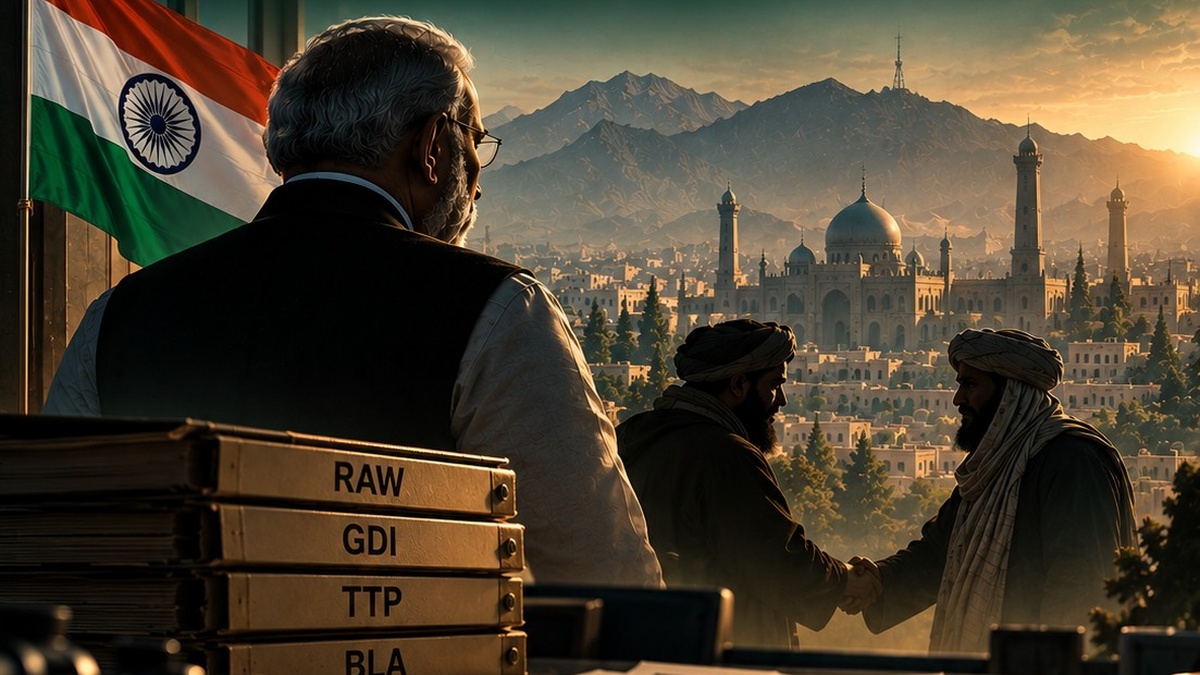
In late June 2026, a convoy of roughly a thousand special forces fighters rolled into Badakhshan, Afghanistan’s northeastern-most province. They were not there to fight the Islamic State-Khorasan cell that had killed a provincial official in Baharak days earlier, nor the anti-Taliban resistance groups regrouping in the mountains nearby.
They were there for the gold. Kandahar had sent its own men to make sure Kandahar, and not the men who already ran the province, decided who profited from what came out of the ground.
That single deployment is a useful place to start, because it captures something the standard framing of Afghanistan misses entirely. Two years ago, the dominant story was “the Taliban versus the world”, an isolated regime, unrecognised and sanctioned, holding a country together by sheer coercion. That story is not wrong, but it is incomplete.
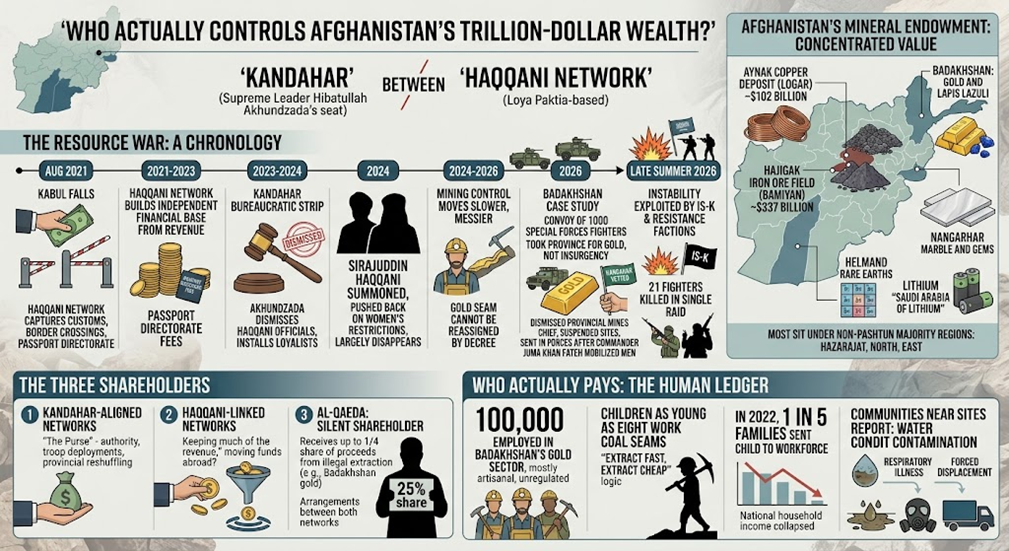
The more consequential fight today is internal: Kandahar against the Haqqani network, over who gets to sit atop nearly a trillion dollars of Afghan mineral wealth. And the people standing on that wealth mostly Tajik, Hazara and Uzbek communities in provinces the Taliban’s leadership barely represents are not participants in that fight. They are its terrain.
A Fortune Sitting in the Wrong Hands
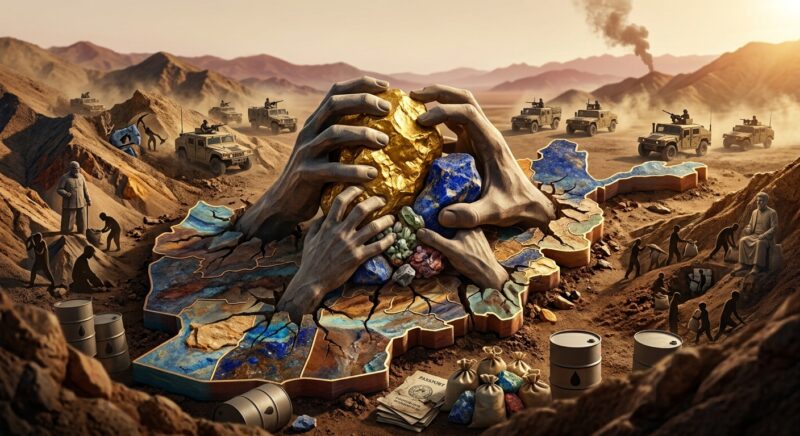
Afghanistan’s mineral endowment has been estimated at anywhere between $1 trillion and $3 trillion since a set of Pentagon-backed geological surveys resurfaced the figure in 2010, the same surveys that produced the now-famous internal memo calling the country “the Saudi Arabia of lithium.” The headline number understates how concentrated the value actually is.
The Aynak copper deposit in Logar province alone has been valued near $102 billion; the Hajigak iron ore field in Bamiyan, one of the largest undeveloped iron reserves on earth, has been put at roughly $337 billion. Layer in Badakhshan’s gold and lapis lazuli, Nangarhar’s marble and gems, and Helmand’s rare earths, and a pattern emerges immediately: almost none of it sits under Pashtun-majority Kandahar, the seat of Taliban power.
It sits under Hazarajat, the north, and the east, regions the leadership does not come from and, in several cases, does not fully trust.
The First Land Grab Was Bureaucratic
When Kabul fell in August 2021, it was the Haqqani network, headquartered in Loya Paktia, in the southeast, that moved fastest and most effectively to capture the state’s actual cash registers: customs posts, border crossings, ports, and the passport directorate, which alone generates enormous fee revenue from a population desperate to leave. For roughly three years, this gave the Haqqanis a financial base arguably independent of Kandahar, run in part through Sirajuddin Haqqani’s own relatives.
Supreme Leader Hibatullah Akhundzada did not tolerate the arrangement indefinitely. Piece by piece, Kandahar stripped it away, dismissing Haqqani-aligned customs officials, engineering the removal of Alam Gul Haqqani’s brother from the passport directorate after footage of alleged misconduct surfaced, and installing loyalists in his place.
By 2024, when Sirajuddin Haqqani himself pushed back on Kandahar’s restrictions on women’s visibility in public life, he was summoned to the leader’s compound and largely disappeared from public view for months afterward. The message was unambiguous: there is one purse, and Kandahar holds it.
“The Haqqani network is keeping much of the revenue generated by the [mining] sector,” one mining expert told Foreign Policy, revenue that may be moving abroad rather than toward any public purpose.
Badakhshan as Case Study
Mining has followed the same trajectory as customs, only slower and messier, because unlike a border post, a gold seam cannot simply be reassigned by decree, it has to be physically taken. Badakhshan supplies the clearest example. Local and factional commanders, some tied loosely to the Haqqanis and some simply exploiting the post-2021 power vacuum, spent years running the province’s gold and lapis operations with minimal interference from Kabul, let alone Kandahar.
Through 2026, Akhundzada’s inner circle moved methodically to end that: dismissing the provincial mines chief, installing a Kandahar-vetted replacement, suspending extraction at several sites pending “review,” and finally sending in the thousand-man special force after Tajik commander Juma Khan Fateh, accused of land seizures and unauthorised mine control, began mobilising his own men in the Darwaz district.
By late summer, Islamic State-Khorasan and resistance factions were exploiting the resulting instability to strike Taliban positions directly, at one point killing twenty-one fighters in a single raid. A province with no real stake in Kandahar’s leadership had become the site of a war for a treasury it will not control either way.
And there is a third actor worth naming plainly: reporting on Badakhshan’s gold economy has alleged that al-Qaeda receives a share, as much as a quarter, of proceeds from illegal extraction there, allocated to it by arrangement between Haqqani-linked and Kandahar-aligned networks.
Whatever the precise figure, it establishes something the “Taliban versus the world” framing cannot accommodate: the fight over Afghan minerals is not a two-sided contest. It has a third silent shareholder.
Who Actually Pays
Set against a trillion-dollar prize, the human ledger is stark and specific. An estimated 100,000 people are employed directly or indirectly in Badakhshan’s gold sector alone, most in artisanal, unregulated conditions. Children as young as eight have been documented working coal seams elsewhere in the north with no protective equipment, part of a pattern researchers link to the same insurgent-economy logic now governing formal mining: extract fast, extract cheap, and treat labour and environmental cost as externalities.
A 2022 household survey by Save the Children found that one in five families had sent a child into the workforce within six months of the Taliban’s return, as household income collapsed nationally. Communities near mine sites report water contamination, respiratory illness, and, in Badakhshan specifically, forced displacement tied to expanding extraction zones.
None of this is being negotiated by the people it affects. It is being decided in Kandahar, contested from Loya Paktia, and occasionally skimmed by a transnational militant network that answers to neither.
The Framing That Needs to Change
It is easier, and more emotionally satisfying, to read Afghanistan as a binary: the Taliban against everyone else. But a large share of what actually drives Taliban behaviour, the purges, the troop deployments, the sudden reshuffling of provincial officials, is not ideological at all. It is a resource war between two Pashtun-led power centres, fought over ground that belongs, ethnically and historically, to neither of them.
Kandahar and Loya Paktia supply the authority. Hazarajat, Badakhshan, and the east supply the collateral. Until that asymmetry is named correctly, every policy conversation about Afghan minerals, foreign investment, sanctions relief, “critical mineral” partnerships, will be a conversation about the wrong map.

Haleema Khalid is a research and strategic communications professional specializing in policy research, knowledge management, and analytical writing. With an interdisciplinary background spanning linguistics, security studies, and regional affairs, her work focuses on translating complex research into accessible outputs for policy and stakeholder audiences. She is a published researcher in corpus linguistics and political communication and is currently pursuing an MPhil in Intelligence & Security Studies, with a growing focus on Pak-Afghan affairs, regional security, and South Asian dynamics.