Energy is a crucial element for economic growth for any country. Energy security ensures national security; without it, a state can not survive because it is the backbone of economic stability. When it comes to renewable energy, the world often looks to China, not just as a participant, but as the engine driving the global transition. Today, China is the undisputed global leader, boasting more solar and wind capacity than the rest of the world combined. China’s quest for energy has been a long journey.
Since its 1st five-year plan (1953-1957), China’s focus has remained on industrial development. That’s why energy security is an important topic for Chinese policymakers. Chinese leader XI jinping emphasized energy security in many of his statements. During the Russia-Ukraine conflict, XI said, Energy security is one of the most important security issues facing the country.
Due to rapid economic development, China’s energy demand is increasing day by day. Most of the energy demand is fulfilled by domestic energy resources, i.e., coal. China is the largest producer of coal. China’s coal production hit 4.83 billion tons in 2025; however, it still relies on foreign energy resources, i.e., oil and gas, to meet its energy requirements.
In 1993, China was the largest importer of oil from Russia and the Middle East. In 2024, China imported 11.1 million barrels per day of crude oil, for a total of 74 percent of the country’s oil consumption.
Energy security depends upon 3 factors: reliability, affordability, and environmental sustainability, and geopolitical scenarios have a profound impact on these factors. If there is any conflict between two states, energy trade would be interrupted, like in the case of the U.S/Israel-Iran conflict.
Most of China’s energy trade happens through the Strait of Melacca and the Strait of Taiwan; both of these straits have geopolitical tension and security risks. Meanwhile, China’s oil trade happens through the Strait of Hormuz. The recent closure of the Strait of Hormuz caused a global price shock for oil, but China resisted that shock due to its green energy policy.
U.S. regulates and guards most of the sea lanes used for energy trade among different states. That makes China’s energy trade more vulnerable. That’s why China, in its 15th Five-Year Plan, emphasized green energy, which means reducing dependency on volatile foreign fossil fuels and energy resources.
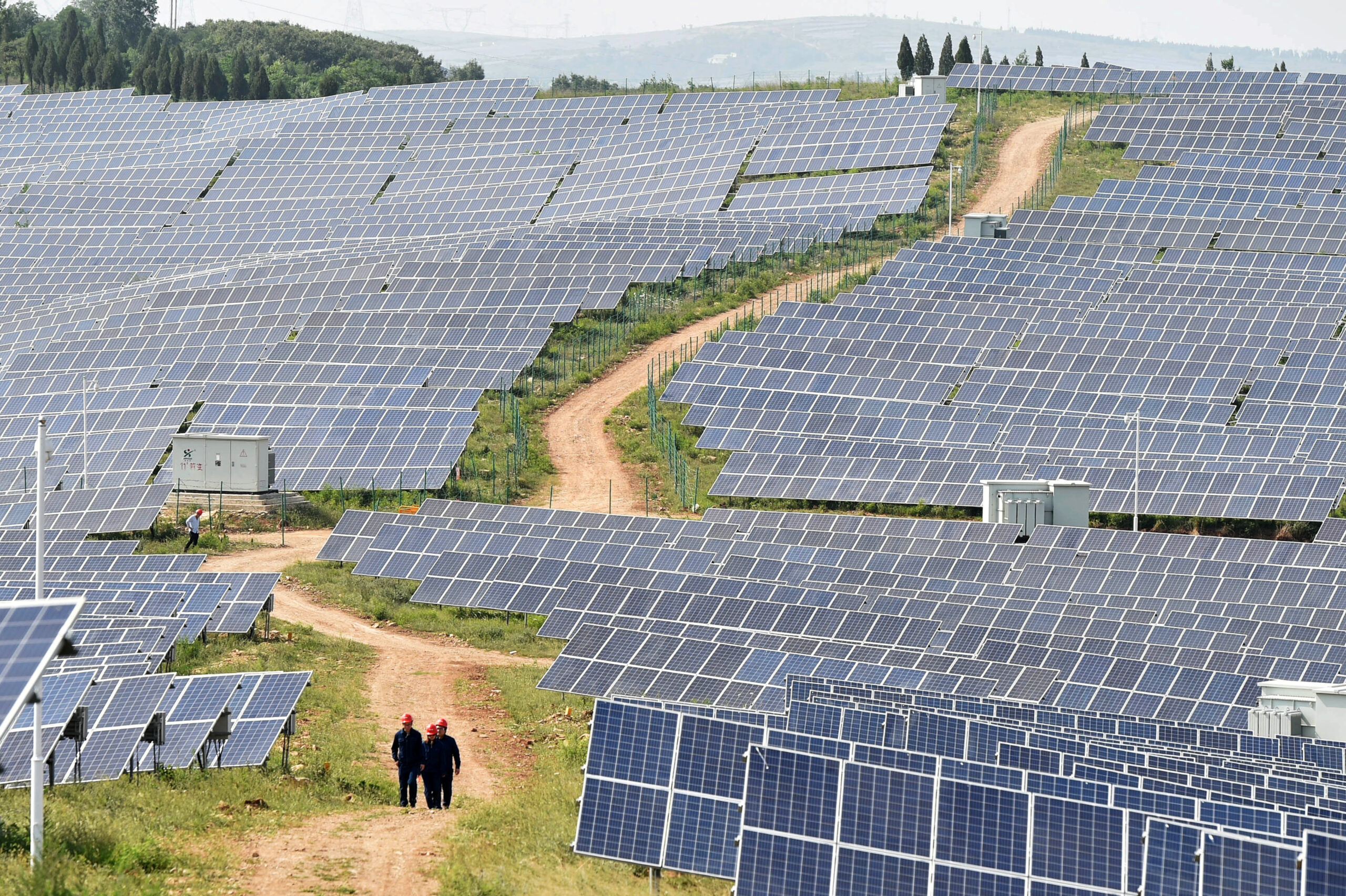
This phase of the energy transition took many years to accomplish clean and green energy technology. Now China has a dominant position in global green manufacturing sectors, including Electric vehicles, lithium-ion batteries, and photovoltaic cells. It produces 91% of the world’s capacity of solar panels, 89% of lithium batteries, and 72% of wind turbines. China has the world’s largest global supply chain of minerals, i.e., nickel, cobalt, copper, and lithium. China’s investment in clean energy has reached $625 billion in 2024. It is all because
of a long-term strategy, clear goals, advanced infrastructure, and most importantly, support for research and development. Chinese policymakers already have a clear idea about future uncertainties regarding non-renewable energy resources, so they developed a strong strategy of a medium- and long-term development plan solely focused on renewable energy resources.
China’s green energy technology is not benefiting domestically; rather, it provides blueprints for a global transition towards more diverse and reliable sources of energy. China is working with other countries to make more sustainable energy development and build a global governance system to deal with energy security. Now the world is taking serious note of energy security, and it has become an essential topic in the foreign policies of different countries. The world is racing to acquire more sustainable energy resources. From 2014 to 2023, the global share of non-fossil fuels in energy consumption rose from 13.6 percent to 18.5 percent, with China accounting for 45.2 percent of this increase.
China is providing opportunities for international cooperation through different platforms, and many multinational companies are heavily investing in China’s energy sector. China’s Summer Davos 2026 is a recent example of this. Moreover, China is supporting different countries to achieve their green energy transition goal through the Belt and Road Initiative. Pakistan’s Karot hydropower station is a project under the China Pakistan Economic Corridor, which is providing 3200 GWh of clean electricity. Many projects are underway in various countries through China’s cooperation to reduce the world’s dependence on non-renewable energy resources.
China is playing a leading role in the global green energy transition from traditional fossil fuels towards renewable energy resources. China has sufficient stockpiles of oil, coal, and other energy resources, as well as mineral reserves. China’s strategy of green energy technology reflects technological innovation, advanced infrastructure, long-term sustainable goals, and policy evolution. Its 15th Five-Year Plan clearly emphasized the importance of renewable energy development. U.S and other European countries are competing in this transition, but China has dominated in the field of energy security. Now, China is providing a gateway to a low-carbon, clean-energy transition through bilateral and multilateral cooperation mechanisms.

Ayesha Khan
I’m Ayesha Khan, pursuing my bachelor’s degree in Political Science and International Relations from The Women’s University Multan. I am affiliated with the Institute of Strategic Studies Islamabad as a research intern. My areas of interest are geopolitics, diplomacy, and strategic studies.