Human rights advocacy draws its authority from one non-negotiable premise: that findings are built on verified fact, not on the narrative most readily supplied by an interested party.
Amnesty International’s latest report on Pakistan’s precision strikes of March 16 and 17 fails this test. In substance and sequence, the report tracks closely with the account put forward by the Afghan Taliban, while critical operational evidence, evidence that bears directly on questions of intent, target selection, and casualty attribution, receives only glancing treatment.
An organisation that positions itself as an arbiter of international humanitarian law owes the public more rigour than this.
Camp Phoenix was not, as some renderings imply, a purpose-built civilian complex that Pakistan mistook for a military target. It was established in 2003 as a NATO military compound, and its military character long predates the events of March 2026.
The Omid Drug Rehabilitation Centre was carved out of a section of that compound in 2010, itself an indicator of how thoroughly the old base and its later civilian tenant remained physically and administratively intertwined.
Crucially, in 2016 an entirely new Omid Hospital was constructed roughly 5.6 kilometres away by air and some 20 kilometres by road from the old Camp Phoenix site. Once the new hospital opened, the old Omid facility inside Camp Phoenix was closed. That closure is the pivot on which this entire controversy turns, and it is a fact that deserved far more scrutiny in Amnesty’s account than it received.
Pakistan has shown proof that the strike targeted a drone workshop and munitions storage site inside the old Camp Phoenix compound, not the shuttered Omid barracks. By the time of the strike, those barracks were reportedly not functioning as a treatment facility at all.
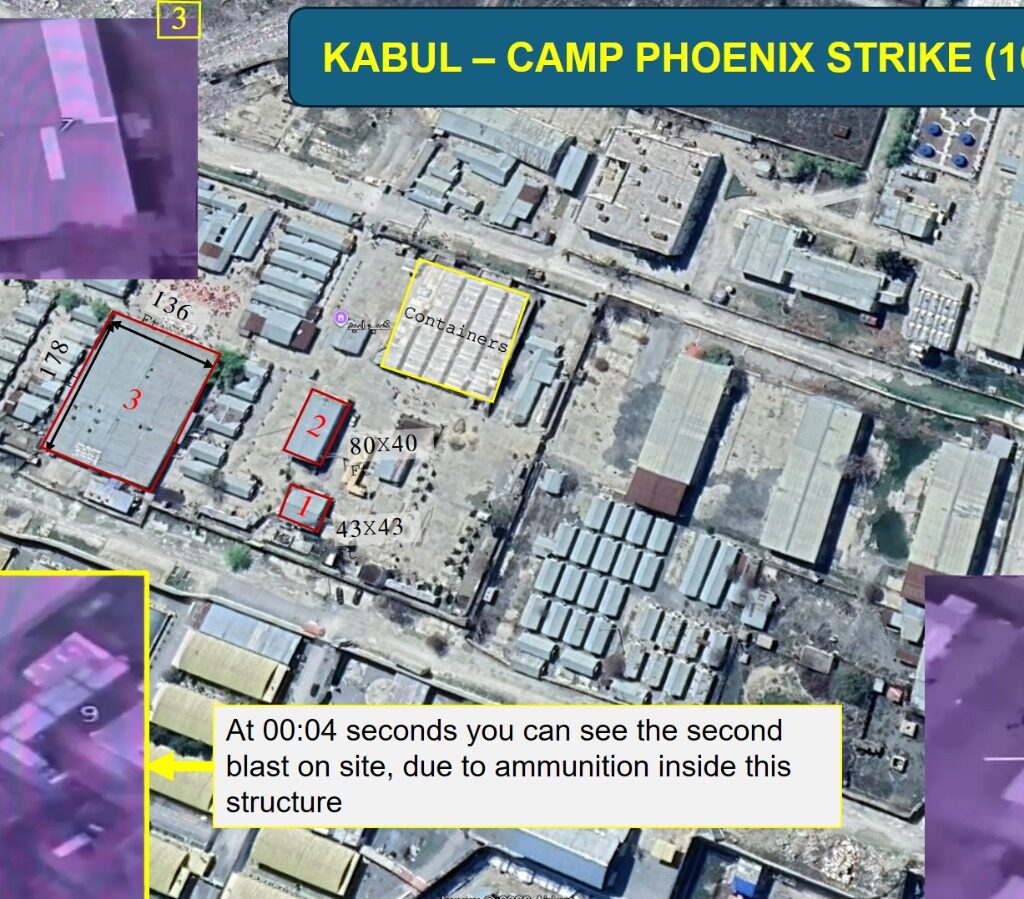
They were being used to house roughly 350 soldiers of the Taliban Army’s Qita Yarmuk formation. On this account, the casualties in the barracks were a consequence of secondary explosions, munitions detonating and spilling fire outward from the storage site that was the actual target, rather than of a strike deliberately or recklessly aimed at a functioning medical centre.
The dead were combatants caught in the blast radius of a legitimate military target, not patients in a drug treatment ward. That is precisely the kind of operational detail, site history, chain of custody of the building, presence of an armed garrison, that a rigorous investigation is obligated to run down before publishing a possible finding. It is not a detail to be waved away because a closed facility’s old signage or a years old documentary shows what it once was.
The discrepancies in casualty reporting are themselves a red flag that ought to have slowed Amnesty’s rush to conclusions. The Taliban regime’s initial claim was as high as 408 civilians killed and 165 injured. UNAMA’s independently verified figures have differed substantially from that initial claim, and reporting on the ground, including the fact that funerals were held for only a fraction of the claimed dead in the days immediately following the strike, sits uneasily with the scale of civilian death being alleged.
Numbers that move this much, this quickly, are not incidental. They are diagnostic of a propaganda operation working in real time to shape the narrative before independent verification could catch up.
Amnesty International does not operate inside Taliban controlled Afghanistan with the independent access, forensic authority, or on the ground verification capacity that a war crimes finding demands. Satellite imagery and witness testimony gathered through intermediaries in a closed authoritarian environment are not equivalent to an independent, adversarial investigation with access to both sides’ operational records.
When an organization’s findings align this closely with the public claims of a regime that controls all access to the site, the burden of proof should rise, not fall. Instead, Amnesty’s report reproduces the Taliban’s casualty framing nearly wholesale, without the kind of institutional skepticism that credible human rights work requires when one party to a conflict is also the sole gatekeeper of the evidence.
This is not merely an academic dispute over methodology. Reports of this kind carry consequences. When international bodies lend credibility to unverified civilian casualty claims without rigorously testing the underlying facts, they create a permissive environment for militant groups to embed military assets adjacent to civilian coded sites.
There are already indications that the Taliban regime, emboldened by the reception its narrative received from UNAMA and Amnesty, is relocating drone and ammunition storage facilities directly into populated areas. If true, that is the predictable and perverse incentive created by advocacy that rewards the tactic of hiding behind civilians rather than penalizing it.
Human rights advocacy that applies rigorous verification standards to some actors and takes the claims of others at face value is not advocacy at all. If Amnesty International wishes to retain the standing to call any strike a war crime, it must apply the same evidentiary discipline to claims made by armed non state actors and de facto authorities as it does to the states it investigates.
Selective scrutiny, however well intentioned, does not protect civilians. It protects narratives, and in doing so, it can make civilians less safe, not more.
The views and opinions expressed in this article are solely those of the author and do not necessarily reflect the editorial position of South Asia Times.